
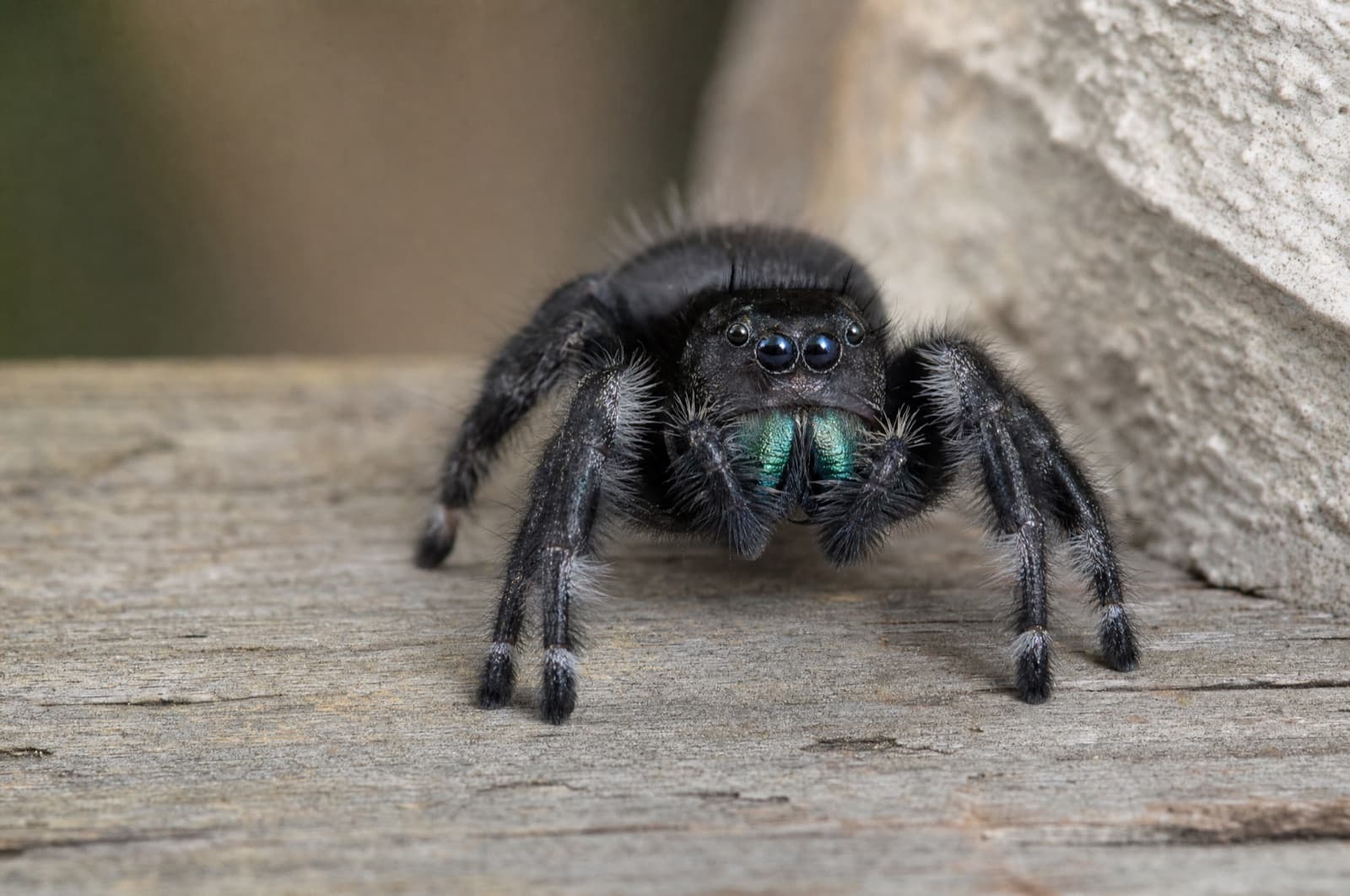
How to Get Rid of Jumping Spiders
At a glance
- Difficulty: Beginner
- Time: A few minutes per spider; a weekend if you also want to seal entry points
- Cost: Low — a cup and card, some caulk
- Success: High — most encounters resolve with simple catch-and-release
Can you DIY Jumping Spider?
The verdict on Jumping Spider DIY
Genuinely one of the easiest, lowest-stakes spiders in the house — and arguably one you don't need to remove at all.
Jumping spiders (family Salticidae) are daytime visual hunters with famously large forward-facing eyes, and the 'it jumps AT you' fear is a myth — that bold turn-and-approach toward movement is curiosity and hunting behavior, not aggression, and they're far more likely to flee or leap away than to bite. They're beneficial predators of flies, mosquitoes, and other household pests, which is exactly why control here is optional rather than urgent.
The 5 DIY methods — honestly graded
Every approach graded for this species, in IPM order — prevention first, chemistry late. Pick a method to see how it works, the steps, and what it actually takes.
Prevention / Exclusion
Works wellEffective if you want fewer indoors — they hunt near sunny windows and doors where prey insects gather.
Jumping spiders follow their prey, and sunny windows and doorways attract both the insects they hunt and the spiders themselves. Sealing gaps and maintaining intact screens closes that path without needing to target the spider directly.
Best for: Reducing how many wander in over a season
Seal gaps at sunny windows and doors
Caulk cracks and gaps around windows and doors, prioritizing sunny, insect-rich spots where jumping spiders are most often seen.
Repair screens
Patch or replace torn window and door screens, which are a common entry route for both prey insects and the spiders that hunt them.
Tools & materials
Why DIY falls short here
Not scare tactics — the specific, proportionate reasons a home attempt can stall for this species.
Fear-driven spraying of a beneficial predator
Some homeowners spray jumping spiders out of fear of the 'jumps at you' myth, which removes free pest control for no real safety benefit.
Treating a symptom of abundant prey
Seeing several jumping spiders usually just means there's plenty of prey insects around — chemical treatment aimed at the spiders doesn't fix the underlying insect source.
How risky is it, really?
An honest read — most nuisance species are genuinely low risk, and we say so.
Jumping spiders are harmless, beneficial, and genuinely one of the least concerning spiders you'll find indoors. Their forward-facing eyes and bold, curious behavior toward movement make them look alert and "aggressive," but that's investigative hunting behavior, not a threat to people.
- Defensive biteRare
Extremely rare, defensive-only, and produces mild, mosquito-bite-like symptoms; venom is not medically significant to humans
UF/IFAS
- Perceived aggression from bold approach behaviorCommon
This is curiosity and hunting behavior, not an attack — jumping spiders are far more likely to flee than bite
PestWorld / WebMD
- Allergic reactionRare
Possible with any arthropod bite, but not a documented pattern for this species
UF/IFAS
More Bugs Than Usual? We'll Find Why.
Jumping spiders are harmless, but a lot of them usually means plenty of prey insects nearby. Anchor Pest Services can inspect and address the underlying issue across southern and central New Hampshire. Family-owned since 2017, NH license #782664.
Call a pro when…
- Unusually large numbers indoors pointing to a bigger underlying insect problem
- You'd prefer a professional inspection to identify what's drawing them in
General Pest Control
A pro is rarely needed for jumping spiders — this is one of the hub's most honest 'you may not need to do anything' pages. Consider one only if indoor prey insects are unusually abundant and you'd rather address the underlying pest issue directly.
Keep them out
- Seal gaps around sunny windows and doors where prey insects gather
- Repair torn screens
- Reduce indoor flies and gnats through sanitation
Jumping spiders in New Hampshire
Jumping spiders are common throughout New Hampshire homes and gardens, most active and visible on sunny days when they hunt by sight near windows and doors. They're often noticed more in late summer and fall as they, like many wandering species, move toward structures ahead of cooler weather and the first hard frost, roughly October 19–29 in Manchester (NOAA).
Peak season
Summer through early fall
First-frost anchor
Manchester first hard frost ~Oct 19 (50%) / Oct 29 (80%), NOAA 1991–2020
Make sure it's a Jumping Spider
Two quick detours worth taking — confirm the ID, then learn what drew it in so it doesn't come back.
Frequently asked
Sources & further reading(3)
- [1]
- [2]
- [3]UF/IFAS via ExoPetGuides — Jumping Spider Bites
Bites only occur when the spider is held with no escape route
academicverified 2026-07-13
Written & reviewed by
VerifiedDaniel Brady
NH-Licensed Pesticide Applicator · License #782664 (NHDAMF, RSA 430)
Daniel Brady is the New Hampshire–licensed applicator behind Anchor Pest Services, a family-owned pest control company serving the Manchester area since 2017.
Last updated July 2026
Other species you can tackle
Same category — the dot shows each one's DIY verdict at a glance (green = friendly, amber = doable with care, red = call a pro).
Professional Pest Control
More Bugs Than Usual? We'll Find Why.
Jumping spiders are harmless, but a lot of them usually means plenty of prey insects nearby. Anchor Pest Services can inspect and address the underlying issue across southern and central New Hampshire. Family-owned since 2017, NH license #782664.
- Inspection-first approach
- NH-licensed applicators (#782664)
- Free inspection — same-day service across southern NH
NH License #782664 · No obligation · We answer in person
Your next step
- Book a NH pro
Spider Pest Control
Book now - What to do next
Jumping Spider in NH: ID, Bite Risk & State Spider
Read the answer - Also relevant
Jumping Spider in NH: ID, Bite Risk & State Spider
Read the answer - Also relevant
Spider Prevention: Cut the Food Supply, Not Just the Webs
Read the answer - Also relevant
When Are Spiders Most Active in the House? NH Spider Guide
Read the answer - Related guide
How to Get Rid of House Spiders
Read the answer