
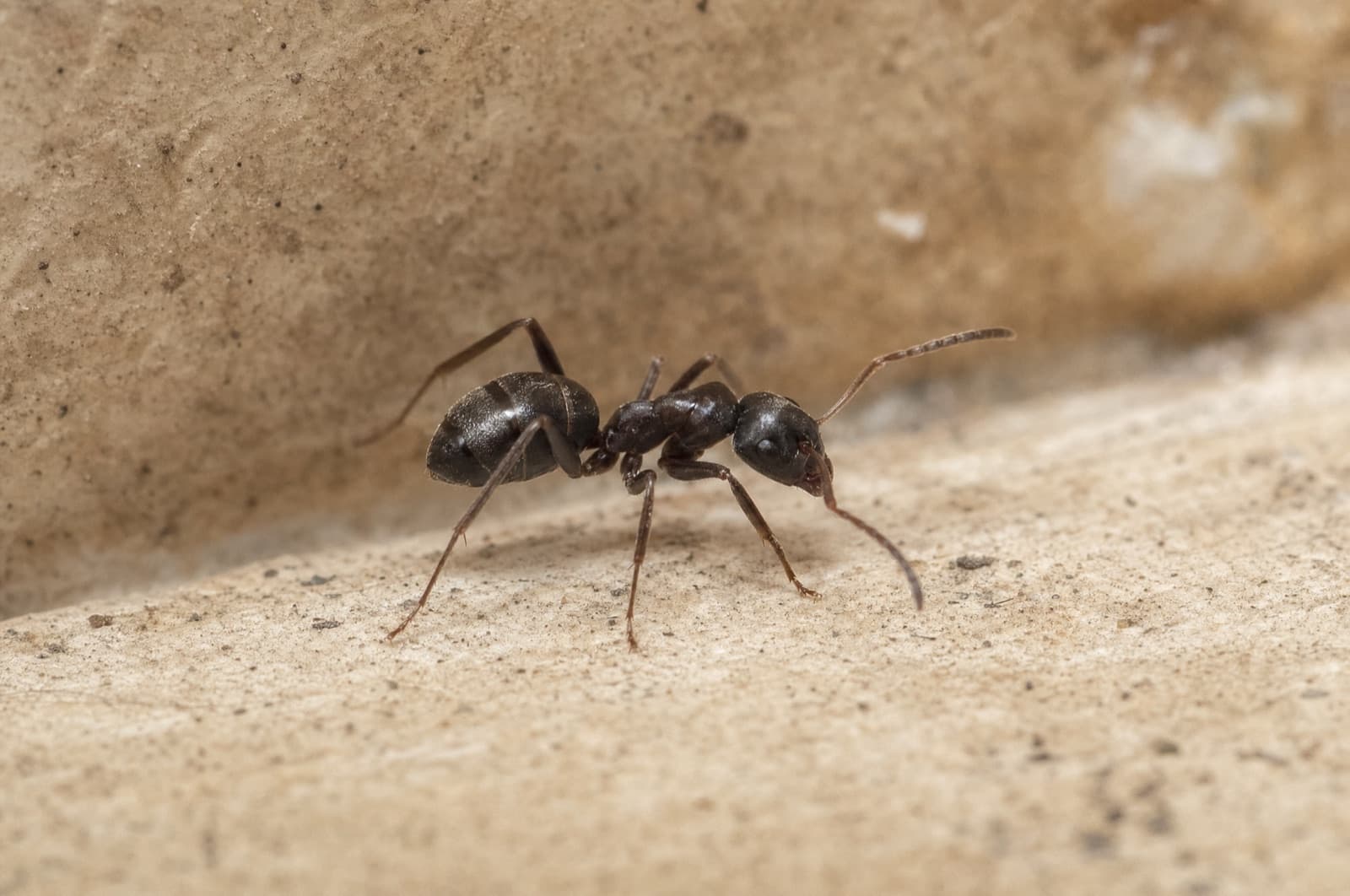
Odorous House Ant — Quick ID for New Hampshire
Also called Stink ant · Coconut ant · OHA
Odorous house ants are New Hampshire's most common kitchen nuisance ant — tiny, dark, and identifiable by their rotten-coconut or blue-cheese smell when crushed. Repellent sprays often make them worse by triggering colony splitting. This is the fast identifier; for the right treatment approach, see the full ant guide.
- Size
- 2.4–3.3 mm
- tiny; Tapinoma sessile
- Signature tell
- Rotten coconut / blue cheese smell when crushed
- the definitive ID test
- Waist
- Hidden petiole
- gaster appears to sit directly on thorax with no visible node
- NH status
- Most common indoor nuisance ant in NH
- supercolonial in urban areas
Is it an odorous house ant?
Odorous house ants are the tiny dark ants that trail to your kitchen counter, coffee maker, and trash can in New Hampshire homes. They are the state's most common indoor nuisance ant — highly adapted to urban and suburban environments, with supercolonies that can spread through wall voids across an entire structure. The fastest way to confirm the species costs nothing: crush one. If it smells like rotten coconut or blue cheese, you have your answer.
This page is a fast identifier. For the full picture — why sprays make them worse, how baiting works, and how they compare to pavement ants — read the complete guide in the Ant FAQ hub linked above.
Quick odorous house ant ID
The crush-and-smell test is the fastest and most reliable field ID for this species.
Odorous house ant
- Scientific name
- Tapinoma sessile
- Family
- Formicidae
- Size
- 2.4–3.3 mm
- Coloration
- Dark brown to black, slightly shiny
- Habitat
- Wall voids, insulation, under sinks, in kitchens and bathrooms; trails to sweets; indoor nests near moisture
- Active season
- Year-round indoors; outdoor activity peaks spring through fall
- Diet
- Strong preference for sweets and sugary liquids; also meats and fats
- Lifespan
- Workers live weeks to months; multiple queens per colony
Found throughout New Hampshire; considered the most common indoor nuisance ant in the state. Highly urban-adapted and supercolonial in developed areas of southern NH.
The tells — key ID features
- Crushed workers emit a strong rotten-coconut or blue-cheese odor — the single fastest definitive ID test, no magnification needed.
- Hidden petiole: the gaster appears to sit directly on the thorax with no visible waist bump or node.
- Tiny, dark brown to black, slightly shiny — uniform in color (not bicolored).
- Persistent indoor trails to sweets; repellent sprays often cause the colony to split and spread (budget) rather than retreat.
Pavement ant
How to tell — Pavement ants are slightly larger (2.5–4 mm) with visible waist nodes and fine grooves on the head; they do not emit a coconut odor when crushed and build crater mounds in pavement cracks.
Acrobat ant
How to tell — Acrobat ants are bicolored (lighter head, darker gaster) and raise their heart-shaped abdomen when alarmed; they do not emit a coconut odor.
Signs of a problem
The crush-and-smell test is definitive.
A faint trail of tiny dark ants leading to sweets, a trash can, or under a sink or dishwasher
What it means — Odorous house ant foraging — colony is likely in a nearby wall void or under a cabinet.
A rotten-coconut or blue-cheese odor when you wipe up or crush an ant trail
What it means — Positive odorous house ant ID — the smell is unique among NH house ants.
Odorous house ant control in New Hampshire
Repellent sprays often worsen odorous house ant infestations by triggering budding — the supercolony splits into multiple smaller colonies and spreads to new nesting sites. Professionals use non-repellent baits that are carried back to the colony. The full ant guide covers the bait vs. spray distinction and why DIY often fails with this species.
When to call a pro
- Indoor trails return after repeated DIY treatment.
- Spraying seems to spread the ants to new areas (a classic sign of colony budding).
- Multiple indoor entry points suggest a large or fragmented colony.
Not sure it's a odorous house ant?
A licensed NH technician can confirm the species and tell you honestly whether it's a DIY fix or a job for a pro — free inspection, same-day service across Southern New Hampshire.
Frequently asked questions
Sources(2)
- [1]University of Minnesota Extension — Odorous House Ants
biology, odor chemistry, supercolony behavior, budding
extensionverified 2026-06-30 - [2]Anchor Pest — Ant FAQ Guide
full NH ant treatment including non-repellent baiting
industryverified 2026-06-30
Written & reviewed by
VerifiedDaniel Brady
NH-Licensed Pesticide Applicator · License #782664 (NHDAMF, RSA 430)
Daniel Brady is the New Hampshire–licensed applicator behind Anchor Pest Services, a family-owned pest control company serving the Manchester area since 2017.
Last updated 2026-06-30

New Hampshire pest control
Dealing with odorous house ants in your home?
Anchor Pest Services identifies and handles odorous house ant problems across southern and central New Hampshire. Family-owned since 2017, NH license #782664.
- NH-licensed applicators (#782664)
- Same-day service · free inspection
- Family-owned since 2017
Your next step
- Next step
Is Ant Block Home Perimeter Ant Bait by Amdro Safe for Pets?
Read the answer - What to do next
How to Get Rid of Odorous House Ants
Read the answer - What to do next
When Do Ants Come Out? NH Ant Season Timing Guide
Read the answer - Related guide
Pavement Ant — Quick ID for New Hampshire Homeowners
Read the answer - Related guide
Carpenter Ant — Quick ID for New Hampshire Homeowners
Read the answer