
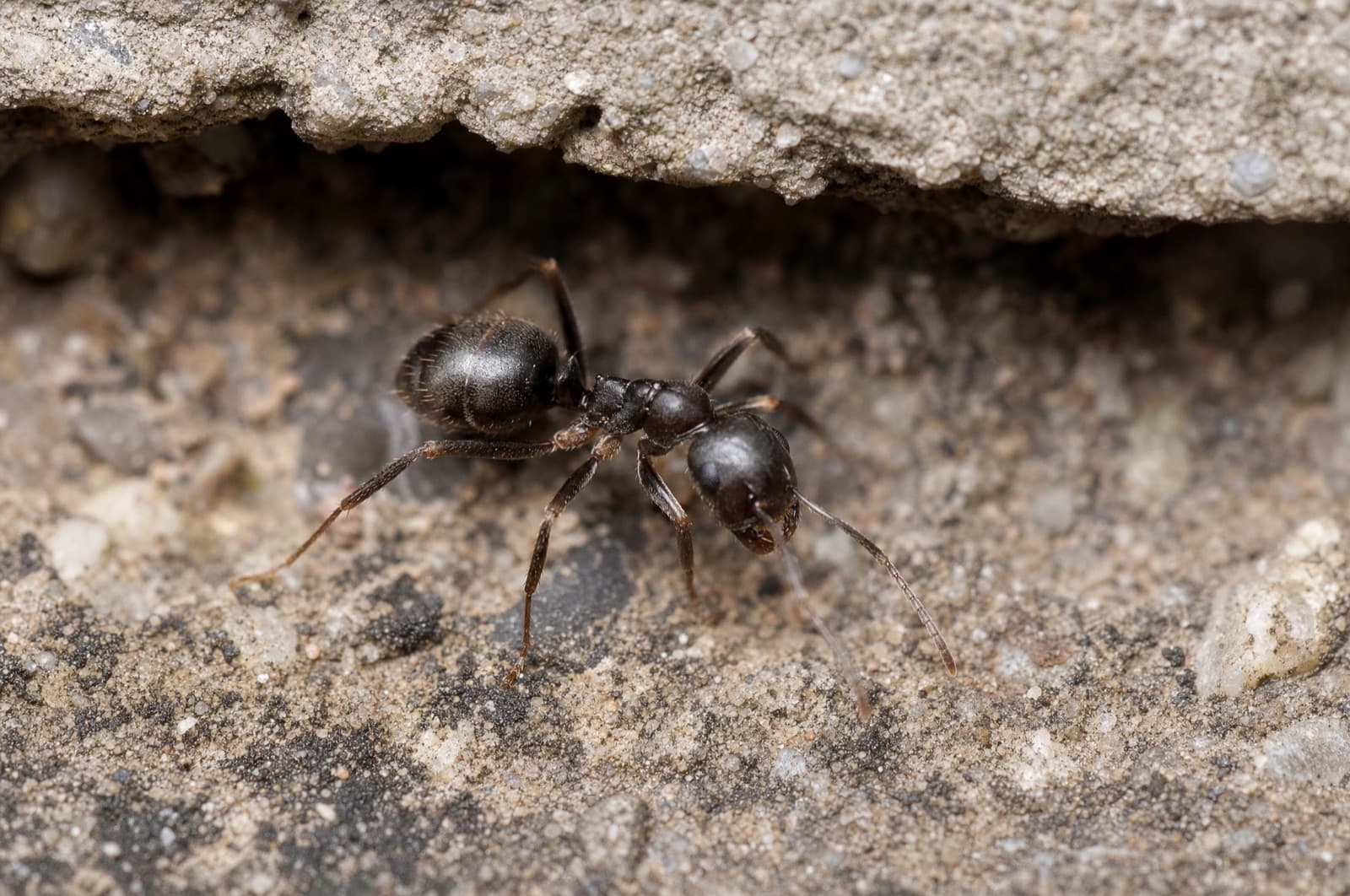
Pavement Ant — Quick ID for New Hampshire Homeowners
Pavement ants are New Hampshire's dominant urban outdoor ant — small, dark, and identified by the tiny crater mounds of excavated soil they push up through sidewalk joints, driveway cracks, and foundation edges. They regularly invade homes from the perimeter. This is the fast identifier; for perimeter control and indoor treatment, see the full ant guide.
- Size
- 2.5–4 mm
- Tetramorium immigrans (formerly T. caespitum)
- Signature sign
- Crater mounds in pavement cracks
- along sidewalks, driveways, foundation edges
- Head texture
- Fine parallel grooves (striations)
- visible under magnification
- NH status
- Dominant urban ant in southern NH
- very common; year-round indoors near heat
Is it a pavement ant?
Pavement ants are the small dark ants pushing up little soil mounds along your sidewalk seams, driveway joints, and foundation edge. They are New Hampshire's dominant urban outdoor ant — a year-round presence in the Anchor service area — and they regularly enter homes through foundation gaps and slab edges, especially in kitchens and basements.
This page is a fast identifier. For the full picture — perimeter control, why slab-nesting colonies resist DIY, and how pavement ants compare to odorous house ants — read the complete guide in the Ant FAQ hub linked above.
Quick pavement ant ID
The outdoor mound and the fine head grooves visible under a hand lens are the two clearest tells.
Pavement ant
- Scientific name
- Tetramorium immigrans (formerly T. caespitum)
- Family
- Formicidae
- Size
- 2.5–4 mm
- Coloration
- Dark brown to black
- Habitat
- Under pavement, sidewalk slabs, driveway joints, foundation edges; indoors in voids near baseboard heat in winter
- Active season
- Year-round (indoors near warmth in winter); peak outdoor activity spring through fall
- Diet
- True omnivore — trails to grease, meats, sweets, crumbs; anything near the foundation
- Reproduction
- Mating flights (swarms) in spring and summer; winged alates emerge from cracks
- Lifespan
- Workers live months to a year; queens several years
Dominant outdoor urban ant throughout southern and central New Hampshire; very common along foundation edges, sidewalks, and driveways in Anchor's service area.
The tells — key ID features
- Tiny crater mounds of excavated soil along sidewalk joints, driveway cracks, or the foundation edge — the signature and most reliable outdoor sign.
- Fine parallel grooves (striations) on the head and thorax — visible under a hand lens.
- Two-segment waist with small spines (propodeal spines) on the rear of the thorax.
- True omnivore: trails to grease, meat, sweets, and crumbs — found at diverse food sources.
Odorous house ant
How to tell — Odorous house ants lack visible waist nodes, emit a rotten-coconut odor when crushed, and do not build soil crater mounds — they nest in wall voids and indoor spaces.
Acrobat ant
How to tell — Acrobat ants are bicolored (lighter head, darker gaster) and raise their abdomen when alarmed; they nest in damp wood rather than under pavement.
Signs of a problem
Look at the pavement and foundation edge.
Small piles of excavated soil forming crater mounds in sidewalk joints, driveway cracks, or along the foundation edge
What it means — Pavement ant colony nesting below — workers ventilate the nest and excavate material upward.
Trails of small dark ants entering at a slab edge, expansion joint, or toe-kick in the kitchen
What it means — Pavement ants foraging into the home from an outdoor colony at the foundation.
Pavement ant control in New Hampshire
Pavement ant colonies nest below slabs and foundation edges — areas inaccessible to most DIY products. Perimeter treatment combined with slow-acting bait is the professional approach. The full ant guide covers treatment options and what makes perimeter control effective in NH's climate.
When to call a pro
- Recurring indoor trails from the foundation or kitchen slab edge.
- Mounds along walkways or entry areas that DIY treatment hasn't resolved.
- Slab or foundation nests that surface treatments can't reach.
Not sure it's a pavement ant?
A licensed NH technician can confirm the species and tell you honestly whether it's a DIY fix or a job for a pro — free inspection, same-day service across Southern New Hampshire.
Frequently asked questions
Sources(2)
- [1]Penn State Extension — Pavement Ants
species biology, mound sign, urban prevalence
extensionverified 2026-06-30 - [2]Anchor Pest — Ant FAQ Guide
full NH pavement ant control and perimeter treatment
industryverified 2026-06-30
Written & reviewed by
VerifiedDaniel Brady
NH-Licensed Pesticide Applicator · License #782664 (NHDAMF, RSA 430)
Daniel Brady is the New Hampshire–licensed applicator behind Anchor Pest Services, a family-owned pest control company serving the Manchester area since 2017.
Last updated 2026-06-30

New Hampshire pest control
Dealing with pavement ants in your home?
Anchor Pest Services identifies and handles pavement ant problems across southern and central New Hampshire. Family-owned since 2017, NH license #782664.
- NH-licensed applicators (#782664)
- Same-day service · free inspection
- Family-owned since 2017
Your next step
- Next step
Is Spectracide Ant Shield Granules Safe for Pets?
Read the answer - What to do next
What Attracts Pavement Ants to Your House?
Read the answer - Also relevant
Do pavement ants damage driveways or patios?
Read the answer - Related guide
Odorous House Ant — Quick ID for New Hampshire
Read the answer - Related guide
Carpenter Ant — Quick ID for New Hampshire Homeowners
Read the answer