
Orchard Orbweaver in NH: ID, Web & Is It a Widow?
Also called Orchard spider · Long-jawed orbweaver · Leucauge
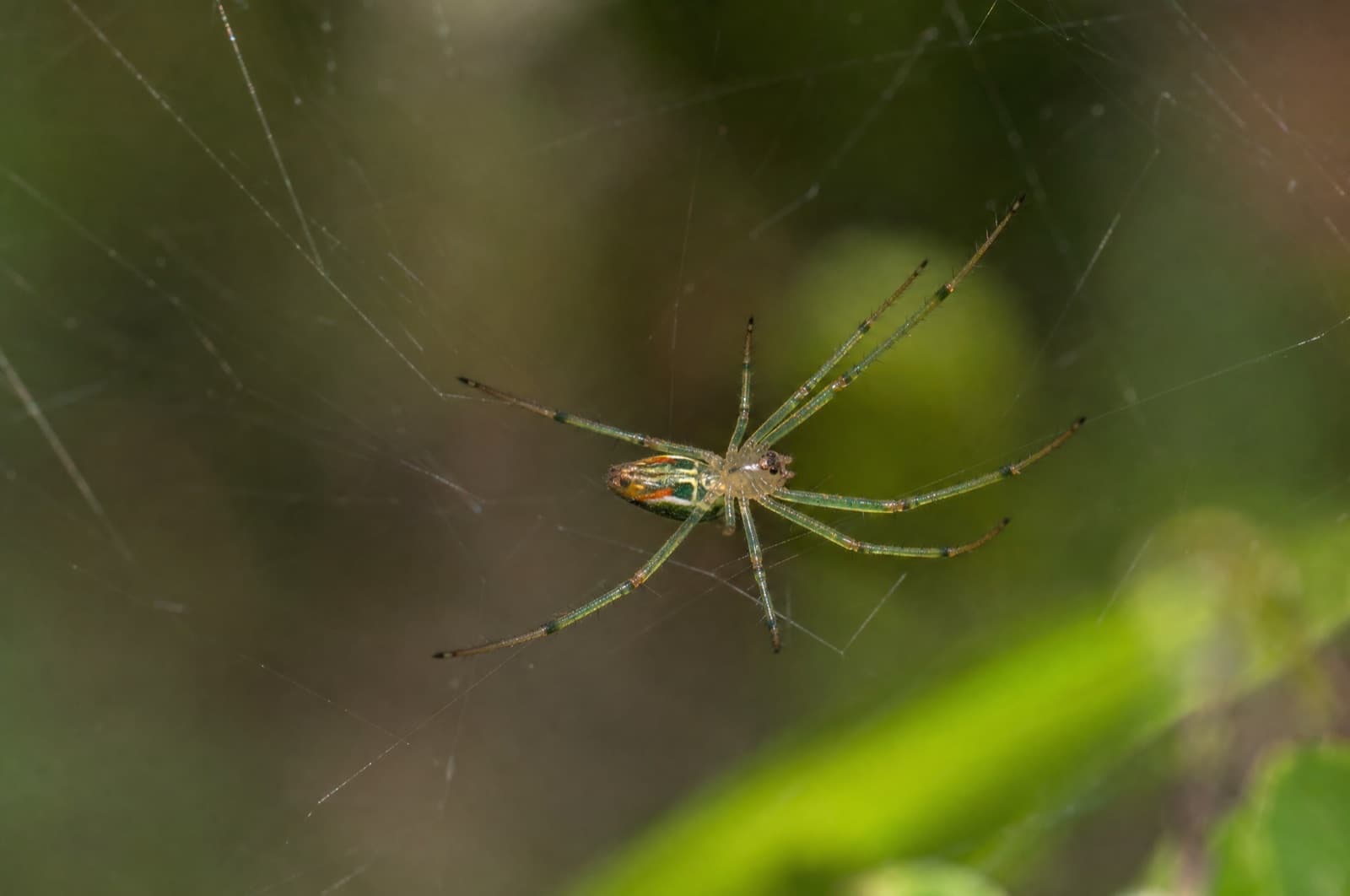
The orchard orbweaver (Leucauge venusta) is a tiny, jewel-like spider — green legs, silvery abdomen, sometimes a red or orange crescent underneath — that builds horizontal orb webs low in shaded shrubs throughout New Hampshire from late spring through summer. Its red underside crescent is harmless pigment, not a widow warning. The true black widow has a tangled, irregular web, hides by day, and is uniformly glossy black. The orchard orbweaver hangs belly-up beneath its neat horizontal web in broad daylight and is completely harmless to humans and pets.
- Body size
- ~3–8 mm (smaller than a grain of rice)
- Illinois DNR
- Web orientation
- Horizontal orb
- vs widow's tangled web; Illinois DNR
- NH status
- Reported in the Northeast; range extends up the East Coast into NH
- regional range records
- Bite risk
- Harmless — no medical significance
- spideridentifications.com
- Red underside mark
- Harmless pigment, NOT a widow
- bugeric.blogspot.com
The 'is that a widow?' spider of the NH garden
The orchard orbweaver (Leucauge venusta) is one of the most beautiful and most misidentified spiders in New Hampshire. Tiny — body no bigger than a grain of rice — with iridescent green legs and a silvery abdomen, it builds low horizontal orb webs in shaded shrubs and garden borders all across the state from late spring through summer. Every year, homeowners spot the red or orange crescent on its underside and immediately fear black widow.
They are not the same spider. The two are opposites in almost every way: the orchard orbweaver is active by day, sits openly in the center of a neat, wheel-like horizontal web, and is completely harmless. The black widow hides by day in a tangled, irregular web, is uniformly glossy black, and has a true red hourglass on its underside — a closed figure-eight, not a crescent mark on an otherwise silver abdomen.
The orchard orbweaver is a beneficial predator, picking off small flying insects that land in its web. If its web does not cross a path or entryway, there is no reason to disturb it. Understanding what it is — and what it is not — is the entire point of this page.
How to identify an orchard orbweaver
Three features identify the orchard orbweaver at a glance: jewel-green legs on a silvery abdomen, a perfectly flat horizontal orb web strung low in a shrub, and the spider hanging upside-down beneath the hub by day. The red or orange crescent on the underside, when present, is variable pigment — not a widow marker.
Orchard orbweaver
- Scientific name
- Leucauge venusta
- Family
- Tetragnathidae
- Size
- ~3–8 mm body length
- Coloration
- Iridescent green legs; silvery-white abdomen with dark streaks; variable red, orange, or yellow crescent on underside — often faint or absent
- Habitat
- Woodland edges, shaded shrubs, garden borders, low understory vegetation
- Active season
- Late spring through early fall (May–September); adults peak mid-summer
- Diet
- Small flying insects — flies, gnats, leafhoppers — caught in the horizontal orb web
- Reproduction
- Egg sac placed in nearby vegetation in late summer; spiderlings emerge the following spring
- Lifespan
- One season — adults die after the first hard frost
East Coast from southern Canada to Central America; common throughout New Hampshire.
The tells — key ID features
- Iridescent green legs and silvery abdomen — the jewel-like color combination is the fastest ID cue.
- Horizontal (not vertical) orb web strung low in a shrub — the web angle alone nearly confirms the ID.
- Hangs upside-down, belly up, beneath the center of the web hub by day.
- Small body — ~3–8 mm, noticeably smaller than a garden spider or any widow.
- Red or orange crescent on the underside when present — variable and often faint.
- Active and visible in daylight, the opposite of the reclusive black widow.
Size, to scale
3–8 mm body length
Smaller than a grain of rice to roughly the size of a small pea (body only)
Black widow
How to tell — Black widow is uniformly glossy black with a true red hourglass (closed figure-eight) on the underside, builds a messy tangled web low in dark corners or voids, and hides by day. Orchard orbweaver has green legs and a silver abdomen, hangs in a neat horizontal orb in daylight, and is harmless.
Basilica spider (Mecynogea lemniscata)
How to tell — Basilica spider builds a domed or barreled sheet web over shrubs, not a flat orb. Similar habitat but completely different web architecture.
Other long-jawed orbweavers (Tetragnatha spp.)
How to tell — Same family, similar slender build; usually found near water with a more elongated body. All species in the family are harmless.
Signs of a problem
The orchard orbweaver leaves clear, predictable signs in the garden. All of them are good news — they indicate a harmless, beneficial predator is at work.
Small horizontal orb web strung low in a shrub or garden border
What it means — Almost certainly an orchard orbweaver — no other common NH spider builds a small, flat, perfectly horizontal orb that close to the ground in a garden shrub.
Tiny green-and-silver spider hanging belly-up beneath a web hub in broad daylight
What it means — Harmless orchard orbweaver resting in its characteristic position. A black widow, by contrast, hides by day and is never seen sitting openly in the center of a neat web.
A red or orange crescent mark visible on the spider's underside
What it means — This is the mark that triggers false widow alarms. If the web is horizontal and the spider is out by day, it is an orchard orbweaver — not a widow.
Web rebuilt each morning in the same shrub
What it means — Active orchard orbweaver maintaining a productive hunting territory. Daily web-rebuilding is normal and means the spider is finding ample prey.
The real risks, calibrated
The orchard orbweaver poses no meaningful risk to humans or pets. Its jaws are extremely small — too small to break adult human skin under ordinary circumstances — and its venom has no medical significance.
Bite (theoretical)
Low riskOnset: Only if the spider is directly pinched against skin with significant force
Jaws too small to break skin in almost all real-world encounters; no medically significant venom documented. At most, minor irritation at the site. No treatment required beyond basic first aid if skin is broken.
DIY — what works, what backfires
In nearly every case the right response is to leave the orchard orbweaver alone. It is a natural pest controller that poses no threat to people or pets. The only practical reason to act is if a web repeatedly crosses a high-traffic walkway.
What actually works
- Leave it in place — orchard orbweavers eat flies, gnats, and leafhoppers, providing free pest control in your garden.
- Relocate a web that crosses a path: use a stick to transfer the web and spider to a nearby shrub and it will rebuild overnight in the new location.
- Use the sighting as an identification opportunity — the horizontal web, green legs, and silver abdomen make this one of the most distinctive spiders in the NH garden.
What backfires
- Don't kill it on sight because of the red underside crescent — that mark is harmless pigment, not a black widow warning.
- Don't clear beneficial webs from garden shrubs unnecessarily — removing orchard orbweavers costs you free insect control.
- Don't confuse web location with danger: widow webs are tangled, low, in dark corners or voids — not neat horizontal orbs in daylight garden shrubs.
Orchard orbweavers in New Hampshire
Leucauge venusta ranges from southern Canada down the East Coast through Central America, and it is a regular resident of New Hampshire woodland edges, shaded backyard shrubs, and overgrown garden borders. In southern NH — Manchester, Nashua, Concord — look for horizontal orb webs strung low in the understory, typically under five feet, from late May through August. The spiders rebuild their webs daily and hang belly-up beneath the hub, a behavior as distinctive as the markings. Cold weather in early fall ends the adult season.
Peak season
Late spring through summer (May–September)
You might actually have
- Black-and-yellow garden spider (vertical orb web, much larger)
- Basilica spider (dome web over shrubs, not a flat orb)
- Common house spider (irregular cobweb, indoors)
We serve these communities
- NH-licensed applicator · #782664
- Same-day service
- Family-owned since 2017
Service Area Map
Southern New Hampshire
When to call Anchor about orchard orbweavers
Orchard orbweavers almost never warrant professional pest control — they are harmless, beneficial, and seasonal. Call us when you have recurring nuisance webs across garden paths or entryways, or when you want a professional ID to confirm the spider is not a species of concern.
When to call a pro
- Webs repeatedly crossing garden walkways or building entryways despite regular relocation.
- You want a professional identification to confirm the spider is not a widow or other species of concern.
- Multiple web-building spider species are appearing in high-traffic areas of your property.
Trim shrubs back from walkways
Cutting vegetation 1–2 feet back from paths eliminates the attachment points orchard orbweavers use and reduces nuisance web crossings on high-traffic routes.
Thin dense foundation plantings
Dense, layered shrubs close to the house create ideal low-web habitat. Thinning reduces harborage for all web-building spiders near entryways.
Reduce outdoor lighting near garden beds
Lights attract the small flying insects that orchard orbweavers feed on. Moving fixtures away from garden shrubs makes those areas less productive hunting territory.
Not sure it's a orchard orbweaver?
A licensed NH technician can confirm the species and tell you honestly whether it's a DIY fix or a job for a pro — free inspection, same-day service across Southern New Hampshire.
Frequently asked questions
Sources(4)
- [1]Illinois DNR — Orchard Spider Leaflet
body size, identification, horizontal orb web orientation
govverified 2026-06-30 - [2]U.S. Fish & Wildlife Service — Beneficial Insects and Spiders
role as beneficial insect predator
govverified 2026-06-30 - [3]Bug Eric — Leucauge venusta profile
red underside crescent identification; harmless pigment
webverified 2026-06-30 - [4]Spider Identifications — Orchard Orbweaver
bite risk assessment; no medical significance
webverified 2026-06-30
Written & reviewed by
VerifiedDaniel Brady
NH-Licensed Pesticide Applicator · License #782664 (NHDAMF, RSA 430)
Daniel Brady is the New Hampshire–licensed applicator behind Anchor Pest Services, a family-owned pest control company serving the Manchester area since 2017.
Last updated 2026-06-30

New Hampshire pest control
Dealing with orchard orbweavers in your home?
Anchor Pest Services identifies and handles orchard orbweaver problems across southern and central New Hampshire. Family-owned since 2017, NH license #782664.
- NH-licensed applicators (#782664)
- Same-day service · free inspection
- Family-owned since 2017
Your next step
- Book a NH pro
Spider Control in New Hampshire
Spider sightings peak in fall. We treat hiding spots and seal the gaps they use.
Book now - Next step
Is Home Defense Ant, Roach & Spider Killer by Ortho Safe for Pets?
Read the answer - What to do next
How to Get Rid of Black Widow Spiders
Read the answer - Related guide
Black Widow Spider in New Hampshire: ID, Risk & Control
Read the answer - Related guide
House Spider in New Hampshire: ID, Webs & Control
Read the answer - Related guide
Common Garden Spider in NH: ID, Web & Is It Dangerous
Read the answer