
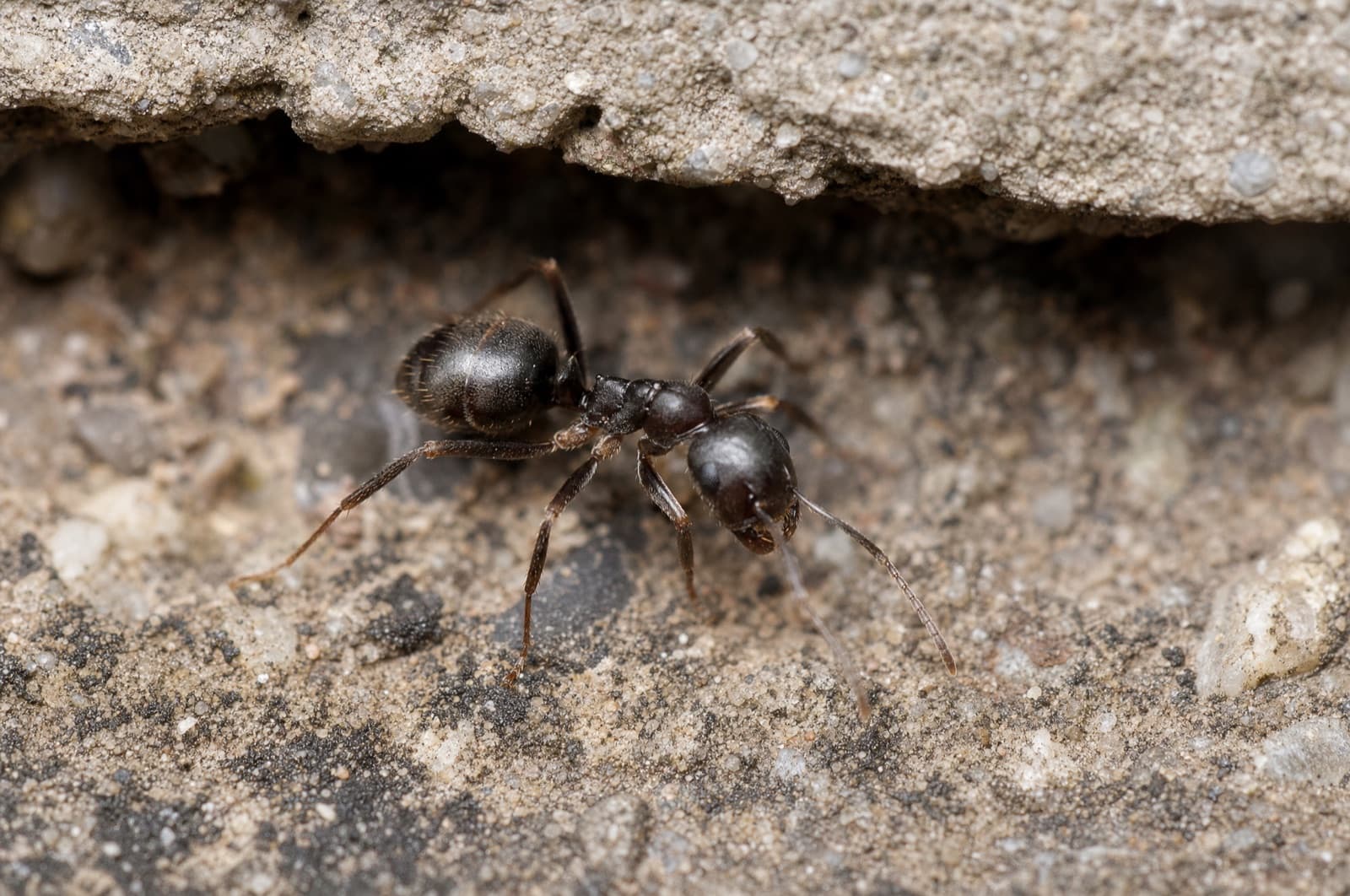
What Attracts Pavement Ants to Your House?
At a glance
- Short answer: Food and moisture — nothing about pavement ants is special
- The verdict: The usual four
The attractant verdict
Four possible answers to why this species turned up. Three stay unlit — and that's the argument: the honest answer could have been any of them, and for this species it wasn't.
This is the most common answer in this hub — an answer, not a shortfall.
Food and moisture — nothing about pavement ants is special
Our own old page said pavement ants are drawn in "mainly because of food and shelter" — accurate as a summary, though it undersells how much the nest location itself, soil under pavement, does the real work of explaining where these ants come from.
A nest already established in soil under a foundation crack, sidewalk, patio, or driveway edge, combined with food and moisture accessible indoors. Foraging ants reach the food through cracks in foundation walls, gaps behind window and door frames, and along utility lines — not through anything special about the house itself.
“Food and moisture — the same two things that attract almost every ant. Nothing about a pavement ant is special, and that's the honest answer.”
Why it's here, in full
Why there's no special story here
Pavement ants get their name from where they nest: in soil under sidewalks, driveways, patios, and foundation cracks, wherever pavement provides a stable cover over the colony. Foraging worker ants then travel from that nest toward whatever food and moisture they can find indoors, entering through cracks in foundation walls, gaps around window and door frames, or along heating ducts and utility lines.
That's the whole explanation. The house isn't the attraction — the nest under the nearby pavement is, and the ants simply follow the shortest path from there to food.
How to tell it's actually this species
Real signs only — a species with four honest tells gets four, and stops. Where a sign is weak on its own, we say so.
Small mounds of excavated soil pushed up through cracks in pavement, sidewalks, or driveways
Visible ant trails leading from an outdoor crack toward a food source indoors
A brief swarm of winged ants indoors, usually in spring
Could be something else: Winged ant swarms can come from several ant species, and a single sighting doesn't confirm which one without a closer look.
Want pavement ant gone?
This page only answers why it's here. Every removal step for this exact species — what to seal, what to set, what actually works — lives on its own dedicated guide.
Two questions, two pages
Here: why it turned up at all — the honest answer, blame removed.
There: the step-by-step removal guide for this exact species.
Key takeaways
- Pavement ants nest in soil under sidewalks, driveways, and foundation cracks, not inside the house itself.
- Foraging ants enter through foundation cracks and gaps around doors and windows chasing food and moisture.
- Small soil mounds pushed up through pavement cracks are the clearest sign of a nearby nest.
- Removal steps live at /top-diy-methods/pavement-ant.
Want it gone, not just explained?
This page is about why pavement ants show up. Removal is covered at /top-diy-methods/pavement-ant.
Frequently asked
Sources(2)
- [1]Utah State University Extension — Pavement Ants
Pavement ants nest in soil under sidewalks, driveways, and foundations and forage indoors through cracks and gaps
extensionverified 2026-07-17 - [2]Colorado State University Extension — Ants in the Home
Household ants forage indoors for food and moisture, entering through cracks and gaps around the foundation
extensionverified 2026-07-17
Written & reviewed by
VerifiedDaniel Brady
NH-Licensed Pesticide Applicator · License #782664 (NHDAMF, RSA 430)
Daniel Brady is the New Hampshire–licensed applicator behind Anchor Pest Services, a family-owned pest control company serving the Manchester area since 2017.
Last updated Jul 2026
Food and moisture — nothing unusual here
If ants are already established, we handle the rest
Same-day inspections across southern and central New Hampshire.
- Family-owned in Manchester since 2017
- NH commercial applicator #782664, category F1
- We will tell you when the answer is do nothing
NH License #782664 · No obligation · We answer in person
Your next step
- What to do next
Pavement Ant — Quick ID for New Hampshire Homeowners
Read the answer - What to do next
Carpenter ants vs. black ants: how to tell them apart
Read the answer - Also relevant
Do pavement ants damage driveways or patios?
Read the answer - Also relevant
Ant Prevention: Moisture Control Stops NH's Top Pest
Read the answer