
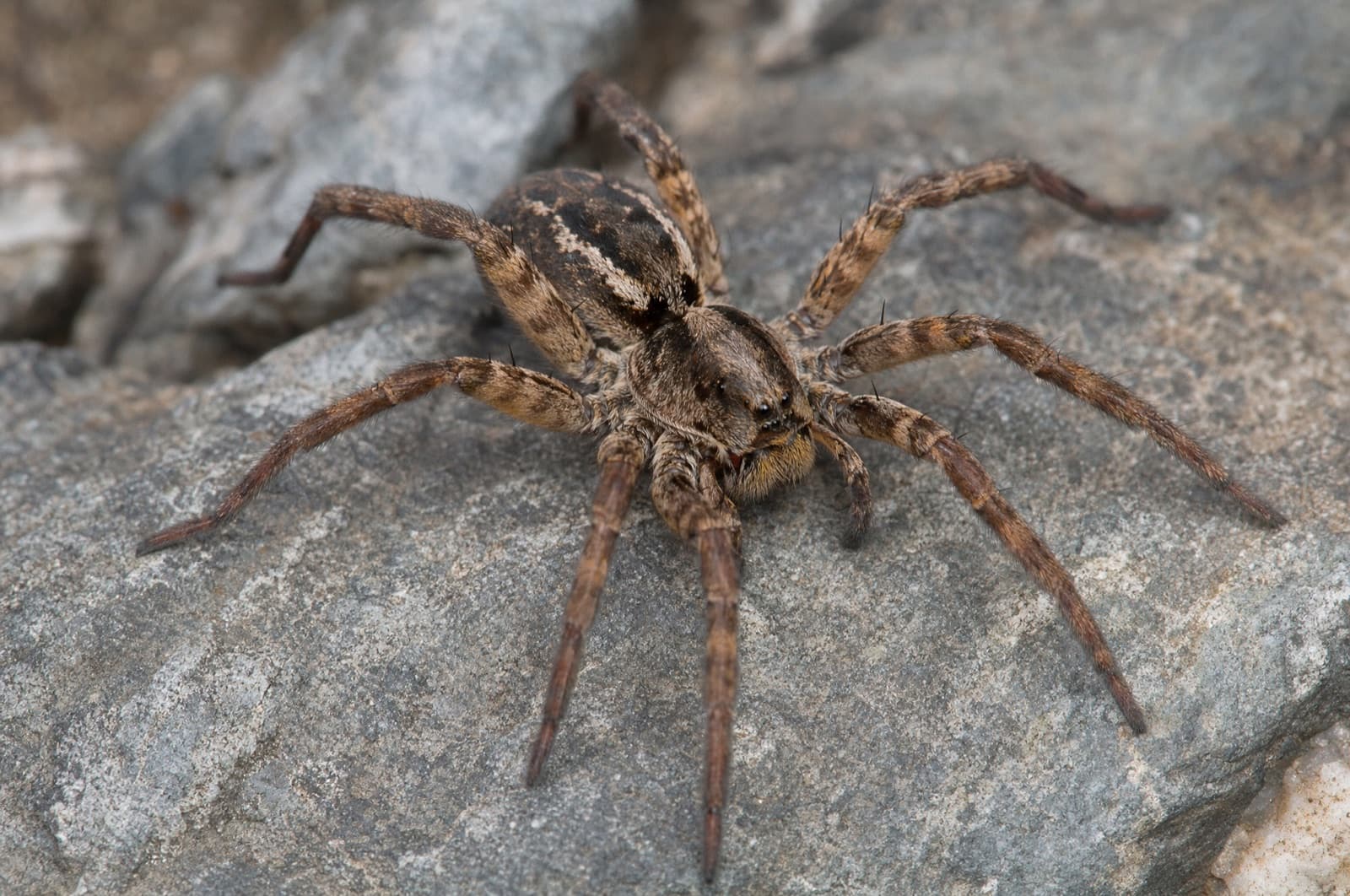
Wolf Spider in New Hampshire: ID, Bite & Is It a Recluse
Also called Ground spider (informal)
Wolf spiders are large, fast, ground-hunting spiders — body up to 1½ inches — that enter NH basements and crawl spaces in fall as temperatures drop. They look alarming but are harmless and beneficial: they hunt crickets, ants, and beetles on the ground and build no web. The most important fact for NH homeowners: the brown recluse is not established in New Hampshire, so a large brown ground spider on a NH basement floor is almost certainly a wolf spider. At night, the distinctive eyeshine — two large eyes reflecting a flashlight like tiny headlights — clinches the identification.
- Body size
- ¼–1½ inch (10–35 mm) by genus
- Utah State University Extension
- Bite
- Rare and mild — redness and itching only
- not medically significant; Colorado State University
- Web?
- None — active ground hunter
- Utah State University Extension
- NH status
- Present, common — basements in fall
- UMD Extension
- Recluse?
- No — brown recluse not established in NH
- Penn State Extension
- Parenting
- Female carries egg sac and young on her body
- Colorado State University
Looks alarming. Harmless. Definitely not a recluse.
The wolf spider is the spider NH homeowners most often mistake for something dangerous. It is large — body up to 1½ inches — hairy, fast across the floor, and it appears most dramatically in September and October when it wanders indoors seeking warmth. The reaction is nearly always the same: 'Is that a brown recluse?'
It is not. The brown recluse (Loxosceles reclusa) is not established in New Hampshire. Its native range is the south-central United States, and despite regular misidentification in the Northeast, there is no reproducing recluse population in NH. Penn State Extension and New England entomologists have confirmed this repeatedly. A large, brown, fast-moving spider on a NH basement floor is a wolf spider — a harmless, beneficial predator of the same ground-dwelling insects most homeowners are glad to be rid of.
The most memorable way to confirm a wolf spider at night: sweep a flashlight low across the lawn or basement floor. Two large eyes catch the beam and flash brilliant green-white, like tiny cat eyes in the dark. That retroreflective eyeshine is unique among common NH spiders and gives the wolf spider away instantly.
How to identify a wolf spider
Wolf spiders are identified by four combined features: large hairy body with a mottled brown-gray pattern, fast purposeful ground movement with no web present, two prominent forward-facing eyes, and — the most memorable feature — brilliant green-white eyeshine when a flashlight catches them at night. No web, no funnel, no sticky silk at all: just a fast, ground-level hunter.
Wolf spider
- Scientific name
- Family Lycosidae — genera Hogna, Tigrosa, Rabidosa, and others
- Family
- Lycosidae
- Size
- Body 10–35 mm (¼–1½ inch) depending on genus and sex; legspan up to ~3 inch
- Coloration
- Brown to gray with mottled or banded pattern; no metallic or glossy sheen
- Habitat
- Leaf litter, stone walls, woodpiles, grassland; basements and crawl spaces in fall
- Active season
- Year-round; most active warm months outdoors; indoor sightings peak September–November
- Diet
- Ground-dwelling invertebrates — crickets, ants, beetles, cockroaches, and other spiders
- Reproduction
- Female attaches egg sac to spinnerets and carries it; after hatching, spiderlings ride on her abdomen for several weeks
- Lifespan
- Most species 1–2 years; larger Hogna species can live several years
Found statewide across New Hampshire; common throughout North America in a wide range of habitats.
The tells — key ID features
- Brilliant eyeshine at night when illuminated — two large eyes reflect a flashlight beam green-white, the single most memorable ID feature.
- Large, hairy, mottled brown-gray body up to 1½ inch; legspan can reach roughly 3 inches.
- Two large forward-facing eyes in the second eye row, giving a distinctive face-forward appearance.
- Fast, purposeful ground movement — no web present anywhere near the spider.
- Female carries a pale, round egg sac attached to her spinnerets, then spiderlings riding on her back after hatching.
- Found on the ground or floor, never in a web, funnel, or silken retreat.
Size, to scale
Body 10–35 mm; legspan up to roughly 75 mm
Body about the size of a half-dollar for the largest NH species
Brown recluse (Loxosceles reclusa)
How to tell — Brown recluse is NOT established in New Hampshire. If you are in NH, the large brown spider on your basement floor is almost certainly a wolf spider. Key differences: recluse is smaller and tan-brown with a violin-shaped mark on the back and only 6 eyes in three pairs; wolf spider has 8 eyes, no violin mark, and a hairy, mottled body. Penn State Extension confirms recluse is not native to the Northeast.
Nursery web spider (Pisaurina mira)
How to tell — Similar size and coloring, but the female carries her egg sac in her jaws, not on her spinnerets, and builds a nursery tent web for her young. Wolf spider females always carry the sac attached to the rear of the abdomen.
Funnel weaver (family Agelenidae)
How to tell — Funnel weavers build a flat, funnel-shaped sheet web in grass or low corners and retreat into the funnel when disturbed. Wolf spiders build no capture web of any kind.
Signs of a problem
Wolf spider signs are behavioral and situational. Because the spider builds no web and leaves no silk retreat, the spider itself is usually the sign — often seen at exactly the wrong moment.
Brilliant eye-shine points of light on the lawn or garden at night when a flashlight sweeps low
What it means — Classic wolf spider hunting signature. The tapetum behind their large eyes reflects light the same way a cat's eyes do; dozens of spiders can be visible in a single sweep across a NH lawn after dark.
Large, fast, hairy brown spider crossing a basement floor in September or October
What it means — Seasonal wandering wolf spider — the most common fall intrusion in NH homes. A single individual following warmth or prey indoors, not an infestation.
Spider with a white or cream ball attached to the underside of its abdomen
What it means — Female wolf spider carrying her egg sac on her spinnerets — a unique and unmistakable behavior shared by no other common NH spider.
Spider with its abdomen covered in tiny moving dots
What it means — Female wolf spider carrying spiderlings that have hatched from the egg sac and are riding on her back — completely normal maternal behavior, not an infestation.
The real risks, calibrated
Wolf spiders are not medically significant. They bite only when directly trapped or handled, and the effect is roughly comparable to a mild bee sting — brief and self-limiting.
Defensive bite
Low riskOnset: Only if the spider is trapped — e.g., inside clothing or shoes — or directly handled
Mild localized pain, redness, and itching at the bite site; symptoms typically resolve within hours. Clean the area with soap and water. If pain worsens, redness expands, signs of infection appear, or any systemic symptoms develop, contact a doctor or the Northern New England Poison Control Center at 1-800-222-1222.
Alarm response
Low riskOnset: On sight
Wolf spiders trigger fear disproportionate to any actual risk because of their size and speed. Knowing the ID — and that the brown recluse is not in NH — eliminates the most significant harm they cause.
DIY — what works, what backfires
Wolf spider control in NH is almost entirely about exclusion and harborage reduction — stopping them from coming in before fall, rather than treating the ones already inside.
What actually works
- Cup-and-release any wolf spider found indoors — place a cup over the spider, slide a stiff card beneath, and release outside.
- Seal ground-level entry points before fall: caulk foundation cracks, fill the rim-joist gap above the foundation wall, and weatherstrip garage doors.
- Move woodpiles, leaf piles, and stone piles at least 10 feet from the foundation — these are prime wolf spider habitat and overwintering sites.
- Thin ground-level foundation plantings and remove dense mulch thick against the house wall to reduce harborage immediately adjacent to entry points.
What backfires
- Don't assume a large brown spider in NH is a brown recluse — the recluse is not established here, and misidentification drives unnecessary pesticide applications.
- Don't fog or bomb a basement for a seasonal wolf spider — non-target chemical exposure is not proportionate to a harmless, temporary intruder.
- Don't handle a wolf spider with bare hands — use a cup to avoid the small risk of a defensive bite when the spider is cornered.
Wolf spiders in New Hampshire homes and basements
Wolf spiders (family Lycosidae) are abundant throughout New Hampshire in leaf litter, stone walls, woodpiles, and foundation plantings. They are solitary ground hunters — no web — and NH homeowners encounter them most often from late September through November, when dropping temperatures push individuals toward shelter. Fieldstone basements, crawl spaces, and ground-level garage entries are the typical access points. Manchester's first hard frost typically arrives in mid-to-late October, and spider intrusion reports track that timing closely across Hillsborough and Rockingham counties.
Peak season
Year-round outdoors; indoor intrusions peak September–November
You might actually have
- Cellar spider (long thin legs, loose cobweb in basement corners)
- Ground beetle (similar fast ground-running; six legs, no silk)
- Funnel weaver spider (builds flat funnel web in lawn or low corner)
We serve these communities
- NH-licensed applicator · #782664
- Same-day service
- Family-owned since 2017
Service Area Map
Southern New Hampshire
When to call Anchor about wolf spiders
An occasional fall wolf spider in a basement is part of NH life and rarely needs professional treatment. Call us when intrusions are frequent, you cannot locate the entry points, or the presence is causing significant household distress.
When to call a pro
- Repeated intrusions into living space — not just the basement — each fall despite DIY exclusion efforts.
- You want a professional inspection to identify and seal the specific entry points being used.
- You are seeing multiple large spiders regularly and want peace of mind from a licensed assessment.
- You want a confirmed professional ID to rule out any species of concern.
Seal the rim joist and foundation
The gap between the foundation wall and sill plate is the primary fall entry route for ground-level spiders in NH. Spray foam and caulk applied before the first hard frost seal this gap before the migration begins.
Reduce outdoor harborage
Move woodpiles and leaf piles away from the house and thin dense ground-cover plantings against the foundation. Wolf spiders overwinter in these materials — removing them from the perimeter reduces both harborage and the migration pressure toward your foundation.
Reduce ground-level exterior lighting
Exterior lights near ground-level entries attract the insects wolf spiders hunt, drawing them closer to the house. Moving fixtures away from foundation walls reduces that pull.
Not sure it's a wolf spider?
A licensed NH technician can confirm the species and tell you honestly whether it's a DIY fix or a job for a pro — free inspection, same-day service across Southern New Hampshire.
Frequently asked questions
Sources(4)
- [1]University of Maryland Extension — Wolf Spiders
fall indoor behavior, NH/regional status
extensionverified 2026-06-30 - [2]Utah State University Extension — Top 20 Arachnids
identification, family Lycosidae, body size by genus, eyeshine, no web (active ground hunter)
extensionverified 2026-06-30 - [3]Colorado State University — Entomology and Plant Pathology
wolf spider biology and control guidance, bite mild/not medically significant, maternal egg-sac and spiderling carrying
extensionverified 2026-06-30 - [4]Penn State Extension — Brown Recluse Spiders
brown recluse absence from the Northeast; misidentification context
extensionverified 2026-06-30
Written & reviewed by
VerifiedDaniel Brady
NH-Licensed Pesticide Applicator · License #782664 (NHDAMF, RSA 430)
Daniel Brady is the New Hampshire–licensed applicator behind Anchor Pest Services, a family-owned pest control company serving the Manchester area since 2017.
Last updated 2026-06-30

New Hampshire pest control
Dealing with wolf spiders in your home?
Anchor Pest Services identifies and handles wolf spider problems across southern and central New Hampshire. Family-owned since 2017, NH license #782664.
- NH-licensed applicators (#782664)
- Same-day service · free inspection
- Family-owned since 2017
Your next step
- Book a NH pro
Spider Control in New Hampshire
Spider sightings peak in fall. We treat hiding spots and seal the gaps they use.
Book now - Next step
Is Home Defense Ant, Roach & Spider Killer by Ortho Safe for Pets?
Read the answer - What to do next
How to Get Rid of Brown Recluse Spiders — and Why You Probably Don't Have One
Read the answer - Related guide
House Spider in New Hampshire: ID, Webs & Control
Read the answer - Related guide
Brown Recluse Spider: Is It in New Hampshire? (No)
Read the answer - Related guide
Spider Beetles in New Hampshire: Not a Spider — Here's the Real ID
Read the answer