
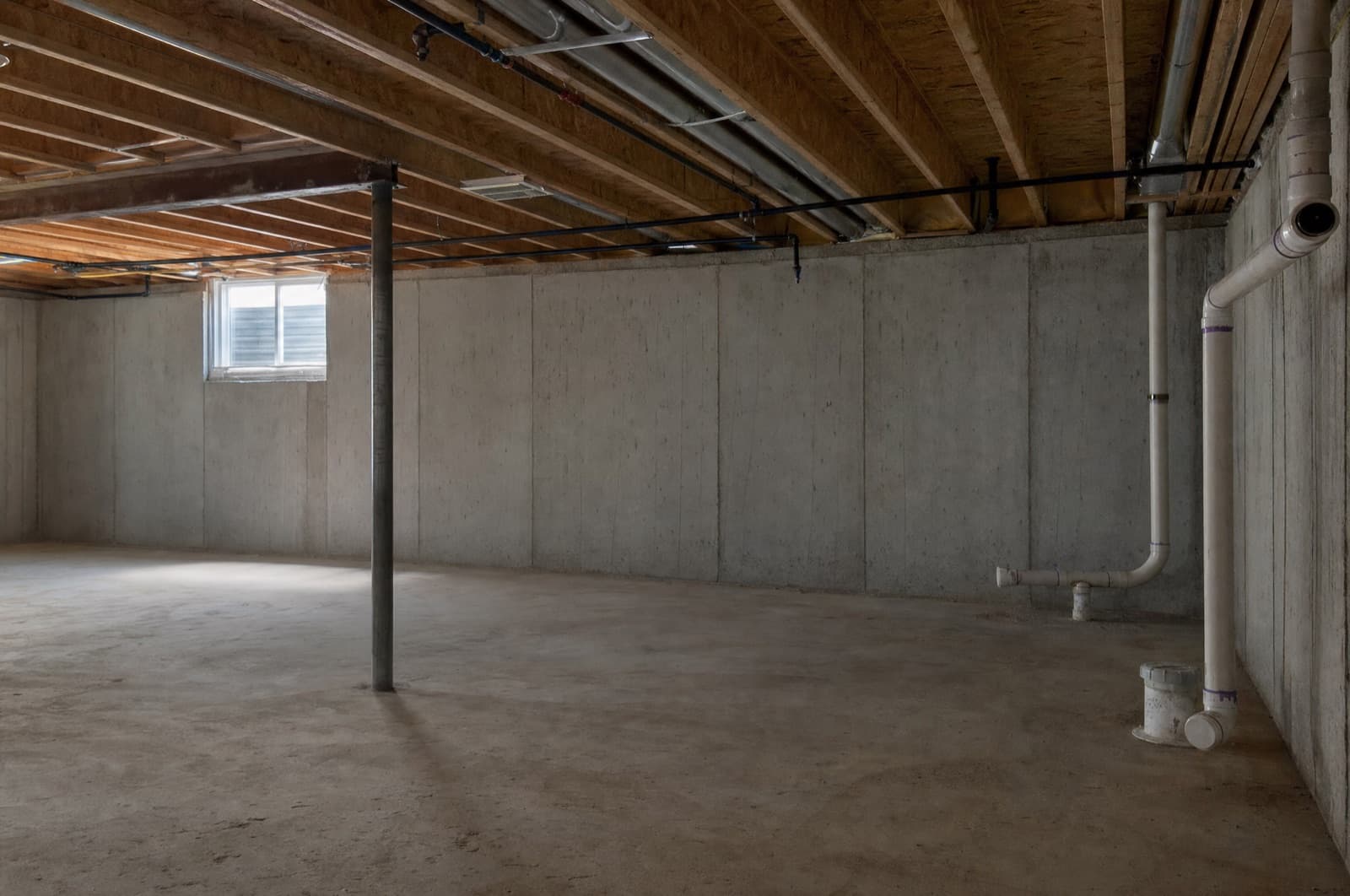
What Is That Smell in My Basement? Common Causes and Fixes
A musty, earthy smell that's worse in humid months is the single most common basement odor in New Hampshire, and it means moisture — condensation, minor seepage, or poor ventilation — not necessarily anything actively growing that you can see. A rotten-egg smell from a rarely used floor drain usually means its P-trap has dried out and stopped blocking sewer gas; refilling it with water is the first fix. An ammonia smell with droppings points to rodents, especially in older fieldstone-foundation homes. Because basements commonly hold a furnace or water heater, carbon monoxide is a real, if low-frequency, consideration — CO has no smell at all, so a working alarm is what protects you, not your nose.
Basements combine everything that produces a household odor: cool masonry that condenses summer humidity, floor drains that dry out and stop blocking sewer gas, rodents that find gaps at the sill plate, and — in most New Hampshire homes — the furnace or water heater itself. That last point matters beyond just odor: it's exactly why a basement is the room where a working carbon monoxide alarm carries the most weight, whatever's actually causing the smell you're chasing.
At a Glance
- Diagnosing: Basement
- Top cause: Mold / Moisture
- Safety: A real hazard may apply — read the red band below
~37%
Share of tested NH homes that exceed the EPA radon action level
NH DHHS
~100 deaths/year
Estimated NH deaths a year linked to long-term radon exposure
NH DHHS
30-50%
Target indoor relative humidity (keep below 60%) to control basement mold
EPA
Mold or moisture is the single most common basement odor in New Hampshire — sewer gas from a dry floor-drain trap and rodents are the next two most likely causes.
Ranked causes — and how to tell them apart
Like a doctor's differential: the candidate causes for this smell, ranked most-likely first, each with the tell-tale sign that distinguishes it and who actually fixes it.
- Most likelyMold / Moisture
Mold or moisture
How to tell it's this
A musty, earthy smell that's worse in humid months, possibly with visible mold, efflorescence, or condensation on walls or the slab; no droppings or nesting evidence.
Who fixes itMold remediationFix the water source (grading, gutters, sump) and dehumidify below 60% relative humidity; a remediation pro for anything extensive.
- Most likelyPlumbing / Sewer
Sewer gas from a dry floor-drain trap
How to tell it's this
A rotten-egg/sewage smell from a rarely used floor drain or fixture whose water seal has evaporated; not tied to any gas appliance.
Who fixes itPlumberPour a quart of water down the drain to refill the trap; call a plumber if it returns.
- PossiblePest
Rodents or a dead animal
How to tell it's this
An ammonia urine smell or a putrid decay smell, with droppings or gnaw marks near the sill plate, especially in older fieldstone-foundation homes.
Who fixes itPest → AnchorRemoval, enzymatic cleanup, and sealing foundation/sill gaps.
- Less likelyGas
Fuel-appliance combustion / carbon monoxide
How to tell it's this
No smell at all — CO is odorless; a sounding CO alarm or flu-like symptoms that ease when you leave the house are the only warnings. A lazy yellow furnace flame can indicate incomplete combustion.
Who fixes itEmergencyGet to fresh air and call 911 if the alarm sounds; have an HVAC pro inspect the heat exchanger and venting.
- Less likelyOther
Radon
How to tell it's this
Not a smell at all — radon is odorless, but basements are the classic collection point in NH homes; a musty smell is a reasonable prompt to also test for it.
Who fixes itYou can handle itNH DHHS provides free test kits; a certified mitigation contractor if levels are elevated.
What each clue points to
Notice one of these and you can narrow the differential fast.
- Mold / Moisture
If you notice: Musty, earthy smell that's worse in summer humidity
Mold or moisture — dehumidify and fix the water source; remediate if extensive.
- Plumbing / Sewer
If you notice: Rotten-egg smell from a seldom-used floor drain
A dry P-trap — pour water in to refill it; call a plumber if it returns.
- Pest
If you notice: Ammonia smell with droppings near the sill plate
Rodents — pest pro removal plus exclusion at the foundation.
- Gas
If you notice: No smell at all, but a CO alarm sounds
A real emergency — get out immediately and call 911; do not investigate the appliance yourself.
How Anchor finds and fixes it
When the differential points to rodents or a dead animal, here's how a technician approaches an NH basement, especially older fieldstone-foundation homes:
Inspect sill plates, rim joists, and stored items
These are the classic entry and nesting spots in older basements, along with gaps around utility penetrations.
Locate any carcass
If the smell is putrid rather than ammonia-forward, the odor gradient and any fly activity are followed to the source.
Remove with PPE
Nesting material, droppings, and any carcass are removed by hand, following CDC guidance to never dry-sweep or vacuum rodent waste.
Enzymatic cleanup
Urine-soaked areas are treated with an enzyme-based cleaner that breaks down the odor compounds rather than masking them.
Seal foundation and utility-penetration gaps
Fieldstone and rubble foundations are harder to fully seal, so this step is what keeps the next rodent out.
Once rodent activity is removed and the area is cleaned, that odor typically clears within days to about two weeks; a persistent musty smell after that points back to the moisture side of the differential, not the pest side — see musty-mildew-smell-in-house for the mold-specific diagnostic.
Rodents or a dead animal in the basement?
Anchor's NH technicians locate the source, remove it, clean up, and seal the foundation gaps that let it in. Free inspection, same-day service.
Who to call for the other causes
The honest routing: when the smell points somewhere other than a pest, here's the right trade and the conservative next step.
- Mold remediation
The smell is musty and worse in humid months
Fix the water source first (grading, gutters, sump pump, dehumidifier to below 60% relative humidity); call a mold remediation pro for anything beyond a small area.
- Plumber
A rotten-egg smell comes from a floor drain, not a gas appliance
Pour a quart of water down the drain to refill the trap; call a plumber if it returns within days.
- You can handle it
A musty smell prompts a broader air-quality check
Request a free NH radon test kit — radon is odorless and unrelated to the smell itself, but basements are the classic collection point worth checking.
Why NH basements are the hub's strongest CO-reminder page
New Hampshire basements combine cool masonry with humid summer air, making condensation-driven mold the runaway leading basement-odor cause in the region, and unused floor-drain traps dry out over the state's long heating season, letting sewer gas in. Radon is also a genuine Granite State issue — NH DHHS data indicate roughly 37% of tested NH homes exceed the EPA action level, and long-term exposure is estimated to contribute to about 100 New Hampshire deaths a year — so a musty basement is a reasonable prompt to test, separate from the odor diagnosis itself.
NH-licensed applicator #782664 (NHDAMF, RSA 430) · NEPMA member · family-owned since 2017.
Frequently asked
Sources(5)
- [1]EPA — A Brief Guide to Mold, Moisture, and Your Home
Moisture control principle; RH below 60%, ideally 30-50%
gov - [2]ATSDR/CDC — Hydrogen Sulfide Public Health Statement
Sewer-gas rotten-egg odor mechanism; dry-trap household exposure
gov - [3]
- [4]
- [5]
Written & reviewed by
VerifiedDaniel Brady
NH-Licensed Pesticide Applicator · License #782664 (NHDAMF, RSA 430)
Daniel Brady is the New Hampshire–licensed applicator behind Anchor Pest Services, a family-owned pest control company serving the Manchester area since 2017.
Last updated 2026-07-14
Odor-Source Diagnosis & Removal
Rule Out the Pest Cause — Honestly
Anchor Pest Services locates rodent activity or a dead animal in the basement, removes it, and seals foundation and sill-plate gaps, across southern and central New Hampshire — and we'll tell you plainly when the cause is moisture or plumbing instead. Family-owned since 2017, NH license #782664.
- Fieldstone/rubble-foundation-aware inspection
- CDC-aligned cleanup + enzymatic odor removal
- Honest routing to plumber/remediation when it's not a pest issue
NH License #782664 · No obligation · We answer in person
Your next step
- Book a NH pro
Pest Control Services
Licensed, family-owned pest control across southern NH.
Book now - Related guide
Why Do My Vents Smell Bad? Common Causes and How to Fix Them
Read the answer - Related guide
What Is That Smell in My Walls or Ceiling?
Read the answer - Related guide
Why Does My Attic Smell Bad? Common Causes and What to Do
Read the answer - Related guide
Why Does My House Smell Musty or Like Mildew?
Read the answer - Related guide
Why Does My Garage Smell Bad? Common Causes and Solutions
Read the answer