
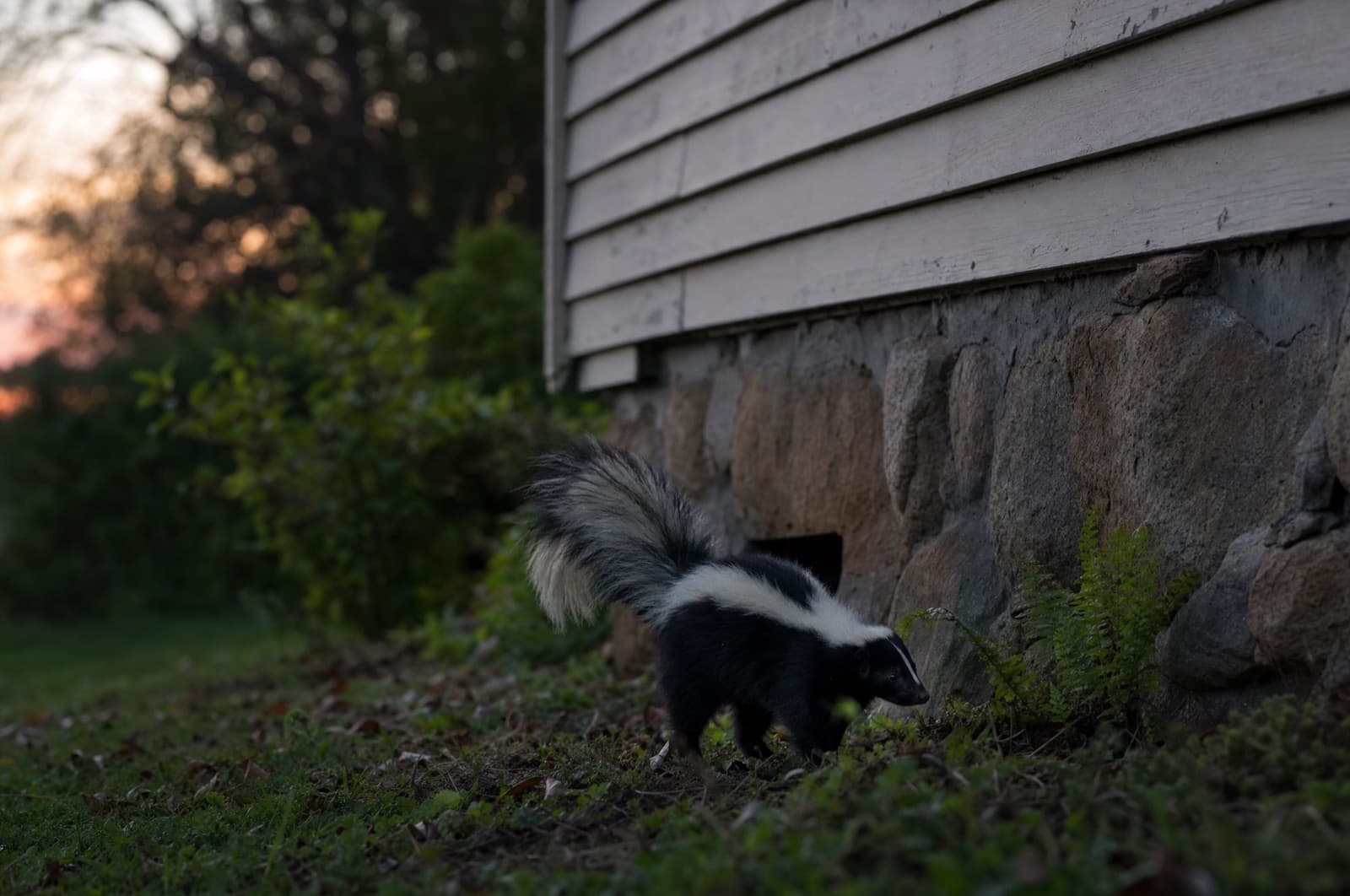
Why Does My House Smell Like Skunk? Causes and Solutions
If the smell is indoors, gassy, or near a gas appliance or meter, treat it as a possible natural-gas leak first — the sulfur compound added to natural gas so leaks are detectable is genuinely mistaken for skunk musk. Leave the building, don't flip switches, and call your gas utility or 911 before assuming it's an animal. Once that's ruled out — or if the smell is clearly outdoor, nighttime, and seasonal — actual skunk spray is the most likely cause, especially in late winter through early spring breeding season, and a persistent musk concentrated at one corner of your house often means a skunk denning underneath a deck, porch, or shed rather than just passing through.
Outdoors, at night, in late winter or early spring — a skunk smell almost always means an actual skunk, spraying nearby or denning under a deck, porch, or shed. But there's one honest and important exception: the odorant added to natural gas to make leaks detectable is a well-documented skunk-smell mimic, and if what you're smelling is indoors or gassy rather than a clear outdoor, seasonal pattern, that possibility needs to be ruled out first.
At a Glance
- Diagnosing: Skunk-like smell
- Top cause: Gas
- Safety: A real hazard may apply — read the red band below
mid-February–mid-March
NH striped-skunk mating season, when musk odor around homes spikes
UNH Extension
up to ~16 feet
Distance a skunk can accurately spray, so keep your distance
UNH Extension
Actual skunk spray, outdoors and seasonal — but a skunky smell indoors or near a gas line should be ruled out as a possible natural-gas leak first.
Ranked causes — and how to tell them apart
Like a doctor's differential: the candidate causes for this smell, ranked most-likely first, each with the tell-tale sign that distinguishes it and who actually fixes it.
- Most likelyPest
Skunk spray outdoors
How to tell it's this
An unmistakable musk outside the house, strongest at night or early morning, often peaking in late-winter breeding season or after a pet gets sprayed.
Who fixes itYou can handle itUsually resolves on its own outdoors, but is unmistakable while it lasts.
- PossibleGas
Natural-gas leak (mercaptan) mistaken for skunk
How to tell it's this
The smell is indoors, gassy, and possibly paired with a hissing sound near a gas appliance or line — it doesn't match an outdoor, nighttime, seasonal pattern.
Who fixes itGas utilityRule this out first, before assuming it's an animal — leave and call the utility/911.
- PossiblePest
Skunk denning under a deck, porch, shed, or crawl space
How to tell it's this
Persistent musk concentrated at one corner of the structure, cone-shaped digging holes in the lawn (skunks dig for grubs), and scratching or rustling under the deck at night.
Who fixes itPest → AnchorWildlife exclusion — evict humanely, then seal the space so it can't re-enter.
- PossibleHVAC
Skunk musk drawn indoors via HVAC or crawl-space air
How to tell it's this
An outdoor spray event nearby, followed by the smell riding indoors through air intakes or a crawl-space connection.
Who fixes itYou can handle itVentilate; if an animal is denning under or into the structure, that needs wildlife exclusion.
- Less likelyPlumbing / Sewer
Other sulfur mimics (sewer gas)
How to tell it's this
A rotten-egg smell from a specific drain rather than the classic musky skunk odor.
Who fixes itPlumberRefill the drain trap first; call a plumber if it persists.
What each clue points to
Notice one of these and you can narrow the differential fast.
- Gas
If you notice: Skunky or sulfur smell indoors, gassy, near a gas appliance or meter
A possible natural-gas leak — leave and call the utility or 911 before assuming it's an animal.
- Pest
If you notice: Classic musk outdoors at night, seasonal, maybe a sprayed pet
Actual skunk spray — usually resolves outdoors on its own.
- Pest
If you notice: Persistent musk at one corner of the house, plus lawn digging and night noises under the deck
A skunk denning underneath — a wildlife-exclusion job.
- Plumbing / Sewer
If you notice: Rotten-egg smell from a drain indoors, not the classic musky skunk note
Sewer gas, not skunk — refill the trap or call a plumber.
How Anchor finds and fixes it
Once a gas leak has been ruled out and the cause is confirmed to be a skunk denning under your deck, porch, or shed, here's how Anchor handles it:
Confirm active denning
An evening exit check — dusting the suspected entrance with flour or dust and looking for tracks after dark — confirms whether the den is active and locates all entry points.
Evict humanely
A one-way door or timed eviction method is used, taking care around breeding season so no young are accidentally sealed inside.
Exclude
Once the den is confirmed empty, galvanized hardware cloth is buried in an outward 'L' shape around the perimeter to stop the skunk (or the next one) from digging back in.
Clean up and neutralize residual musk
Residual odor is treated, and common attractants — grubs, accessible pet food, open compost, unsecured garbage — are addressed so the site doesn't draw another skunk.
Prevent recurrence
Structural skirting around decks and porches, plus reducing yard grubs and rodents that draw skunks in the first place, keeps the problem from repeating.
Once a den is confirmed empty and excluded, the musk smell typically fades over days to a couple of weeks outdoors with normal weathering and airflow.
Skunk denning under your deck or porch?
Anchor's NH wildlife team confirms, evicts humanely, and excludes so it doesn't come back. Free inspection, same-day service.
Who to call for the other causes
The honest routing: when the smell points somewhere other than a pest, here's the right trade and the conservative next step.
- You can handle it
A pet or fabric got sprayed directly
The sulfur-containing thiols in skunk musk can be neutralized with an oxidizing wash — hydrogen peroxide, baking soda, and a small amount of dish soap, mixed fresh and used immediately in an open container (never sealed, since it releases gas), rinsed after a few minutes and repeated as needed. Avoid the eyes and mouth, and note it can lighten dark fur or fabric.
- Plumber
The smell is rotten-egg from a specific drain rather than classic skunk musk
Refill the drain's trap with a quart of water; call a plumber if it persists.
Skunk season in New Hampshire
Striped skunks are common across New Hampshire and den under decks, porches, sheds, and stone walls. Per UNH Extension, striped skunks mate from mid-February through mid-March, and warmer temperatures draw them out of their dens and looking for mates — a period when musk odor around yards and buildings spikes, and Anchor's Southern and Central NH skunk-exclusion calls peak. In New Hampshire, the striped skunk is also a rabies-vector species, so keep your distance and never corner one — spray can reach up to about 16 feet.
NH-licensed applicator #782664 (NHDAMF, RSA 430) · NEPMA member · family-owned since 2017.
Frequently asked
Sources(5)
- [1]Liberty Utilities (NH) — Natural Gas Safety
Mercaptan odorant mistaken for skunk; leave and call the utility/911
utility - [2]CDC — Carbon Monoxide Poisoning: Fact Sheets
CO is a separate, odorless hazard — detectors are the only warning
gov - [3]University of Nebraska–Lincoln Extension — Removing Skunk Odor
Hydrogen peroxide/baking soda/dish soap de-skunking formula; thiol chemistry
extension - [4]UNH Extension — Skunks Active in February?
NH skunk breeding-season timing (mid-February through mid-March)
extension - [5]Cornell University College of Veterinary Medicine — What to Do When Your Dog Gets Skunked
De-skunking formula for a sprayed pet
academic
Written & reviewed by
VerifiedDaniel Brady
NH-Licensed Pesticide Applicator · License #782664 (NHDAMF, RSA 430)
Daniel Brady is the New Hampshire–licensed applicator behind Anchor Pest Services, a family-owned pest control company serving the Manchester area since 2017.
Last updated 2026-07-14
Wildlife Exclusion & Odor Removal
Rule Out Gas First — Then We'll Handle the Skunk
A skunky smell indoors deserves a gas check first. Once that's cleared, if a skunk is denning under your structure, Anchor Pest Services evicts it humanely and seals the space, across southern and central New Hampshire. Family-owned since 2017, NH license #782664.
- Honest gas-leak ruling-out first
- Humane eviction + hardware-cloth exclusion
- Same-day service across Manchester, Nashua, Concord
NH License #782664 · No obligation · We answer in person
Your next step
- Book a NH pro
Pest Control Services
Licensed, family-owned pest control across southern NH.
Book now - Related guide
What Is That Smell Outside My Home? Yard, Porch & Outdoor Odors Explained
Read the answer - Related guide
What Is That Smell in My Walls or Ceiling?
Read the answer - Related guide
Why Does It Smell After Pest Treatment? What's Normal and What's Not
Read the answer - Related guide
What Is That Smell in My Basement? Common Causes and Fixes
Read the answer - Related guide
Why Do My Vents Smell Bad? Common Causes and How to Fix Them
Read the answer