
How to Prevent Termites in a Home Addition Where New Wood Meets Old Framing
This is the storage-and-remodel page where the risk framing is most legitimately elevated — an addition creates new soil-contact points at footings and backfill, new wall and floor junctions, and Extension entomology documents this as a genuine conducive condition when the addition disturbs or bypasses existing protection.
Real risk, and one where getting the detailing right during construction is worth far more than trying to correct it after the walls are closed.
At a glance
- What it is: Real termite risk
- The driver: New soil-contact points created during construction
- Who fixes it: A moisture or building pro
This is the storage-and-remodel page where the risk framing is most legitimately elevated — an addition creates new soil-contact points at footings and backfill, new wall and floor junctions, and Extension entomology documents this as a genuine conducive condition when the addition disturbs or bypasses existing protection.
Real risk, and one where getting the detailing right during construction is worth far more than trying to correct it after the walls are closed.
Pull the right lever, not the sprayer
The organism is downstream of one condition. Remove that condition and it has no foothold — which is why prevention here is rarely a pesticide.
The driver
New soil-contact points created during construction
Extension entomology lists adding an addition to a building without having it treated, and digging or disturbing an existing band of treated soil, among named conducive conditions for termite activity. New footings, grade changes, and buried construction debris create fresh entry routes exactly where new framing ties into old, at a junction that's rarely revisited once the project is finished.
Source:Mississippi State University Extension— Termite Conducive Conditions (Bug's Eye View)
4 levers, honestly ranked
Sorted by what actually moves the driver — primary first, theatre last. Effort is graded so you know what's a five-minute fix and what's a real project.
- Primary — moves the driverHire a pro
Design out wood-to-soil contact and remove all buried wood debris
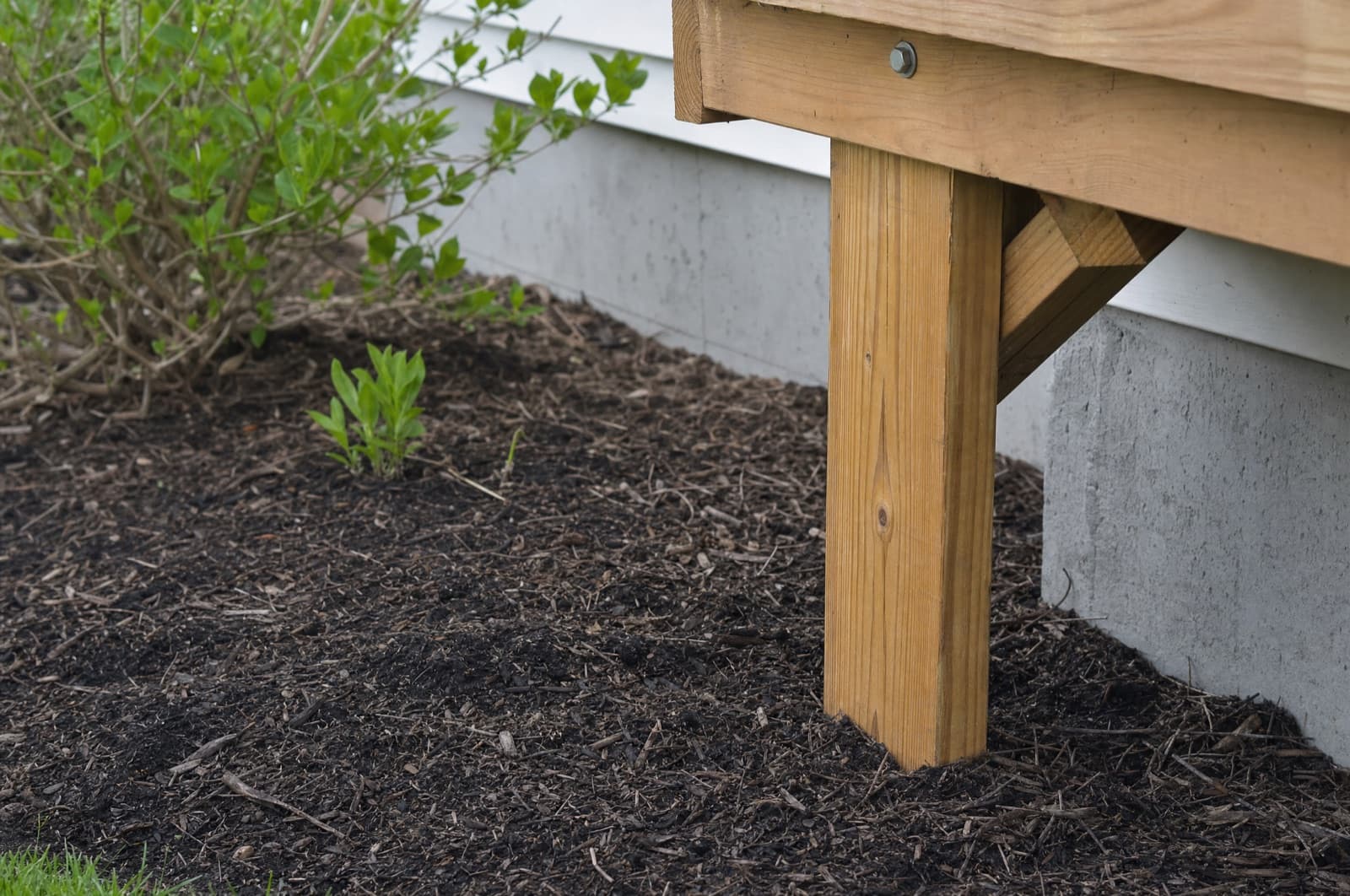
Ensure the addition's sill and framing sit well above grade on the foundation — a common Extension standard is at least six inches of siding-to-soil clearance, and eighteen inches or more between crawlspace beams or joists and soil. Remove every wooden stake, form board, and construction scrap from the soil before backfilling; any untreated wood left buried in the ground constitutes a recognized high risk. Burying no cellulose within the construction zone removes the driver at the source, before it can ever become a problem.
- Primary — moves the driverHire a pro
Have the disturbed soil band and new interface evaluated by a licensed pro
Because excavation and grade changes disturb any existing soil protection, a licensed pest applicator should evaluate the new perimeter and the interface between old and new construction. Where a soil termiticide barrier previously existed, disturbing it without re-treatment is itself a named conducive condition, and the product and method decisions here belong to the applicator, not a DIY step.
- SupportingHire a pro
Consider borate treatment of new bare framing during the dried-in stage
Borate wood treatment of exposed new framing is a recognized supplemental measure, applied before insulation and drywall go in. It protects dry, undisturbed wood and is applied by a licensed pest professional as part of the construction sequence, not something a homeowner sprays on themselves.
- SupportingHire a pro
Detail the new-to-old junction to drain and stay dry
Flash and grade so the addition sheds water away from both the new and existing foundation. A chronically wet junction where old and new framing meet is the moisture half of the driver, and getting the flashing and grading right during construction prevents it from developing later.
Whose job is this, really?
Who actually fixes it
A moisture or building pro
Framing, grading, and debris removal are contractor and building-professional work during construction; a licensed pest professional should separately evaluate the disturbed soil band and any prior treatment before the project is closed up.
Excavation exposes existing mud tubes or damage, or the addition disturbs a prior soil treatment — coordinate a pest professional's evaluation before framing is closed in.
How this calibrates for NH
New-construction detailing — proper clearances and thorough debris removal — is the durable defense in southern New Hampshire, an area of slight-to-moderate termite probability under HUD/IRC classification; getting it right during the build is worth years of avoided worry compared with correcting it afterward.
NH-licensed applicator #782664 (NHDAMF, RSA 430) · NEPMA member · family-owned since 2017.
Frequently asked
Sources(4)
- [1]Mississippi State University Extension
Termite Conducive Conditions (Bug's Eye View, 2023)
- [2]Mississippi State University Extension
Methods of Termite Control
- [3]Building America Solution Center (DOE/PNNL)
Termite-Resistant Foundations and Walls
- [4]University of Kentucky Entomology
ENT-605: Protecting Your Home Against Termites
Written & reviewed by
VerifiedDaniel Brady
NH-Licensed Pesticide Applicator · License #782664 (NHDAMF, RSA 430)
Daniel Brady is the New Hampshire–licensed applicator behind Anchor Pest Services, a family-owned pest control company serving the Manchester area since 2017.
Your next step
- termite-mite-prevention-guides
Preventing termites when replacing subflooring and floor joists
Read the answer - termite-mite-prevention-guides
Preventing termites around a concrete slab foundation
Read the answer - termite-mite-prevention-guides
Preventing termites in a crawl space
Read the answer - faq-pest-damage-and-risks
How do termite infestations weaken homes over time?
Read the answer
Anchor Pest Services
Have a different pest question?
This one may not be a pesticide job — but if you're facing something that is, we serve Southern New Hampshire with a free inspection and same-day service.
- NH-licensed applicator
- Same-day service
- Pet & family-conscious
NH License #782664 · No obligation · We answer in person