
How to Prevent Termites in a Wooden Deck Attached to a House
This is a genuine risk, and a higher-consequence one than a freestanding yard structure — the deck's posts, stringers, and especially the ledger board form a continuous wood path from soil straight into the house framing.
Real and worth inspecting the post bases and ledger connection, but this is not a reason to fear the whole house is compromised. Most attached decks correct in a weekend of building work.
At a glance
- What it is: Real termite risk
- The driver: A continuous wood path from soil to the house framing
- Who fixes it: A moisture or building pro
This is a genuine risk, and a higher-consequence one than a freestanding yard structure — the deck's posts, stringers, and especially the ledger board form a continuous wood path from soil straight into the house framing.
Real and worth inspecting the post bases and ledger connection, but this is not a reason to fear the whole house is compromised. Most attached decks correct in a weekend of building work.
Pull the right lever, not the sprayer
The organism is downstream of one condition. Remove that condition and it has no foothold — which is why prevention here is rarely a pesticide.
The driver
A continuous wood path from soil to the house framing
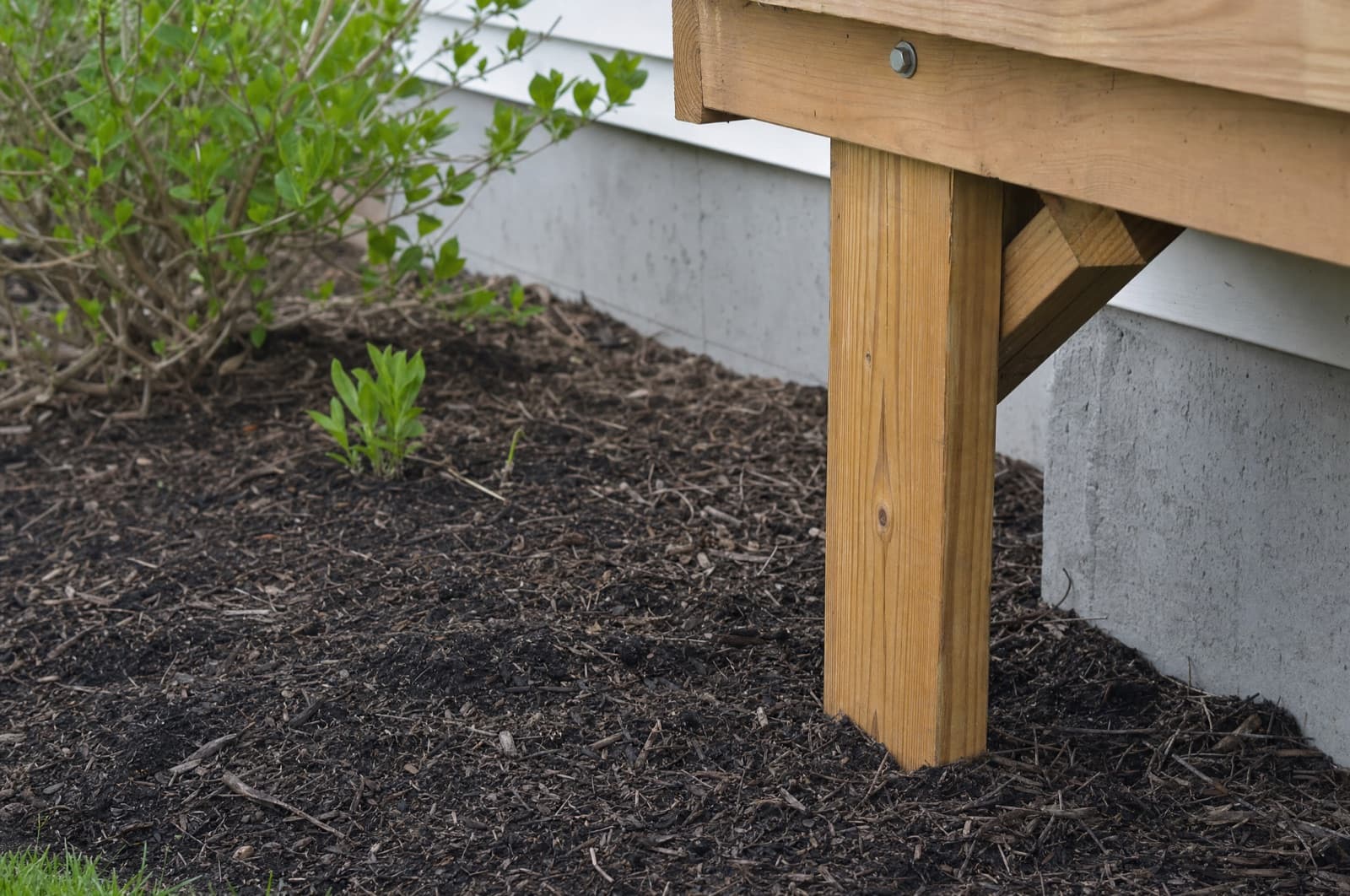
Deck posts embedded in or resting on soil, and stairs or skirting touching grade, give termites a concealed vertical route; because the deck is bolted to the house, that route connects directly to the rim joist and sill. Post bases, beam ends, and the shaded ledger connection stay damp and are rarely inspected, which is exactly the combination subterranean termites need.
Source:University of Kentucky Entomology— ENT-605: Protecting Your Home Against Termites
4 levers, honestly ranked
Sorted by what actually moves the driver — primary first, theatre last. Effort is graded so you know what's a five-minute fix and what's a real project.
- Primary — moves the driverWeekend project
Break wood-to-soil contact at every post
Posts should bear on concrete footings or metal post-base anchors that hold the wood above grade, never buried in soil or set in a concrete collar that wicks moisture into the wood core. Where posts are already embedded, a building professional can retrofit brackets to lift them. Extension guidance is explicit that even pressure-treated posts fail this way, because treatment often does not reach the center and termites enter through the unprotected cut end at the base — so separation from soil matters more than the wood grade.
- Primary — moves the driverHire a pro
Keep the ledger and framing dry and detailed correctly
The ledger board is the deck-to-house junction; proper flashing that sheds water away from the ledger and the house rim keeps this hidden connection from staying chronically damp, which is the condition that lets a colony move from deck into structural wood. A moisture or building professional should verify the flashing and confirm no soil or mulch is banked against the ledger zone.
- SupportingWeekend project
Maintain clearance and drainage under the deck
Keep the soil under the deck graded to drain, remove stored wood and debris from underneath, and keep at least a six-inch visible gap between soil or mulch and any wood or siding so mud tubes on posts and the foundation stay detectable.
- SupportingWeekend project
Use ground-contact-rated or non-wood materials at grade
Where replacement is planned, building stairs and skirting in composite, ground-contact-rated lumber, or on a concrete or gravel base reduces the easy entry point. This deters activity — it does not immunize the deck, and cut ends and connections still need periodic checking.
Whose job is this, really?
Who actually fixes it
A moisture or building pro
Clearance, drainage, and clearing debris are homeowner-level, but footings, post anchors, and ledger flashing are structural work best handled by a building or moisture professional so the deck-to-house junction is done correctly the first time.
You see mud tubes on posts or the foundation, soft or hollow post bases or stringers, or swarmers near the deck — call a licensed pest professional for an inspection.
How this calibrates for NH
In New Hampshire's freeze-thaw climate, deck posts and stairs sitting in wet soil rot for the same reason they attract termite interest: sustained moisture. That overlap means the fixes for wood rot and for subterranean termite risk are largely the same, in a state where the Eastern subterranean termite sits near the northern edge of its persistent range in the southern counties.
NH-licensed applicator #782664 (NHDAMF, RSA 430) · NEPMA member · family-owned since 2017.
Frequently asked
Sources(4)
- [1]University of Kentucky Entomology
ENT-605: Protecting Your Home Against Termites
- [2]Mississippi State University Extension
Methods of Termite Control
- [3]U.S. EPA
Termites: How to Identify and Control Them
- [4]Building America Solution Center (DOE/PNNL)
Termite-Resistant Foundations and Walls
Written & reviewed by
VerifiedDaniel Brady
NH-Licensed Pesticide Applicator · License #782664 (NHDAMF, RSA 430)
Daniel Brady is the New Hampshire–licensed applicator behind Anchor Pest Services, a family-owned pest control company serving the Manchester area since 2017.
Your next step
- termite-mite-prevention-guides
Preventing termites in wooden stairs and stringers near ground level
Read the answer - termite-mite-prevention-guides
Preventing termites around HVAC condensate lines and drip areas
Read the answer - termite-mite-prevention-guides
Preventing termites around downspouts, splash blocks, and poor drainage
Read the answer - faq-pest-damage-and-risks
Why do termites target wooden structures?
Read the answer
Anchor Pest Services
Have a different pest question?
This one may not be a pesticide job — but if you're facing something that is, we serve Southern New Hampshire with a free inspection and same-day service.
- NH-licensed applicator
- Same-day service
- Pet & family-conscious
NH License #782664 · No obligation · We answer in person