
Skip to content
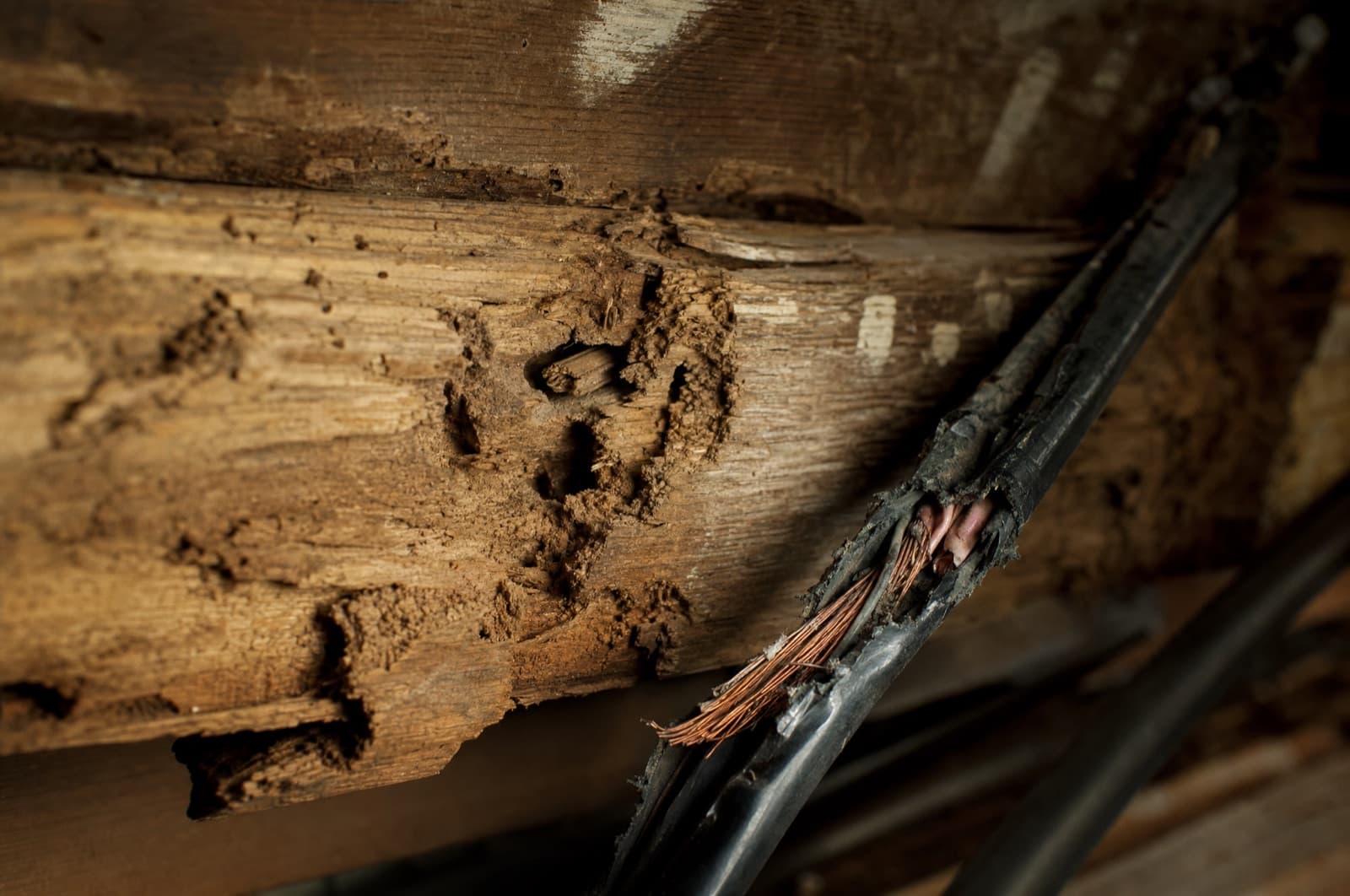
Pest damage evidence — a gnawed structural beam and a chewed electrical wire
Daniel Brady · NH-Licensed Pesticide Applicator · License #782664
Reviewed by Daniel Brady

Why do termites target wooden structures?

Structural — cellulose is food, and a house frame is just concentrated cellulose near soil
Because wood is food, and termites are built to find it wherever it is. Eastern subterranean termites — the only termite species established in New Hampshire — rely on gut-dwelling protozoa to digest wood's cellulose into usable sugars; without those symbionts, they cannot process wood at all. Colonies live underground and send foraging workers outward searching indiscriminately for any accessible cellulose source in contact with, or near, damp soil. A home's sill plates, floor joists, and framing are simply the largest, most convenient cellulose source most colonies encounter — not a target chosen with any intent. Understanding that mechanism also tells you exactly what is and isn't at risk: cellulose near soil moisture, and nothing else.

At a glance

  • Can it?: Yes
  • How common: Occasional
  • Hype: About right
  • Evidence: Well documented
The honest answer

The short of it

The verdict
Structural — cellulose is food, and a house frame is just concentrated cellulose near soil

Subterranean termites target wooden structures because wood is concentrated cellulose and their gut protozoa can digest almost nothing else — foraging workers seek any cellulose near soil moisture, and a sill plate is no different to them than a fallen log.

The correction

What they claim vs. what the evidence supports

One shared severity track, two markers. The span between them is the hype delta — named out loud.

The claim — the claim that termites 'seek out and attack' homes specifically

That termites deliberately target homes, hunting them out and attacking with intent — implying a house is a specific object of pursuit rather than an incidental food source a foraging colony happens to reach.

Where the claim comes from: Pest-marketing copy that anthropomorphizes foraging behavior into deliberate 'attack' and 'hunt' language.

Severity, 0–100
Hype says80
70Evidence says
The hype is fairWell documented
The evidence

Eastern subterranean termites feed on cellulose because gut protozoa — present in this 'lower' termite lineage — secrete the cellulase and cellobiase enzymes needed to digest it; without those symbionts, termites cannot process wood and would starve. Foraging workers fan out from an underground colony searching indiscriminately for any cellulose source in contact with, or near, soil moisture. Structural wood near soil is simply the largest, most convenient cellulose source most colonies encounter — not a specifically chosen target.

The gap

The threat itself is not overstated — termites really do consume structural wood, and this is one of the cluster's earned fears. The only real distortion is the word 'target': it implies intent and pursuit, when the actual mechanism is blind, indiscriminate foraging for cellulose that happens to include your sill plate.

Damage assessment

What is actually harmed

Damage verdict
Structural — cellulose is food, and a house frame is just concentrated cellulose near soil
StructuralCan it?Yes
The specimen
Pest
Eastern subterranean termites (Reticulitermes flavipes) — the only termite species established in New Hampshire
What is in question
Any cellulose-containing material in or near soil contact: sill plates, floor joists, subflooring, framing, paper, and cardboard
How common
Occasional
Evidence
Well documented
Mechanism

Termite workers cannot digest cellulose on their own — Reticulitermes species depend on gut-dwelling flagellate protozoa that secrete cellulase and cellobiase to break wood cellulose down into usable sugars, a symbiotic relationship termites cannot survive without. Colonies live in soil and forage outward through mud tubes, searching for any accessible cellulose; because wood in contact with, or close to, damp soil is both structurally common and easy to reach, home framing becomes an especially convenient target. The 'targeting' is a resource search driven by biology, not a decision made about your specific house.

Actually at risk3
  • Sill plates, floor joists, subflooring, wall studs, and girders near soil contact or persistent moisture
  • Paper, cardboard, and cellulose insulation anywhere termites can reach them
  • Wooden fence posts, deck posts, and landscape timbers in ground contact
Not at risk — despite the myth3
  • Concrete, masonry, and metal — termites tunnel around these but cannot eat or digest them
  • Wood with no soil contact and no sustained moisture source — the colony needs that access route to reach it
  • Homes with no Eastern subterranean termite presence at all — drywood and Formosan termites, whose damage profiles are often more dramatic, are not established in New Hampshire
Worst realistic case
Extensive, undetected framing consumption over several years where wood-to-soil contact and moisture were never addressed — a genuine structural concern, but one that develops over years, not overnight.

Assessed from: Utah State University Extension subterranean termites; Britannica termite nutrition; Connecticut Agricultural Experiment Station Eastern Subterranean Termite fact sheet

Repair scope

Who actually fixes this

Scope, not dollars — the honest answer to “how expensive is it,” routed to the right trade.

Who fixes it
Pest pro first
Effort
A project

Termite colonies require professional soil treatment or a bait system — there is no homeowner-grade fix, and any structural rebuild only makes sense once the colony is actually eliminated.

The right order
  1. 1
    Confirm active termite presence — mud tubes, damaged wood, or swarmers
  2. 2
    Treat with a soil termiticide barrier or bait system
  3. 3
    Address wood-to-soil contact and moisture conducive conditions
  4. 4
    Bring in a licensed contractor for any framing repair
Where we help — and where we don't

Termite prevention and treatment — including addressing wood-to-soil contact and moisture — is core Anchor work. The structural rebuild itself routes out to a licensed contractor.

In depth

The full picture

01

The mechanism: why wood is food at all

Termites can't digest cellulose on their own — no animal can, without help. Eastern subterranean termites belong to a 'lower' termite lineage that carries flagellate protozoa in the hindgut, and those protozoa secrete the cellulase and cellobiase enzymes that actually break wood cellulose down into digestible sugars. Britannica states plainly that without these symbionts, termites would starve. That single biological fact explains the entire behavior: a termite colony isn't choosing to eat wood out of many options — cellulose is nearly the only food source its digestive system is built to use, and wood is concentrated cellulose.

02

Why 'target' is the wrong verb

Foraging workers leave the underground colony through mud tubes and search outward for any accessible cellulose, moving essentially at random relative to what's above ground — a fallen log, a wood pile, a fence post, or a home's sill plate are functionally the same to a foraging termite. There's no scouting behavior aimed at houses specifically, no preference for a particular building, and no intent behind which structure gets found. What determines whether a home is affected is simply whether it offers the conditions a colony needs to reach it: wood in or near soil contact, combined with enough moisture to sustain feeding.

03

What this means for what's actually at risk

Because the mechanism is a search for cellulose near soil moisture, that combination is also the honest boundary of the risk. Sill plates, floor joists, subflooring, and any wood in ground contact are genuinely exposed. Concrete, masonry, and steel are not — termites will tunnel around these materials but cannot eat or digest them under any circumstance. And wood that has no soil contact and stays dry is largely outside a colony's practical reach, which is exactly why moisture control and wood-to-soil separation are the two most effective preventive measures a homeowner can take.

04

Why New Hampshire's termite pressure looks the way it does

Only one termite species, the eastern subterranean termite, is established in New Hampshire; the state sits in a moderate pressure zone by industry classification, and drywood and Formosan termites — species responsible for some of the more dramatic damage figures circulating nationally — are not present here at all. New Hampshire's cold winters also slow termite feeding activity for several months each year, which is one more reason the honest structural timeline in this state runs in years rather than the fast-moving picture sometimes implied by national marketing.

Key takeaways
5 points
  • Termites can't digest wood cellulose without gut protozoa that secrete cellulase and cellobiase — the biology behind the entire behavior.
  • Foraging is indiscriminate: a colony searches for cellulose near soil moisture, not for houses specifically.
  • Wood-to-soil contact and moisture are the two conditions that determine whether a home is reached at all.
  • Concrete, masonry, and metal are never at risk — termites cannot digest them under any circumstance.
  • Only the eastern subterranean termite is established in New Hampshire; drywood and Formosan termites are not present here.
New Hampshire context

What this looks like in New Hampshire homes

Southern New Hampshire sits in a moderate termite-pressure zone, and the classic local setup is wood-to-soil contact — an untreated deck post, a wood pile against the foundation, or original sill plates close to grade — combined with the seasonal moisture from snowmelt and spring rain. New Hampshire's winters slow termite foraging and feeding significantly for several months, which is one reason the honest structural timeline here runs in years rather than the faster pace sometimes seen in warmer termite-pressure regions.

  • NH-licensed #782664

    Southern New Hampshire

  • Family-owned

    Since 2017

  • Honest routing

    Even when it isn’t us

We serve these communities

ManchesterNashuaConcordDerryBedfordSalemHudsonAmherstAuburnGoffstownHooksettLitchfieldLoudonMilfordBristol

Service Area Map

Southern New Hampshire

BristolPop. 3,200LoudonPop. 5,500ConcordPop. 43,900HooksettPop. 14,800GoffstownPop. 18,000AuburnPop. 5,700ManchesterPop. 115,600BedfordPop. 23,300LitchfieldPop. 8,500AmherstPop. 11,300DerryPop. 34,500MilfordPop. 15,700HudsonPop. 25,600NashuaPop. 91,100SalemPop. 30,000HQCityHover for info

Wood-to-soil contact on your property? That's the condition termites actually need.

Anchor identifies and treats the conditions that let a foraging termite colony reach your home — before it becomes a multi-year structural concern.

Follow-up questions

Frequently asked

Sources & citations(3)
  1. Utah State University Extension — Subterranean Termites

    Termite dependence on gut protozoa for cellulose digestion

    extensionverified 2026-07-16
  2. Britannica — Termite: Nutrition

    Flagellate protozoa secreting cellulase and cellobiase; termites would starve without these symbionts

    academicverified 2026-07-16
  3. Connecticut Agricultural Experiment Station — Eastern Subterranean Termite fact sheet

    Eastern subterranean termite biology, foraging behavior, and susceptible framing components

    govverified 2026-07-16

Written & reviewed by

Verified

Daniel Brady

NH-Licensed Pesticide Applicator · License #782664 (NHDAMF, RSA 430)

Daniel Brady is the New Hampshire–licensed applicator behind Anchor Pest Services, a family-owned pest control company serving the Manchester area since 2017.

Verify license

Last updated Jul 2026

Honest pest help for New Hampshire homes

Termites Don't Hunt Houses. They Find Wood Near Soil.

Understanding why termites end up in a home's framing is the first step to preventing it — wood-to-soil contact and moisture are the two conditions that matter. Anchor Pest Services treats active colonies and helps eliminate those conditions; the structural rebuild, if one is ever needed, goes to a licensed contractor. Family-owned since 2017, NH license #782664, serving Manchester, Nashua, Concord and nearby towns.

  • Honest advice — we explain the mechanism, not just sell a treatment
  • NH-licensed applicators (#782664) — free inspection, same-day service
  • Termite treatment and prevention across southern and central New Hampshire

NH License #782664 · No obligation · We answer in person