
How to Prevent Termites in Wooden Stairs and Stringers Near Ground Level
This is a genuine risk — exterior wooden stairs and stringers landing on soil are one of the most frequently cited termite entry points, because the stringer bottom and any support post sit right at grade and often abut the house directly.
Real risk, worth checking, and straightforward to correct. This is a common, low-cost fix rather than a structural emergency.
At a glance
- What it is: Real termite risk
- The driver: Stringers and posts resting on or embedded in soil
- Who fixes it: You can handle this
This is a genuine risk — exterior wooden stairs and stringers landing on soil are one of the most frequently cited termite entry points, because the stringer bottom and any support post sit right at grade and often abut the house directly.
Real risk, worth checking, and straightforward to correct. This is a common, low-cost fix rather than a structural emergency.
Pull the right lever, not the sprayer
The organism is downstream of one condition. Remove that condition and it has no foothold — which is why prevention here is rarely a pesticide.
The driver
Stringers and posts resting on or embedded in soil
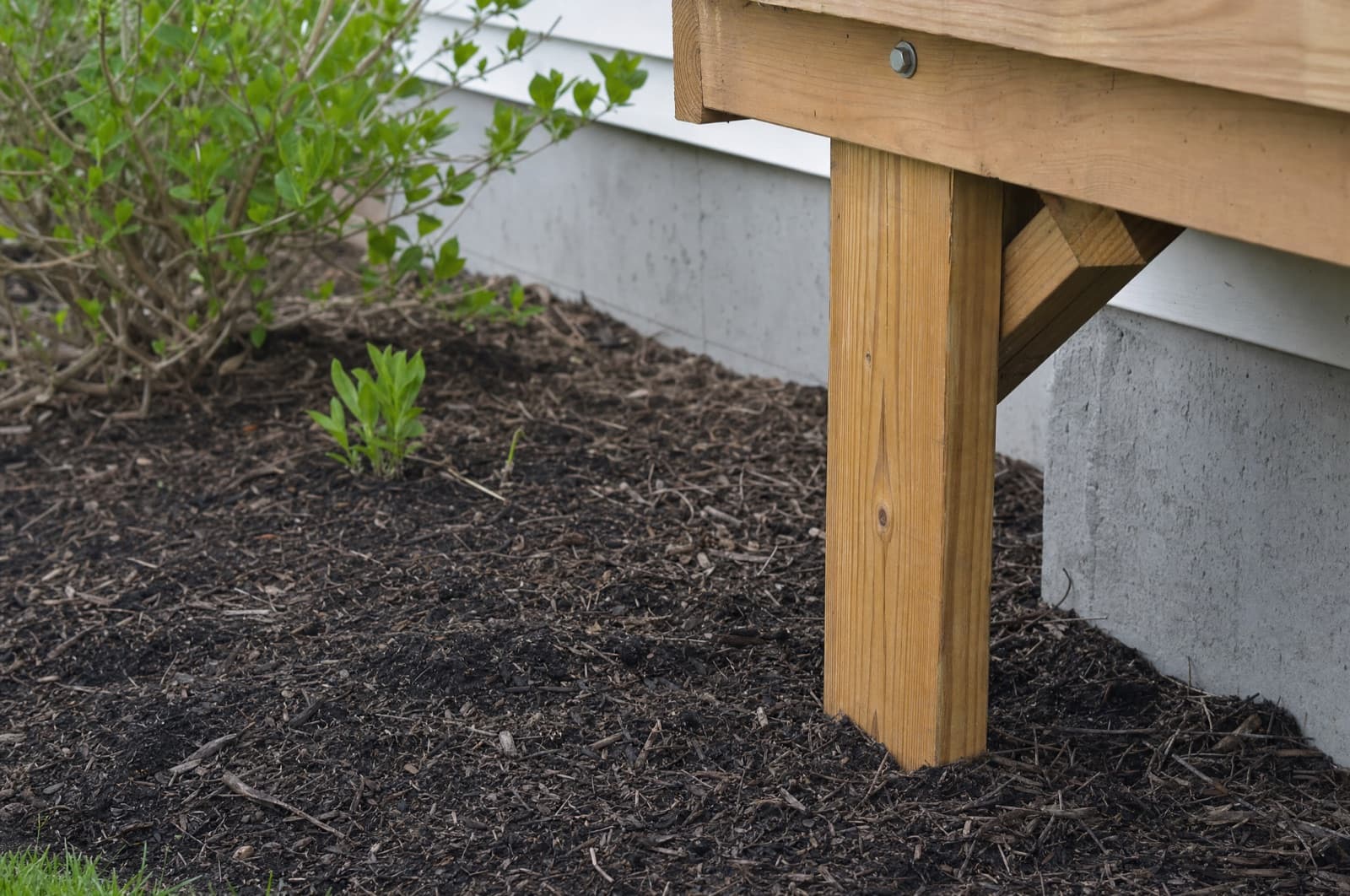
Stringers and stair posts resting on or embedded in soil give termites a direct, hidden climb toward the house. Even stairs sitting on a concrete pad can still be reached where the pad meets the wall, since posts or stairs embedded through concrete usually extend all the way down to the soil beneath.
Source:University of Kentucky Entomology— ENT-605: Protecting Your Home Against Termites
3 levers, honestly ranked
Sorted by what actually moves the driver — primary first, theatre last. Effort is graded so you know what's a five-minute fix and what's a real project.
- Primary — moves the driverWeekend project
Land stringers and posts on concrete above grade, not in soil
Support stairs on a concrete pad or footing with the wood held above the soil line and off the pad surface using metal connectors, and avoid embedding stringers or posts through concrete into the ground below. This is the lever that actually removes the driver; because a stair usually abuts the house, closing this junction also protects the adjacent framing.
- SupportingQuick DIY
Keep the stair base draining and inspectable
Grade so water does not pool at the stair landing, and keep mulch, debris, and vegetation off the stringer ends so you can see mud tubes at the wood-soil or wall junction. The wall gap is where tubes tend to appear even on stairs sitting on a concrete pad, so keeping that gap visible matters as much as the pad itself.
- SupportingWeekend project
Repair or replace with ground-contact-rated or non-wood material at grade
Rot-softened stringers should be replaced promptly; ground-contact-rated lumber or non-wood risers at the base reduce the easy entry point, though this is a deterrent rather than immunity — cut ends still need periodic inspection.
Whose job is this, really?
Who actually fixes it
You can handle this
Drainage and clearance around the stair base are homeowner-level work; re-landing stairs on proper concrete footings is a carpentry job best handled by a moisture or building professional if the existing stringers are embedded in soil.
You see mud tubes climbing the stringer or nearby foundation, hollow or soft stringers, or swarmers at the base — call a licensed pest professional.
How this calibrates for NH
Ground-level wooden steps are ubiquitous on New Hampshire homes and are one of the top wood-to-soil contact points found on a typical property, which makes correcting them a high-value, low-cost prevention step in a region where the Eastern subterranean termite occurs but stays localized to areas with sustained moisture and wood contact.
NH-licensed applicator #782664 (NHDAMF, RSA 430) · NEPMA member · family-owned since 2017.
Frequently asked
Sources(3)
- [1]University of Kentucky Entomology
ENT-605: Protecting Your Home Against Termites
- [2]UF/IFAS Extension
ENY-2044/IN1277: Termite Prevention and Control
- [3]U.S. EPA
Termites: How to Identify and Control Them
Written & reviewed by
VerifiedDaniel Brady
NH-Licensed Pesticide Applicator · License #782664 (NHDAMF, RSA 430)
Daniel Brady is the New Hampshire–licensed applicator behind Anchor Pest Services, a family-owned pest control company serving the Manchester area since 2017.
Your next step
- termite-mite-prevention-guides
Preventing termites in a wooden deck attached to a house
Read the answer - termite-mite-prevention-guides
Preventing termites where porch steps have wood-to-soil contact
Read the answer - termite-mite-prevention-guides
What to check if mud tubes appear on a foundation wall
Read the answer - faq-pest-damage-and-risks
Why do termites target wooden structures?
Read the answer
Anchor Pest Services
Have a different pest question?
This one may not be a pesticide job — but if you're facing something that is, we serve Southern New Hampshire with a free inspection and same-day service.
- NH-licensed applicator
- Same-day service
- Pet & family-conscious
NH License #782664 · No obligation · We answer in person