
How to Prevent Termites in Landscape Timbers and Garden Beds Near a Home
This is a genuine risk — wooden landscape timbers and railroad-tie bed borders are untreated or marginally treated wood lying directly in moist soil, which is a textbook feeder site for a subterranean colony.
Real, and Extension guidance on this one is blunt: avoid wooden edging near the house. The fix is a straightforward materials swap, not an emergency.
At a glance
- What it is: Real termite risk
- The driver: Wood edging and timbers buried in damp soil
- Who fixes it: You can handle this
This is a genuine risk — wooden landscape timbers and railroad-tie bed borders are untreated or marginally treated wood lying directly in moist soil, which is a textbook feeder site for a subterranean colony.
Real, and Extension guidance on this one is blunt: avoid wooden edging near the house. The fix is a straightforward materials swap, not an emergency.
Pull the right lever, not the sprayer
The organism is downstream of one condition. Remove that condition and it has no foothold — which is why prevention here is rarely a pesticide.
The driver
Wood edging and timbers buried in damp soil
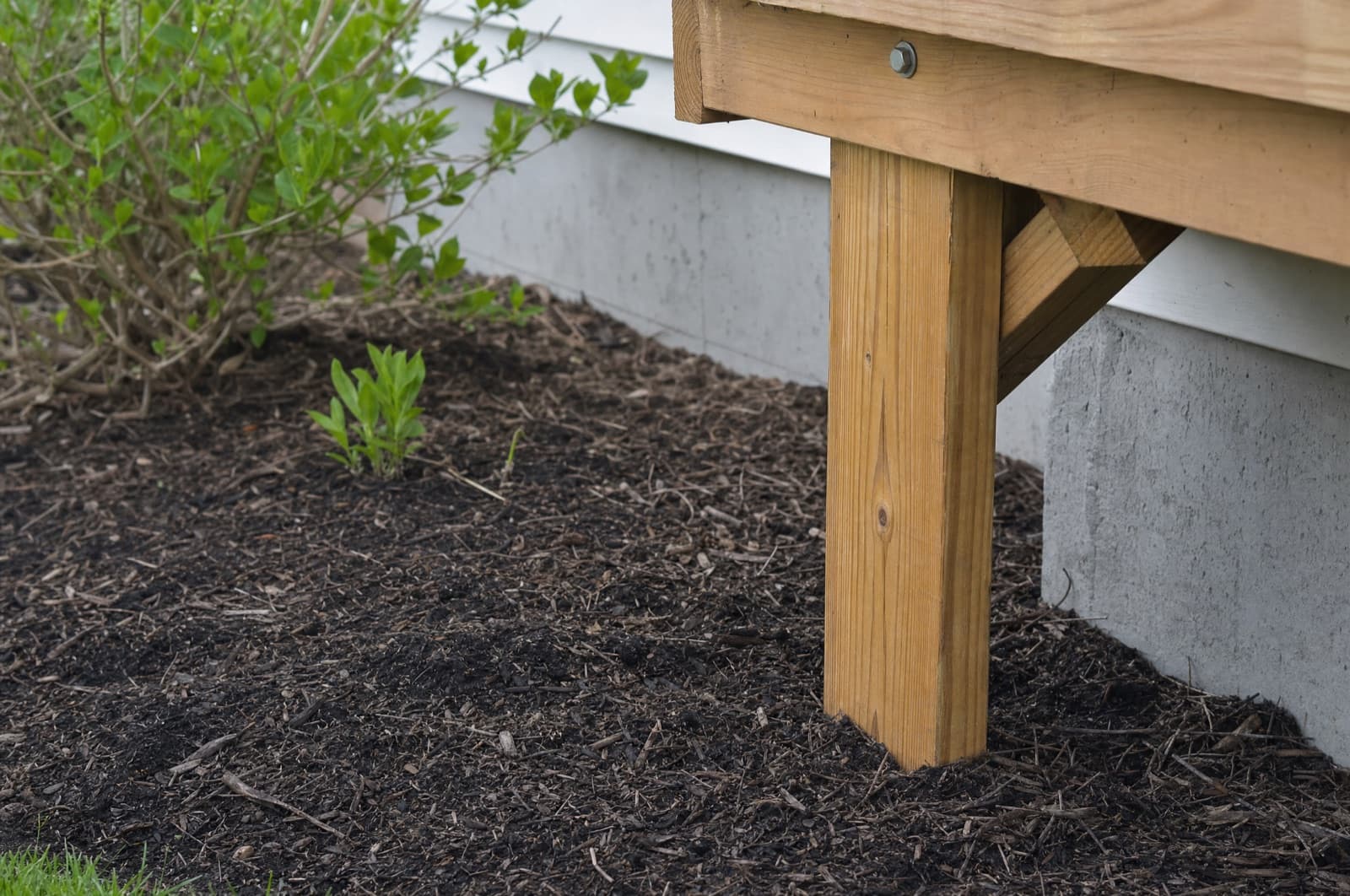
Timbers, ties, and bed borders sit in damp soil and rot, becoming especially attractive to foraging termites; raised beds banked against the foundation also let soil or mulch bridge over the base of the wall, hiding the entry point. University Extension guidance states plainly to place landscape plants at least two feet away from exterior walls and to avoid using wooden landscape timbers for edging near the house.
Source:UF/IFAS Extension— ENY-2044/IN1277: Termite Prevention and Control (Faith Oi et al.)
3 levers, honestly ranked
Sorted by what actually moves the driver — primary first, theatre last. Effort is graded so you know what's a five-minute fix and what's a real project.
- Primary — moves the driverWeekend project
Replace wooden edging with non-cellulose materials
Use metal edging, stone, brick, or concrete pavers for bed borders near the house instead of timbers or ties; this removes the in-ground food source entirely. Where timbers must stay for structural retaining, keep them as far from the foundation as design allows and inspect them periodically by probing with a screwdriver for soft, hollow, or soil-packed wood. This is the lever that actually removes the driver — the wood sitting in the soil.
- Primary — moves the driverQuick DIY
Keep beds and mulch off the foundation
Maintain a gap of bare soil or thin ground cover between any bed and the foundation, and don't bank raised beds against the wall, so soil and mulch cannot bridge over the base of the siding and hide entry points. Never let bed soil or mulch contact siding directly.
- SupportingWeekend project
Grade beds to drain away from the house
Shape beds and irrigation so water moves away from the foundation rather than toward it; chronically wet bed soil against the house is the moisture half of the driver, and correcting the grade addresses it directly.
Whose job is this, really?
Who actually fixes it
You can handle this
Swapping edging materials, keeping mulch off the foundation, and general bed maintenance are homeowner-level jobs; regrading a bed that slopes toward the house is better handled with a moisture or building professional.
You see mud tubes running from bed soil up the foundation, or hollow timbers plus signs of activity at the house — call a licensed pest professional. Termites found only in a detached raised-bed border with no sign of moving toward the structure may need no intervention at all.
How this calibrates for NH
Railroad ties and timber edging are common in New Hampshire landscaping, and swapping to stone or metal near the foundation is a durable fix in a state where subterranean termite prevalence is low but genuinely present in the southern counties, near the species' northern range edge.
NH-licensed applicator #782664 (NHDAMF, RSA 430) · NEPMA member · family-owned since 2017.
Frequently asked
Sources(3)
- [1]UF/IFAS Extension
ENY-2044/IN1277: Termite Prevention and Control (Faith Oi et al.)
- [2]University of Kentucky Entomology
ENT-605: Protecting Your Home Against Termites
- [3]Ask Extension (national Extension Q&A)
Detached wood structures with termite activity and no structural connection
Written & reviewed by
VerifiedDaniel Brady
NH-Licensed Pesticide Applicator · License #782664 (NHDAMF, RSA 430)
Daniel Brady is the New Hampshire–licensed applicator behind Anchor Pest Services, a family-owned pest control company serving the Manchester area since 2017.
Your next step
- termite-mite-prevention-guides
Preventing termites where mulch is piled against the foundation
Read the answer - termite-mite-prevention-guides
Preventing termites with dense shrubs against exterior walls
Read the answer - termite-mite-prevention-guides
Preventing termites where irrigation sprays the foundation
Read the answer - faq-pest-damage-and-risks
Why do termites target wooden structures?
Read the answer
Anchor Pest Services
Have a different pest question?
This one may not be a pesticide job — but if you're facing something that is, we serve Southern New Hampshire with a free inspection and same-day service.
- NH-licensed applicator
- Same-day service
- Pet & family-conscious
NH License #782664 · No obligation · We answer in person