
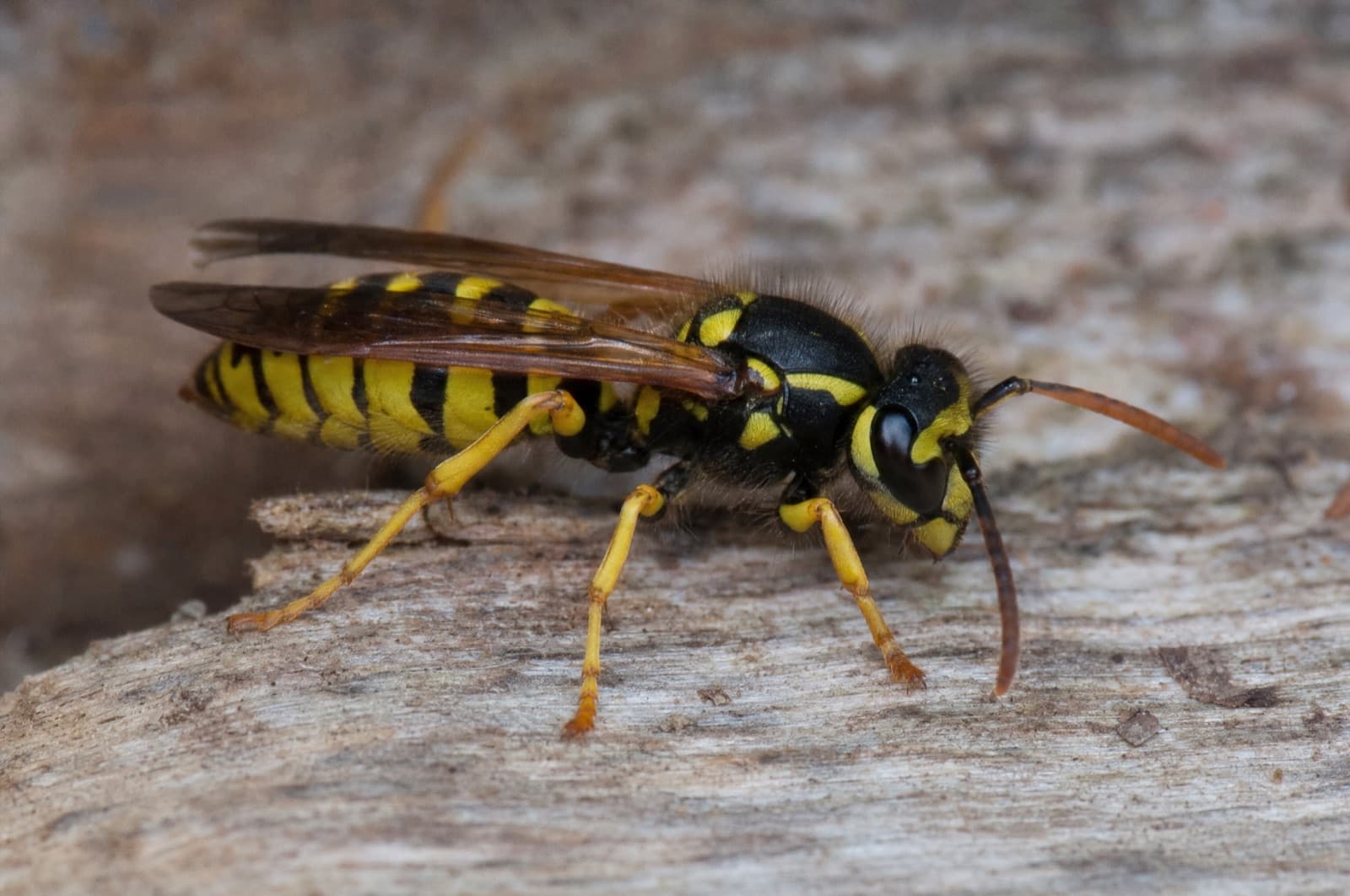
How to Get Rid of Yellowjackets
At a glance
- Difficulty: Pro only
- Time: N/A for nest removal — handled by a pro; ongoing for prevention
- Cost: N/A — free inspection from Anchor for nest removal
- Success: Low and risky for DIY nest treatment; high with professional equipment for the nest itself; high for homeowner prevention/avoidance steps
Can you DIY Yellowjacket?
The verdict on Yellowjacket DIY
Pro-recommended for nest removal — this is the cluster's most defensively aggressive species.
Yellowjackets build enclosed paper nests, most often underground but also in wall voids and cavities, and colonies can exceed 1,000 workers by late summer. They post guards, react to vibration and movement, and release an alarm pheromone that recruits nestmates into a coordinated mass attack — Oklahoma State Extension warns "one will almost certainly be stung if a lawn mower or trimmer is used near a yellowjacket nest." Ground and wall-void nests are also frequently discovered by accident. The DIY-appropriate piece of this job is avoidance, exclusion, and securing food sources; actual nest treatment belongs to a licensed pro, especially for any ground or void nest.
The 5 DIY methods — honestly graded
Every approach graded for this species, in IPM order — prevention first, chemistry late. Pick a method to see how it works, the steps, and what it actually takes.
Prevention / Exclusion
Works wellThe most effective DIY-appropriate track — sealing potential nest sites and removing food sources reduces both new nests and nuisance foraging.
Yellowjackets nest in existing ground cavities, wall voids, and other openings, and are drawn to exposed food, trash, and sugary drinks. Closing off nesting sites in winter/early spring, before queens select a location, and removing attractants cuts down on both new colonies and late-summer nuisance activity around the house.
Best for: Reducing new nests and late-summer nuisance foraging
Seal wall and ground openings early
In winter or early spring, before nesting season starts, seal foundation gaps, wall penetrations, and ground holes/rodent burrows that could become a nest entrance.
CautionNever seal an opening you suspect already has active yellowjacket traffic.Secure food and trash outdoors
Keep trash cans covered, cover food and sugary drinks at outdoor gatherings, and clean up spills promptly, especially in late summer when yellowjackets aggressively forage for sugar.
Locate ground nests before mowing
Walk the lawn and visually check for ground-nest entrances (a steady stream of insects at a small hole) before mowing or trimming near likely spots.
Tools & materials
Why DIY falls short here
Not scare tactics — the specific, proportionate reasons a home attempt can stall for this species.
Mass-response colony defense
An alarm pheromone recruits nestmates to a coordinated group attack when the nest is disturbed, leading to many repeated stings rather than one or two.
Hidden ground and void nests
Ground and wall-void nests are frequently struck by accident — mowing, trimming, or routine yard work — with no warning before the swarm response begins.
Allergy makes this genuinely high-stakes
A single sting can be life-threatening for someone with a known stinging-insect allergy, which is why this is one of the few places in this hub where DIY simply isn't worth gambling on.
How risky is it, really?
An honest read — most nuisance species are genuinely low risk, and we say so.
For the general population, a yellowjacket sting is painful with local pain, redness, and swelling, and multiple stings are possible if a nest is disturbed — a moderate baseline risk, not a blanket death threat. The risk is specifically and genuinely elevated toward anaphylaxis for individuals with a KNOWN stinging-insect allergy, and this conditional framing matters: it is not a claim that everyone faces a severe reaction.
- Multiple stings during a mass colony-defense responseOccasional
Colonies can exceed 1,000 workers by late summer; a disturbed nest can trigger many coordinated stings, not just one
Oklahoma State University Extension
- Accidental nest disturbance during mowing/yard workCommon
Ground nests are easy to strike with a mower or trimmer before noticing them
Oklahoma State University Extension
- Anaphylaxis in individuals with a known stinging-insect allergyRare
Elevated specifically for the allergic subset — per ACAAI, potentially life-threatening reactions occur in 0.4–0.8% of children and about 3% of adults; per CDC MMWR (mm7227a6) there were an average of 72 U.S. deaths per year from hornet/wasp/bee stings during 2011–2021, most involving allergic individuals. This is NOT a claim that every sting is life-threatening for everyone.
CDC MMWR (mm7227a6) / American College of Allergy, Asthma & Immunology
The Cluster's Most Serious Nest — Handle It Safely
Yellowjacket colonies can exceed 1,000 workers and respond to disturbance as a coordinated group. Anchor Pest Services removes ground, void, and wall nests safely across southern and central New Hampshire. Family-owned since 2017, NH license #782664.
Call a pro when…
- Any ground, wall-void, or under-foundation nest — this is pro-only regardless of nest size
- A nest near an entry, walkway, patio, or play area
- You've located a nest before mowing and need it addressed safely
- Anyone in the household has a known stinging-insect allergy
General Pest Control
Nest treatment for an established yellowjacket colony — especially any ground, wall-void, or under-foundation nest — is a professional job. Anchor's licensed technicians have the equipment and protective gear to handle the mass-defense response safely.
Keep them out
- Seal wall and ground openings in winter/early spring before nesting season
- Keep trash covered and food/drinks covered at outdoor gatherings, especially in late summer
- Walk the lawn for ground-nest entrances before mowing or trimming
Yellowjackets in New Hampshire
In New Hampshire, yellowjacket colonies build through spring and summer and peak in size — and aggression — by late summer and early fall, when foraging for sugar (picnics, trash, fallen fruit) intensifies. Colonies die off, except for new queens, around the first hard frost, roughly October 19–29 in Manchester (NOAA); an old paper nest found in winter is inactive and safe to remove, but any nest found during the active season should be routed to a pro.
Peak season
Late summer through early fall, when colonies and aggression peak
First-frost anchor
Manchester first hard frost ~Oct 19 (50%) / Oct 29 (80%), NOAA 1991–2020
Make sure it's a Yellowjacket
Two quick detours worth taking — confirm the ID, then learn what drew it in so it doesn't come back.
Frequently asked
Sources & further reading(6)
- [1]Oklahoma State University Extension — Paper Wasps, Yellowjackets, and Other Stinging Wasps
Colony size, mower-disturbance risk, aggression
extensionverified 2026-07-13 - [2]Oregon State University Extension — Yellowjackets and Wasps
Nest biology, foraging behavior
extensionverified 2026-07-13 - [3]American College of Allergy, Asthma & Immunology — Insect Sting Allergies
Allergic-reaction prevalence figures (0.4–0.8% children, ~3% adults)
medicalverified 2026-07-13 - [4]CDC MMWR — Deaths from Hornet, Wasp, and Bee Stings (mm7227a6)
National sting-fatality data (788 deaths, 2011–2021, avg 72/year)
govverified 2026-07-13 - [5]CDC/NIOSH — Insects and Scorpions (Outdoor Workers)
Epinephrine/medical ID guidance for known-allergic individuals
govverified 2026-07-13 - [6]Cleveland Clinic — Yellow Jacket Sting
Sting symptoms, when to seek emergency care
medicalverified 2026-07-13
Written & reviewed by
VerifiedDaniel Brady
NH-Licensed Pesticide Applicator · License #782664 (NHDAMF, RSA 430)
Daniel Brady is the New Hampshire–licensed applicator behind Anchor Pest Services, a family-owned pest control company serving the Manchester area since 2017.
Last updated July 2026
Other species you can tackle
Same category — the dot shows each one's DIY verdict at a glance (green = friendly, amber = doable with care, red = call a pro).
Professional Pest Control
The Cluster's Most Serious Nest — Handle It Safely
Yellowjacket colonies can exceed 1,000 workers and respond to disturbance as a coordinated group. Anchor Pest Services removes ground, void, and wall nests safely across southern and central New Hampshire. Family-owned since 2017, NH license #782664.
- Licensed NH applicators (#782664)
- Safe removal of ground and wall-void nests
- Free inspection — same-day service across southern NH
NH License #782664 · No obligation · We answer in person