
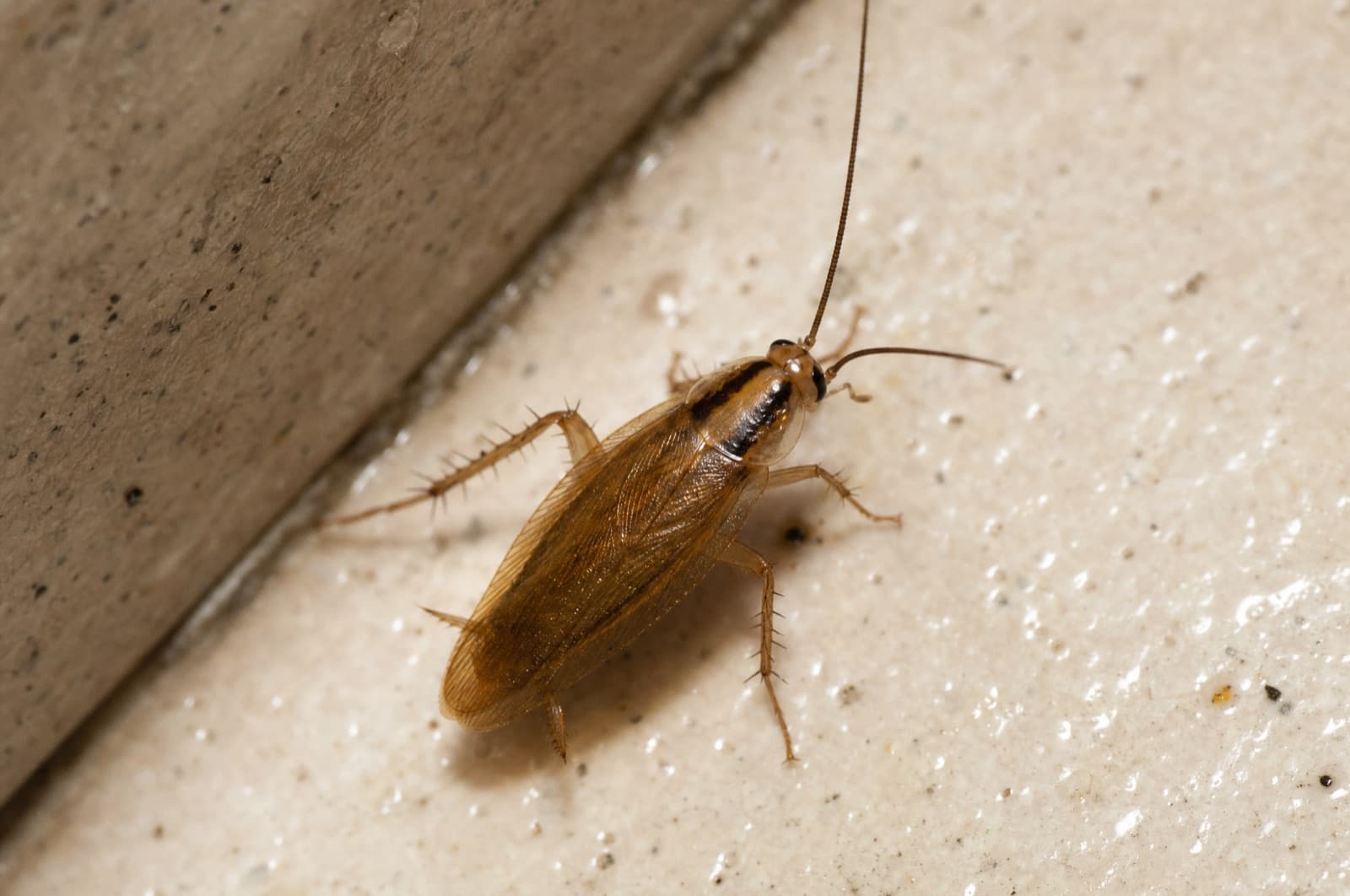
How to Get Rid of German Cockroaches
At a glance
- Difficulty: Pro only
- Time: Days to assess whether a sighting is truly isolated; established infestations run weeks to months even with professional treatment
- Cost: Low for an early attempt; a professional treatment plan is the honest path for anything beyond that
- Success: Good for a single early sighting with prompt correct bait use; poor for an established infestation without a professional
Can you DIY German Cockroach?
The verdict on German Cockroach DIY
The hardest common house roach to DIY — early sightings are workable, established infestations usually aren't.
The German cockroach (Blattella germanica) is NH's most common kitchen roach, per UNH Extension, and the highest-stakes species in this cluster because of two documented, real mechanisms that defeat casual DIY: glucose/bait aversion (a heritable trait where affected roaches taste the sugar in bait as bitter and refuse it) and broad insecticide resistance (a 2024/2025 literature review found resistance reported against 60 different active ingredients, with very high resistance ratios common for pyrethroids). It's also the fastest-breeding common house roach — NC State reports 3-6 generations per year — so a light sighting can become entrenched quickly. A single, genuinely early, light sighting caught immediately may still respond to prompt, correct gel-bait use; an established infestation is honestly a professional job.
The 5 DIY methods — honestly graded
Every approach graded for this species, in IPM order — prevention first, chemistry late. Pick a method to see how it works, the steps, and what it actually takes.
Prevention / Exclusion
Works wellFoundational for every case, early or established — sanitation removes competing food so bait actually gets eaten.
German cockroaches live entirely indoors in association with people and typically arrive by hitchhiking — in cardboard boxes, grocery bags, or used appliances — rather than wandering in from outside. Removing food, water, clutter, and entry cracks starves the population and makes any bait you place far more attractive by comparison.
Best for: Every case — this makes bait work and is necessary alongside professional treatment
Deep-clean grease, crumbs, and standing water
Degrease stovetops, backsplashes, and under appliances; wipe counters nightly; fix leaks and dry standing water in sinks — German cockroaches routinely forage for surface moisture overnight.
De-clutter and seal cracks
Remove cardboard and paper clutter (genuine harborage material) and seal cracks and crevices near appliances, cabinets, and plumbing penetrations.
Inspect anything entering the house
Check secondhand appliances, delivered boxes, and grocery bags before bringing them inside — hitchhiking is the primary way German cockroaches establish in a new home.
Tools & materials
Why DIY falls short here
Not scare tactics — the specific, proportionate reasons a home attempt can stall for this species.
Glucose/bait aversion — a genetic trait, not a placement mistake
A heritable trait causes some German cockroach populations to taste the glucose in standard gel bait as bitter and refuse it outright; an otherwise-perfect bait placement can simply be genetically rejected, and a homeowner often can't tell aversion from a bad placement.
Broad insecticide resistance
A 2024/2025 literature review found German-cockroach resistance reported against 60 different insecticidal active ingredients, with very high resistance ratios common for pyrethroids — meaning many over-the-counter sprays underperform even when applied correctly.
Aerosol sprays and foggers used as a first response
University of Illinois Extension testing found wild German cockroach mortality below 20% after limited aerosol exposure; sprays also scatter a concentrated harborage into adjacent rooms and wall voids, turning one colony into several, and contaminate nearby bait so roaches stop feeding on it.
3-6 generations per year outpaces casual effort
This is the fastest-breeding common house roach, per NC State — a delayed or half-measure response lets a light, easily-solved sighting become an entrenched infestation before a homeowner realizes what happened.
How risky is it, really?
An honest read — most nuisance species are genuinely low risk, and we say so.
German cockroaches don't bite or sting meaningfully, so this isn't a physical-injury risk. The genuinely elevated, well-sourced concern is allergens: because this species lives entirely indoors year-round, it's considered the worst common household allergen producer, and cockroach allergens are a documented childhood asthma trigger. That's a real, proportionate reason to address an infestation promptly — not a 'disease-carrying vermin' panic.
- Allergen exposure and asthma exacerbation, especially in childrenCommon
Clinical literature links early-life cockroach allergen exposure to repeated wheezing and asthma; German and American cockroaches are named as the principal domestic species involved
Journal of Allergy and Clinical Immunology (Arruda et al. 2001) / CDC Healthy Homes
- Mechanical contamination of food-prep surfacesCommon
Roaches can carry organisms from unsanitary areas to countertops and food; sanitation is the correct, proportionate response
CDC (Healthy Homes)
- Bite or sting to people or petsRare
Not a meaningful risk from this species
NC State Extension
German Cockroach Bait Not Working?
Persistent activity despite correct bait placement is a real, documented sign of aversion or resistance, not a DIY mistake. Anchor Pest Services rotates bait chemistries and treats the full picture across southern and central New Hampshire. Family-owned since 2017, NH license #782664.
Call a pro when…
- Sightings in more than one room, or roaches seen at night with a flashlight (a sign of an established population, not a single wanderer)
- Correct gel-bait placement that hasn't reduced activity after 1-2 weeks (a possible sign of aversion or resistance)
- Any household with a child or asthma/allergy-sensitive member, where faster resolution matters most
General Pest Control
German cockroach is this cluster's clearest case for calling a professional — not because DIY is impossible, but because the two documented mechanisms behind it (bait aversion and insecticide resistance) mean a single homeowner attempt can fail even when done correctly, and every week of delay lets a fast-breeding population get further ahead. A pro brings bait-chemistry rotation and IGR options a homeowner can't easily access.
Keep them out
- Inspect secondhand appliances, boxes, and grocery bags before bringing them inside
- Deep-clean kitchens nightly and eliminate standing water
- Address any sighting immediately — this species breeds 3-6 generations per year
German cockroaches in New Hampshire
UNH Cooperative Extension identifies the German cockroach as New Hampshire's most common kitchen cockroach — unlike the American and Oriental species, it lives entirely indoors year-round rather than wandering in seasonally from outside. That means NH homes don't get a seasonal reprieve: an infestation that establishes in winter keeps breeding at the same pace it would in summer, which is part of why prompt action on an early sighting matters so much.
Peak season
Year-round indoors — no seasonal lull
First-frost anchor
Manchester first hard frost ~Oct 19 (50%) / Oct 29 (80%), NOAA 1991-2020 — not a factor for this indoor-only species
Make sure it's a German Cockroach
Two quick detours worth taking — confirm the ID, then learn what drew it in so it doesn't come back.
Frequently asked
Sources & further reading(8)
- [1]NC State Extension — German Cockroach Surveillance and Management
3-6 generations per year, insecticide resistance, spray guidance
extensionverified 2026-07-13 - [2]Wada-Katsumata, Silverman & Schal (2013), Science 340:972-975
Neural basis of glucose/bait aversion
academicverified 2026-07-13 - [3]Wada-Katsumata & Schal (2024) review
Prevalence of glucose-averse field populations
academicverified 2026-07-13 - [4]German-cockroach insecticide-resistance literature review (PMC12677976)
Resistance to 60 insecticidal active ingredients, pyrethroid resistance ratios
academicverified 2026-07-13 - [5]University of Illinois Extension — DIY Spray and Aerosol Products Likely Fail Against German Cockroach
Aerosol mortality under 20%, scattering effect
extensionverified 2026-07-13 - [6]Texas A&M AgriLife — IPM Action Plan for German Cockroaches
Repellent spray contaminating bait
extensionverified 2026-07-13 - [7]Journal of Allergy and Clinical Immunology — Arruda et al. 2001
Cockroach allergen exposure and childhood asthma
medicalverified 2026-07-13 - [8]UNH Cooperative Extension — Kitchen Pests Fact Sheet
German cockroach as NH's most common kitchen cockroach
extensionverified 2026-07-13
Written & reviewed by
VerifiedDaniel Brady
NH-Licensed Pesticide Applicator · License #782664 (NHDAMF, RSA 430)
Daniel Brady is the New Hampshire–licensed applicator behind Anchor Pest Services, a family-owned pest control company serving the Manchester area since 2017.
Last updated July 2026
Other species you can tackle
Same category — the dot shows each one's DIY verdict at a glance (green = friendly, amber = doable with care, red = call a pro).
Professional Pest Control
German Cockroach Bait Not Working?
Persistent activity despite correct bait placement is a real, documented sign of aversion or resistance, not a DIY mistake. Anchor Pest Services rotates bait chemistries and treats the full picture across southern and central New Hampshire. Family-owned since 2017, NH license #782664.
- Bait-chemistry rotation for resistant populations
- NH-licensed applicators (#782664)
- Free inspection — same-day service across southern NH
NH License #782664 · No obligation · We answer in person
Your next step
- Book a NH pro
Cockroach Control
Book now - What to do next
German Cockroach in New Hampshire — ID, Signs & Control
Read the answer - Also relevant
German Cockroach in New Hampshire — ID, Signs & Control
Read the answer - Also relevant
Chemical Control for Roaches, Silverfish, Crickets & Termites
Read the answer - In your area
Where Do Cockroaches Go In The Winter?
Read the answer - Also relevant
Are Cockroaches Active at Night? NH Roach Timing Guide
Read the answer