
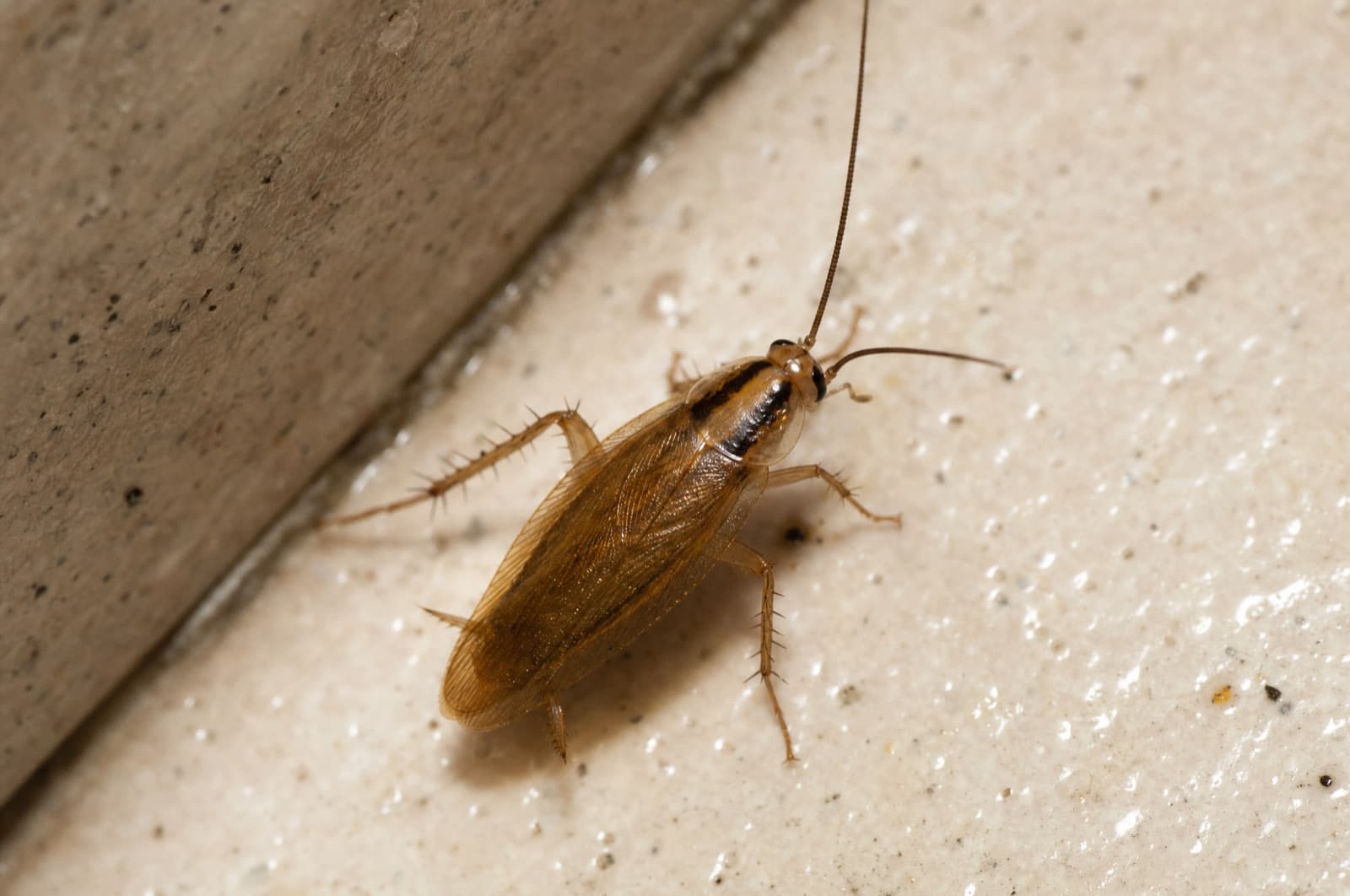
German Cockroach in New Hampshire — ID, Signs & Control
The German cockroach is New Hampshire's most common and most serious indoor roach — a tiny (~½ in) tan insect with two dark parallel stripes that breeds explosively in kitchens and bathrooms year-round. Foggers and sprays routinely fail; the proven path is sanitation plus professional gel baiting. Call a pro promptly — populations double in weeks.
- Adult size
- ½–⅝ in (13–16 mm)
- University of Florida IFAS; Rutgers NJAES
- Best visual tell
- Two dark parallel 'racing stripes' on the pronotum
- University of Florida IFAS
- Breeding speed
- 3–4 generations per year (up to 6)
- Michigan State University; Rutgers
- Eggs per case
- 30–40 eggs, carried by the female until hatching
- University of Florida IFAS; Rutgers
- Allergens produced
- 11 documented aeroallergens — the strongest cockroach asthma trigger
- DeVries et al., Scientific Reports 2019
- Fogger outcome
- Failed to cut populations; raised kitchen-surface pesticide residue 603× over baseline
- DeVries & Schal, BMC Public Health 2019 / NC State
- DIY verdict
- Usually NO — sanitation + professional gel baiting is the proven approach
- UNH Extension; Rutgers
The roach that beats DIY — and why it does
The German cockroach (*Blattella germanica*) is the most common indoor cockroach in New Hampshire and the one pest-control professionals take most seriously. It's small — about the size of a penny — tan to light brown, with two dark parallel stripes behind its head. It breeds year-round inside heated homes, multiplying 3–4 generations per year with populations that are 75–80% nymphs at any given time. Finding a German roach in your kitchen is not a minor nuisance; it is a signal to act quickly.
Two myths need to be corrected right away. First: clean homes can't get them. False — German roaches hitchhike in on groceries, secondhand appliances, moving boxes, and bags, regardless of how clean a home is. Second: a fogger or bug bomb will solve it. This is the most harmful myth. Peer-reviewed NC State University research (*BMC Public Health* 2019) found that total-release foggers failed to reduce German cockroach populations while raising kitchen-surface pesticide residue 603 times over baseline. Foggers scatter roaches and make kitchens toxic to cook in — they do not solve infestations.
The proven path is sanitation plus targeted gel baiting, repeated over several weeks. For any established infestation — and German roaches establish fast — a licensed professional is the honest recommendation. The longer you wait, the larger and harder to treat the population becomes.
How to identify a German cockroach
The German cockroach is identified by its small size, tan color, and the two dark parallel stripes running from the front of the pronotum toward the body. Size is the first clue: if the roach is small — about as long as a penny is wide — and tan with dark stripes, it is almost certainly a German roach. The larger, reddish American and near-black Oriental roaches look completely different.
German cockroach
- Scientific name
- Blattella germanica
- Family
- Ectobiidae
- Size
- ~½–⅝ in (13–16 mm)
- Coloration
- Light brown to tan with two dark longitudinal stripes on the pronotum
- Habitat
- Kitchens and bathrooms — behind and under appliances (refrigerators, stoves, dishwashers), under sinks, in wall voids near plumbing and warmth, inside cabinet hinges and drawer tracks
- Active season
- Year-round indoors; no cold-weather diapause since they live entirely inside heated buildings
- Diet
- Omnivorous — crumbs, grease, starches, soap, toothpaste, glue, even other roaches
- Reproduction
- Female carries an ootheca of 30–40 eggs until 1–2 days before hatching; 4–8 cases per lifetime
- Lifespan
- Adults ~100–200 days; 3–4 generations per year under NH conditions
An obligate indoor pest worldwide; cannot survive outdoors in cold climates and relies entirely on heated human structures in New Hampshire
The tells — key ID features
- Two dark parallel 'racing stripes' on the pronotum behind the head — the fastest and most reliable ID cue.
- Small: about the size of a penny to a fingernail (½–⅝ in).
- Tan to light brown body; nymphs are darker with the same distinctive stripe pattern.
- Has wings but does not fly — runs quickly to shelter.
- Clusters tightly near food, water, and warmth; rarely found far from the kitchen or bathroom.
Size, to scale
½–⅝ in (13–16 mm)
About as long as a penny is wide — small enough to hide in a crack you could slip a coin into
Asian cockroach (Blattella asahinai)
How to tell — Nearly identical coloration and stripes, but the Asian cockroach flies readily and lives outdoors; not a structural pest in NH.
American cockroach nymph
How to tell — Larger, reddish-brown; lacks the two clean parallel pronotal stripes; associated with drains and basements, not kitchen cabinets.
Brown-banded cockroach
How to tell — Has lighter bands running across the wings and abdomen rather than two longitudinal pronotal stripes; less common in New England.
Signs of a problem
German roaches are nocturnal and stay hidden, but their signs are distinctive. The dropping pattern is the most reliable early indicator — look at cabinet hinges and drawer tracks before you ever look for live insects.
Tiny dark specks resembling ground pepper or coffee grounds (1–2 mm) at cabinet hinges, drawer tracks, and behind and under appliances
What it means — Active harborage nearby — the most reliable early sign of a German cockroach presence.
Live roaches seen in the kitchen or bathroom during daylight hours
What it means — Heavy infestation; German roaches are nocturnal, and daytime sightings mean the population is large enough that roaches are being pushed out of prime harborage.
Small tan egg cases (oothecae) near warm, humid hiding spots — under sinks, behind appliances
What it means — Active breeding; each case holds 30–40 eggs.
Musty, oily odor in the kitchen, especially near the stove or under the sink
What it means — Significant population; German roaches produce aggregation pheromones detectable in heavy infestations.
Smear marks — dark streaks or staining — along wall edges, baseboards, and cabinet corners
What it means — High-traffic travel routes; roaches deposit fecal material and body oils as they run the same paths repeatedly.
The real risks, calibrated
The German cockroach is the most significant cockroach health concern in New Hampshire — not because it bites, but because it breeds indoors year-round, produces the strongest known cockroach allergens, and spreads bacteria on food-contact surfaces.
Asthma and allergic disease
HighOnset: Chronic exposure — weeks to months
German cockroaches produce 11 documented aeroallergens that are confirmed asthma triggers. Research published in Scientific Reports (2019) found 85% of inner-city U.S. homes positive for cockroach allergens, with 60–93% of inner-city asthmatic children sensitized to them. Allergens are present in feces, shed skins, saliva, and body parts.
Mechanical pathogen transfer
ModerateOnset: Ongoing while active
Carries Salmonella, E. coli, and other bacteria — including antibiotic-resistant strains — from waste and filth to food surfaces and utensils.
Rapid and compounding population growth
HighOnset: Within weeks
Three to four generations per year, with 30–40 eggs per ootheca carried by the female. A small early infestation becomes a large, harder-to-treat population in weeks without intervention.
Failed food-service health inspections
ModerateOnset: On inspection
German cockroaches are used by NH health departments as a sanitation indicator for restaurants and commercial food-preparation facilities.
DIY — what works, what backfires
Honest verdict: for an established German cockroach infestation, DIY usually fails. The reasons are biological — eggs are carried shielded by the female's body, populations develop insecticide resistance, and roaches hide in wall voids inaccessible to surface sprays. For a very early, small, and confirmed infestation, the measures below can help. For anything beyond a single roach sighting, professional gel baiting is the realistic path.
What actually works
- Rigorous sanitation first: eliminate every food source (crumbs, grease, spills), fix dripping faucets, and store all food in sealed containers — German roaches cannot thrive without these resources.
- Seal cracks around plumbing, cabinet backs, and appliance housings to reduce harborage.
- Deploy professional-style gel bait (e.g., Advion, Maxforce) placed in small dots close to harborage — inside cabinet hinges, behind drawers, at the back corners under the sink.
- Use insect growth regulators (IGRs) such as hydroprene alongside bait to disrupt the reproductive cycle.
- Set sticky monitors in harborage zones to track population size and confirm treatment is working.
What backfires
- Do NOT use total-release foggers or 'bug bombs.' NC State University research (DeVries & Schal, BMC Public Health 2019) found they failed to reduce German cockroach populations while raising kitchen-surface pesticide residue 603 times over baseline — with roughly 34% of surfaces still elevated a month later. They scatter roaches and contaminate your kitchen without solving anything.
- Don't spray repellent insecticides (synthetic pyrethroids) near gel bait — the repellent odor makes roaches avoid the bait, rendering it useless.
- Don't expect a single treatment to end it — German roach control requires repeated bait application and monitoring over several weeks, because eggs in oothecae survive initial treatments.
German cockroaches in New Hampshire homes and apartments
UNH Cooperative Extension identifies the German cockroach as New Hampshire's most common kitchen cockroach, noting it 'matures in 40 days and multiplies throughout the year.' It thrives in the heated interiors of NH homes, apartments, multi-unit buildings, and commercial kitchens year-round — not just in warm months. In multi-unit buildings in Manchester, Nashua, and Concord, German roaches move between units through plumbing chases and wall voids, meaning a single unit's infestation can affect neighbors. They do not survive outdoors in New Hampshire winters, so every German cockroach you find indoors was introduced — and is breeding indoors.
Peak season
Year-round indoors; no seasonal peak — heated buildings provide stable breeding conditions
You might actually have
- American cockroach (larger, reddish-brown with figure-8 band; tied to drains and basements)
- Oriental cockroach (large, near-black; damp basements and floor drains)
We serve these communities
- NH-licensed applicator · #782664
- Same-day service
- Family-owned since 2017
Service Area Map
Southern New Hampshire
When to call Anchor Pest Services for German cockroaches
Any confirmed German cockroach in a kitchen or bathroom is a call-promptly situation. Waiting a few weeks while the population grows from dozens to hundreds makes the problem significantly harder and more costly to solve. Anchor's licensed technicians (NH #782664) apply professional-grade gel baits and IGRs in the exact harborage locations that matter, follow up to confirm the population is collapsing, and advise on the structural fixes (caulking, plumbing repairs) that prevent re-introduction.
When to call a pro
- Any confirmed German cockroach sighting in a kitchen or bathroom — call promptly.
- Pepper-like droppings at cabinet hinges or drawer tracks, even without a live sighting.
- Daytime sightings of small tan striped roaches — indicative of a large established population.
- Musty kitchen odor with no apparent food spoilage source.
- In a multi-unit building where neighbors have reported roaches.
Inspect incoming goods
Before bringing in secondhand appliances, furniture, moving boxes, or even grocery bags from bulk stores — inspect them for roaches or egg cases. This is the primary introduction route for German cockroaches.
Keep kitchens dry and crumb-free
Fix dripping faucets, wipe down stove tops and counter seams nightly, and store food in sealed containers. German roaches need food and moisture within 6 inches of harborage to thrive.
Seal plumbing penetrations
Caulk gaps behind cabinets where plumbing enters walls; use escutcheon plates around pipes. This also limits movement between units in multi-family buildings.
Not sure it's a german cockroach?
A licensed NH technician can confirm the species and tell you honestly whether it's a DIY fix or a job for a pro — free inspection, same-day service across Southern New Hampshire.
Frequently asked questions
Sources(8)
- [1]University of Florida IFAS — German Cockroach
adult size, stripes, egg-case biology, northern range behavior
extensionverified 2026-06-30 - [2]Rutgers NJAES — German Cockroach (FS1322)
reproduction, generations per year, population structure
extensionverified 2026-06-30 - [3]Michigan State University Extension — German Cockroach
generations per year, nymph percentage in growing populations
extensionverified 2026-06-30 - [4]DeVries et al. — Scientific Reports 2019 (cockroach allergens)
11 aeroallergens, 85% of inner-city homes positive, 60–93% children sensitized
academicverified 2026-06-30 - [5]DeVries & Schal — BMC Public Health 2019 (foggers 603×)
total-release foggers: 603× residue increase, failed to reduce populations
academicverified 2026-06-30 - [6]NC State News — Bug Bombs Are Ineffective
plain-language summary of the fogger study findings
newsverified 2026-06-30 - [7]UNH Cooperative Extension — Kitchen Pests Fact Sheet
NH status: most common kitchen roach; matures in 40 days; year-round breeding
extensionverified 2026-06-30 - [8]Cockroach Care — Cockroach Droppings ID
dropping appearance comparison by species (non-critical visual decoder only)
industryverified 2026-06-30
Written & reviewed by
VerifiedDaniel Brady
NH-Licensed Pesticide Applicator · License #782664 (NHDAMF, RSA 430)
Daniel Brady is the New Hampshire–licensed applicator behind Anchor Pest Services, a family-owned pest control company serving the Manchester area since 2017.
Last updated 2026-06-30

New Hampshire pest control
Dealing with german cockroachs in your home?
Anchor Pest Services identifies and handles german cockroach problems across southern and central New Hampshire. Family-owned since 2017, NH license #782664.
- NH-licensed applicators (#782664)
- Same-day service · free inspection
- Family-owned since 2017
Your next step
- Next step
Is Advion Cockroach Gel Bait Safe for Pets?
Read the answer - What to do next
How to Get Rid of German Cockroaches
Read the answer - What to do next
Where Do Cockroaches Go In The Winter?
Read the answer - What to do next
Are Cockroaches Active at Night? NH Roach Timing Guide
Read the answer - Related guide
American Cockroach in New Hampshire — ID, Signs & Control
Read the answer