
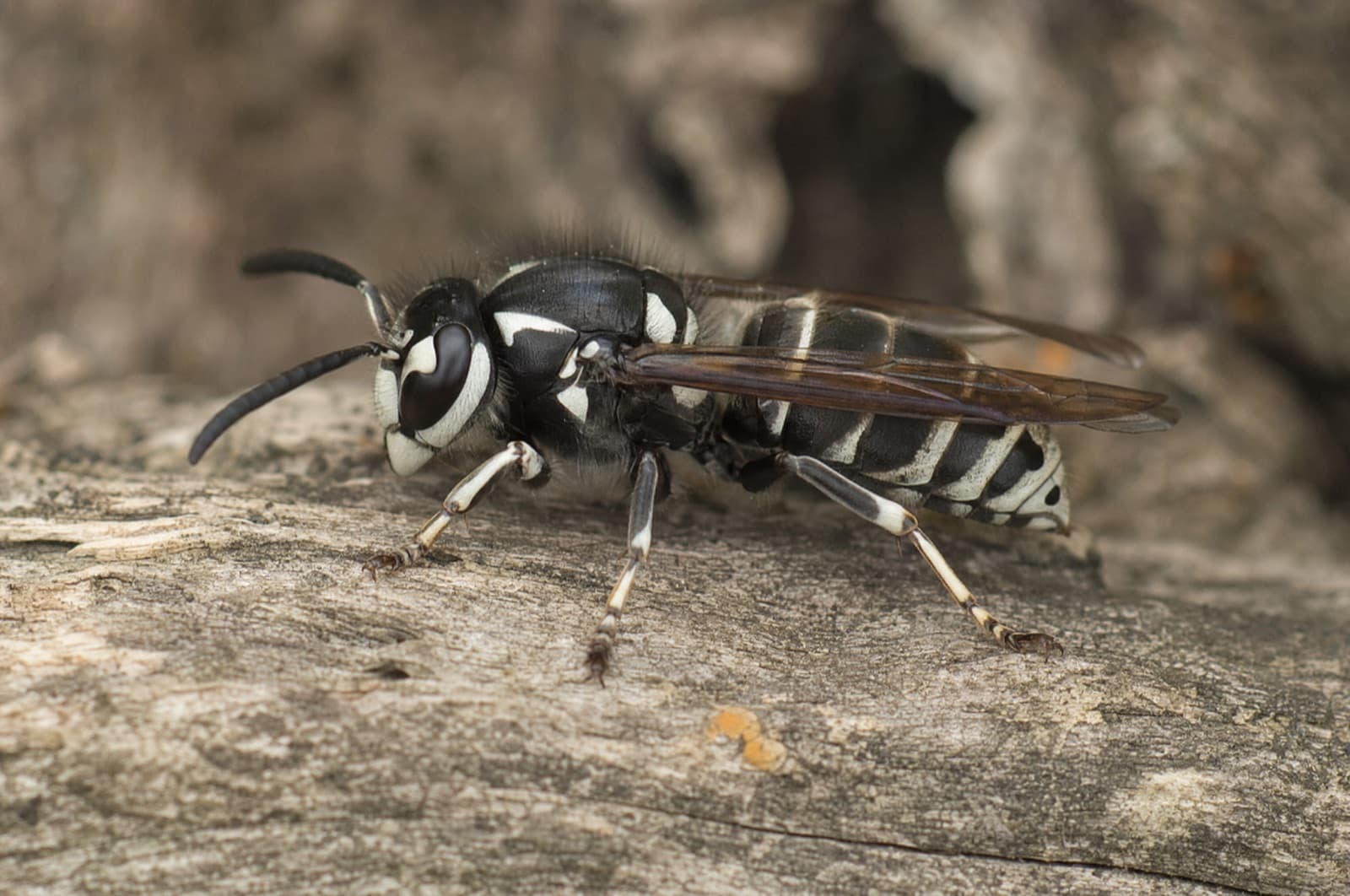
How to Get Rid of Bald-Faced Hornets
At a glance
- Difficulty: Pro only
- Time: N/A — handled by a pro
- Cost: N/A — free inspection from Anchor
- Success: Low and risky as a homeowner DIY attempt; high with professional equipment and PPE
Can you DIY Bald-Faced Hornet?
The verdict on Bald-Faced Hornet DIY
Pro-recommended — a large, aggressive aerial nest is genuinely too dangerous to DIY.
The bald-faced hornet is actually an aerial yellowjacket that builds a large, enclosed gray paper nest — Penn State Extension notes colonies can reach "100 to 400 workers," and Orkin reports nests "as large as a basketball" with up to 700 workers. It's aggressive when disturbed, stings repeatedly, and can spray venom toward the eyes. Nests are also frequently high in trees, on utility poles, or under eaves — exactly the combination (height + coordinated defense) that turns a DIY attempt into a fall-and-multiple-sting incident. The honest DIY-appropriate piece of this job is identification, distance, and prevention; nest removal belongs to a licensed pro.
The 5 DIY methods — honestly graded
Every approach graded for this species, in IPM order — prevention first, chemistry late. Pick a method to see how it works, the steps, and what it actually takes.
Prevention / Exclusion
SituationalReduces the chance of a NEW nest forming; does nothing for one that already exists.
Bald-faced hornet nests are annual — the whole colony dies off at the first hard frost except for new queens, who overwinter and start fresh nests elsewhere the following spring. Monitoring likely nesting spots in early spring can help you spot and address a new nest while it's still small.
Best for: Catching next year's nest early and routing it to a pro before it grows
Monitor in early spring
Check trees, eaves, sheds, and utility poles for a small, early-stage nest starting in April–May, before it grows large.
Call a pro for any nest you find
Even a small bald-faced hornet nest is best handled by a professional given this species' defensive behavior — don't attempt removal yourself.
Tools & materials
Why DIY falls short here
Not scare tactics — the specific, proportionate reasons a home attempt can stall for this species.
Height and ladder risk
Aerial nests are often high in trees, on utility poles, or under eaves — a ladder combined with a defensive swarm response is a serious fall-injury risk.
Coordinated colony defense
With up to 700 workers, the colony mounts a coordinated response to disturbance rather than a few individual stings, so a botched DIY attempt risks multiple stings at once.
Venom can be sprayed toward the eyes
Bald-faced hornets can spray venom, making face and eye protection essential — protection a homeowner attempt often skips.
How risky is it, really?
An honest read — most nuisance species are genuinely low risk, and we say so.
This is one of the cluster's genuinely elevated-risk species for the general population, not just for allergic individuals — large colonies mount a coordinated, repeated-sting defense when disturbed, and nests are frequently in hard-to-reach locations that add fall risk to any DIY attempt.
- Multiple, repeated stings during a coordinated colony defenseCommon
If the nest is disturbed — this is the primary reason this species is pro-recommended for the general population, not only allergic individuals
Penn State Extension / Orkin
- Venom sprayed toward the face/eyesOccasional
A documented defensive behavior of this species; eye protection is essential for anyone working near a nest
Pest control industry entomology sources
- Fall injury from ladder use near an aerial nestOccasional
Nests are frequently high in trees, on poles, or under eaves
UNH Cooperative Extension
- Anaphylaxis in individuals with a known stinging-insect allergyRare
Genuinely life-threatening for the allergic subset specifically — carry a prescribed epinephrine auto-injector and call 911 for signs of a systemic reaction
CDC MMWR (mm7227a6) / ACAAI
This One's Not a DIY Job
Up to 700 aggressive workers in a nest that's often high off the ground is a genuine safety risk, not a weekend project. Anchor Pest Services removes bald-faced hornet nests safely across southern and central New Hampshire. Family-owned since 2017, NH license #782664.
Call a pro when…
- Any active nest — this species is pro-recommended at baseline, not just for large or hard-to-reach nests
- A nest near an entry, walkway, or play area (added urgency)
- A nest high in a tree, on a utility pole, or under an eave (ladder risk)
- Anyone in the household has a known stinging-insect allergy (added urgency)
General Pest Control
This is the cluster's clearest call-a-pro case. Given the colony size, aggression, and typical nest locations, Anchor's licensed technicians handle bald-faced hornet nests with the right equipment and protective gear — don't attempt this one yourself.
Keep them out
- Monitor likely nesting spots (trees, eaves, sheds, poles) in early spring
- Keep household members and pets away from any nest you spot
- Call Anchor at the first sign of a nest rather than waiting for it to grow
Bald-faced hornets in New Hampshire
In New Hampshire, bald-faced hornet colonies build through spring and summer and peak in size by late summer, then die off — except for new queens — around the first hard frost, roughly October 19–29 in Manchester (NOAA). An empty gray paper nest spotted in bare winter trees is not a danger and won't be reused, but a nest found during the active season should be treated as a call-a-pro situation, not a DIY project.
Peak season
Late summer, when colonies reach maximum size
First-frost anchor
Manchester first hard frost ~Oct 19 (50%) / Oct 29 (80%), NOAA 1991–2020
Make sure it's a Bald-Faced Hornet
Two quick detours worth taking — confirm the ID, then learn what drew it in so it doesn't come back.
Frequently asked
Sources & further reading(5)
- [1]Penn State Extension — Wasps, Hornets, and Yellowjackets
Colony size (100–400 workers)
extensionverified 2026-07-13 - [2]
- [3]UNH Cooperative Extension — Stinging Insects (Resource000532/Rep554)
NH-specific stinging-insect guidance, hands-off vs. direct-action framing
extensionverified 2026-07-13 - [4]CDC MMWR — Deaths from Hornet, Wasp, and Bee Stings (mm7227a6)
National sting-fatality data
govverified 2026-07-13 - [5]American College of Allergy, Asthma & Immunology — Insect Sting Allergies
Allergic reaction prevalence
medicalverified 2026-07-13
Written & reviewed by
VerifiedDaniel Brady
NH-Licensed Pesticide Applicator · License #782664 (NHDAMF, RSA 430)
Daniel Brady is the New Hampshire–licensed applicator behind Anchor Pest Services, a family-owned pest control company serving the Manchester area since 2017.
Last updated July 2026
Other species you can tackle
Same category — the dot shows each one's DIY verdict at a glance (green = friendly, amber = doable with care, red = call a pro).
Professional Pest Control
This One's Not a DIY Job
Up to 700 aggressive workers in a nest that's often high off the ground is a genuine safety risk, not a weekend project. Anchor Pest Services removes bald-faced hornet nests safely across southern and central New Hampshire. Family-owned since 2017, NH license #782664.
- Licensed NH applicators (#782664)
- Proper equipment for aerial and hard-to-reach nests
- Free inspection — same-day service across southern NH
NH License #782664 · No obligation · We answer in person
Your next step
- Book a NH pro
Wasp Removal
Book now - What to do next
Bald-Faced Hornet — Quick ID for New Hampshire
Read the answer - What to do next
Is It Dangerous to Remove a Hornet Nest Without Professional Help?
Read the answer - What to do next
Wasp vs Hornet — How to Tell Them Apart (New Hampshire Guide)
Read the answer - What to do next
Do hornets damage homes or just sting?
Read the answer - Also relevant
Bald-Faced Hornet — Quick ID for New Hampshire
Read the answer