
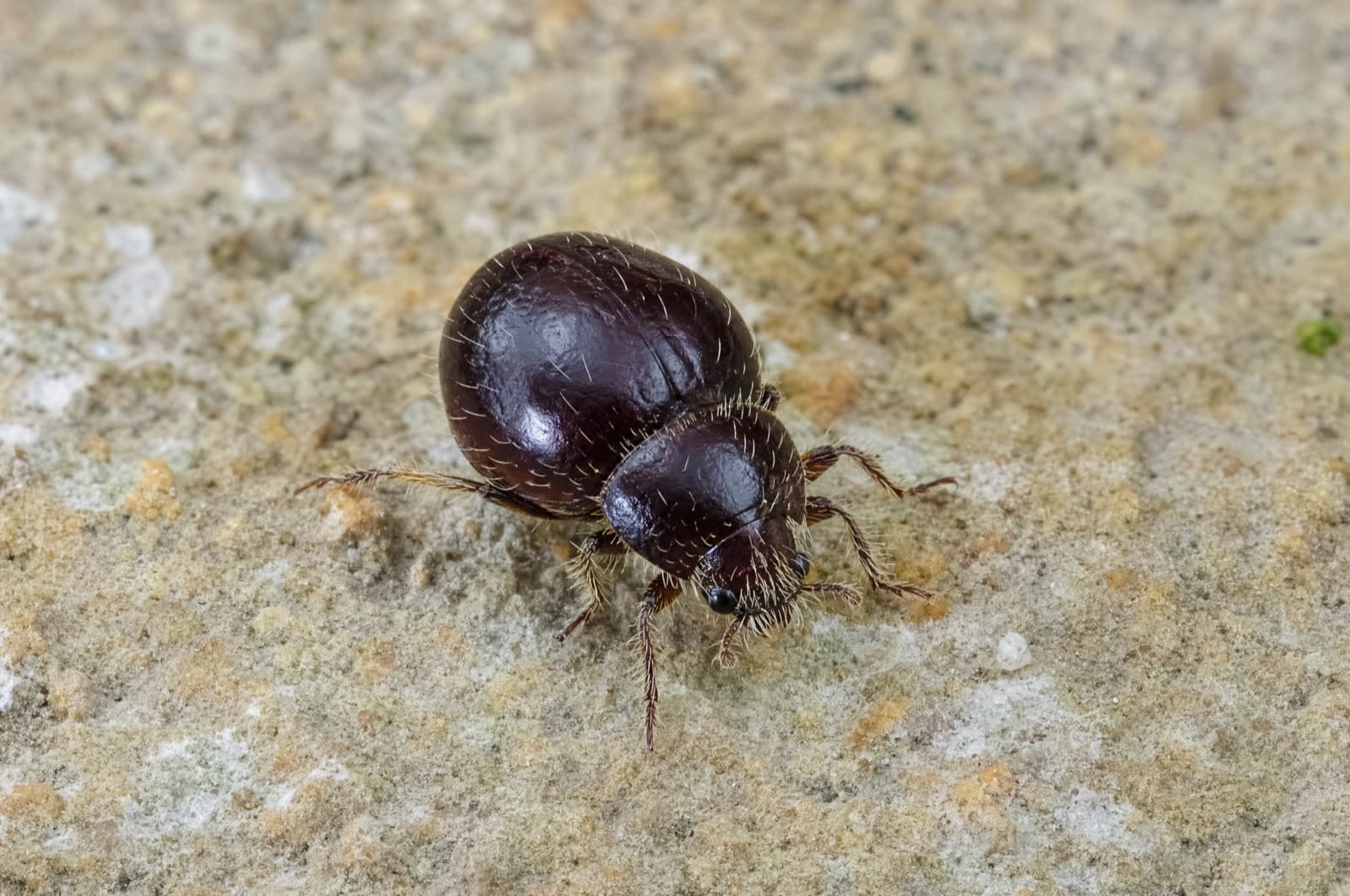
How to Get Rid of Spider Beetles
At a glance
- Difficulty: Intermediate
- Time: A few hours for pantry inspection; longer if a rodent or debris source in an attic/void needs addressing
- Cost: Low — airtight containers, vacuum, and rodent exclusion if needed
- Success: Good once both food AND non-food (rodent/insect debris) sources are addressed; recurring if only the pantry is checked
Can you DIY Spider Beetle?
The verdict on Spider Beetle DIY
A doable DIY, but source-tracing takes more digging than other pantry beetles.
Spider beetles (family Ptinidae) are scavengers with an unusually broad diet — broken grain, seeds, dried fruit and meat, wool, hair, feathers, rodent droppings, dead insects and other animal remains, books, dried mushrooms, animal feed, and sugar. That range means the source is often not food at all, but rodent nesting material, droppings, or dead-insect debris in an attic or void. Sanitation still solves it — no pesticide needed — but you have to widen the search beyond the pantry, and often address a rodent issue at the same time.
The 5 DIY methods — honestly graded
Every approach graded for this species, in IPM order — prevention first, chemistry late. Pick a method to see how it works, the steps, and what it actually takes.
Prevention / Exclusion
Works wellAirtight food storage is necessary but not sufficient — you also have to eliminate non-food scavenger fuel.
Because spider beetles scavenge rodent droppings, dead insects, and nesting material as readily as food, prevention has to close off both food storage and these debris reservoirs, or the infestation persists regardless of pantry hygiene.
Best for: Stopping both food-based and debris-based infestations
Store dry goods airtight
Keep grain products, seeds, dried fruit, and sugar in sealed rigid containers.
Eliminate debris reservoirs
Clean out rodent droppings, dead-insect accumulations, and bird or rodent nesting material from attics, wall voids, and crawl spaces.
CautionThis is the step most people skip — and the reason infestations return after a pantry-only cleanout.Address rodent entry points
Seal gaps that let rodents into voids and attics, since an active or past rodent presence is a common hidden source.
Tools & materials
Why DIY falls short here
Not scare tactics — the specific, proportionate reasons a home attempt can stall for this species.
Non-food reservoirs missed
Infestations commonly persist in rodent droppings, dead insects, and nesting material — cleaning the pantry alone leaves the actual source untouched, and beetles reinvade after 'primary' infestations are controlled.
Cryptic larvae in infested material
Larvae stay hidden within the scavenged material itself, so a quick visual check misses an active population.
Unaddressed rodent link
If a mouse or rat problem is feeding the beetles' debris supply, ignoring it lets the infestation keep reseeding no matter how well the pantry is cleaned.
How risky is it, really?
An honest read — most nuisance species are genuinely low risk, and we say so.
Spider beetles are a nuisance/contamination pest — no bite or sting. The rodent-debris association is a sanitation flag pointing to a separate issue worth addressing, not a direct health threat from the beetle itself.
- Contamination of stored food and scavenged debris accumulationCommon
The main practical harm; broader diet than typical pantry beetles
Iowa State University Extension
- Signals an unaddressed rodent or dead-insect debris sourceOccasional
A sanitation/inspection flag rather than a direct health threat from the beetle
DoD Defense Centers for Public Health
- Health or property harm to people or pets from the beetle itselfRare
No bite, sting, or disease association with the beetle
Iowa State University Extension
Spider Beetles Keep Coming Back?
A persistent infestation often means an unaddressed rodent or debris source. Anchor Pest Services offers inspection across southern and central New Hampshire. Family-owned since 2017, NH license #782664.
Call a pro when…
- Beetles persist despite a thorough pantry clean-out
- You suspect debris in an attic, wall void, or crawl space you can't safely access
- You have or recently had a rodent problem that may be feeding the infestation
General Pest Control
Spider beetles are DIY-friendly, but because the source is often non-food debris tied to a rodent or dead-insect problem, a professional inspection can help when you can't pin down where the infestation is coming from.
Keep them out
- Store dry goods airtight
- Clean out dead-insect and rodent-debris accumulations in attics/voids
- Address rodent entry points if you have or had a rodent issue
Spider beetles in New Hampshire
UNH Cooperative Extension's Kitchen Pests fact sheet lists spider beetles among the stored-product insects documented in New Hampshire homes. Unlike the strictly grain-feeding pantry pests, spider beetles don't follow an outdoor seasonal cycle, but New Hampshire's cooler months push rodents to seek shelter indoors — and since spider beetles scavenge rodent droppings and nesting material, a fall/winter rodent presence can quietly seed a spider beetle problem that shows up later. Addressing rodent entry points alongside pantry sanitation is the more complete fix here than for the cluster's strictly grain-feeding species.
Peak season
Year-round indoors; often tied to fall/winter rodent activity
Make sure it's a Spider Beetle
Two quick detours worth taking — confirm the ID, then learn what drew it in so it doesn't come back.
Frequently asked
Sources & further reading(3)
- [1]Iowa State University Extension — Spider Beetle
Broad scavenger diet, non-food sources
extensionverified 2026-07-13 - [2]DoD Defense Centers for Public Health — Spider Beetle
Reinvasion from rodent/dead-insect debris after primary control
govverified 2026-07-13 - [3]UNH Cooperative Extension — Kitchen Pests [fact sheet]
Spider beetles listed among New Hampshire stored-product/kitchen pests
extensionverified 2026-07-22
Written & reviewed by
VerifiedDaniel Brady
NH-Licensed Pesticide Applicator · License #782664 (NHDAMF, RSA 430)
Daniel Brady is the New Hampshire–licensed applicator behind Anchor Pest Services, a family-owned pest control company serving the Manchester area since 2017.
Last updated July 2026
Other species you can tackle
Same category — the dot shows each one's DIY verdict at a glance (green = friendly, amber = doable with care, red = call a pro).
Professional Pest Control
Spider Beetles Keep Coming Back?
A persistent infestation often means an unaddressed rodent or debris source. Anchor Pest Services offers inspection across southern and central New Hampshire. Family-owned since 2017, NH license #782664.
- Hidden-source & rodent-link inspection
- NH-licensed applicators (#782664)
- Free inspection — same-day service across southern NH
NH License #782664 · No obligation · We answer in person