
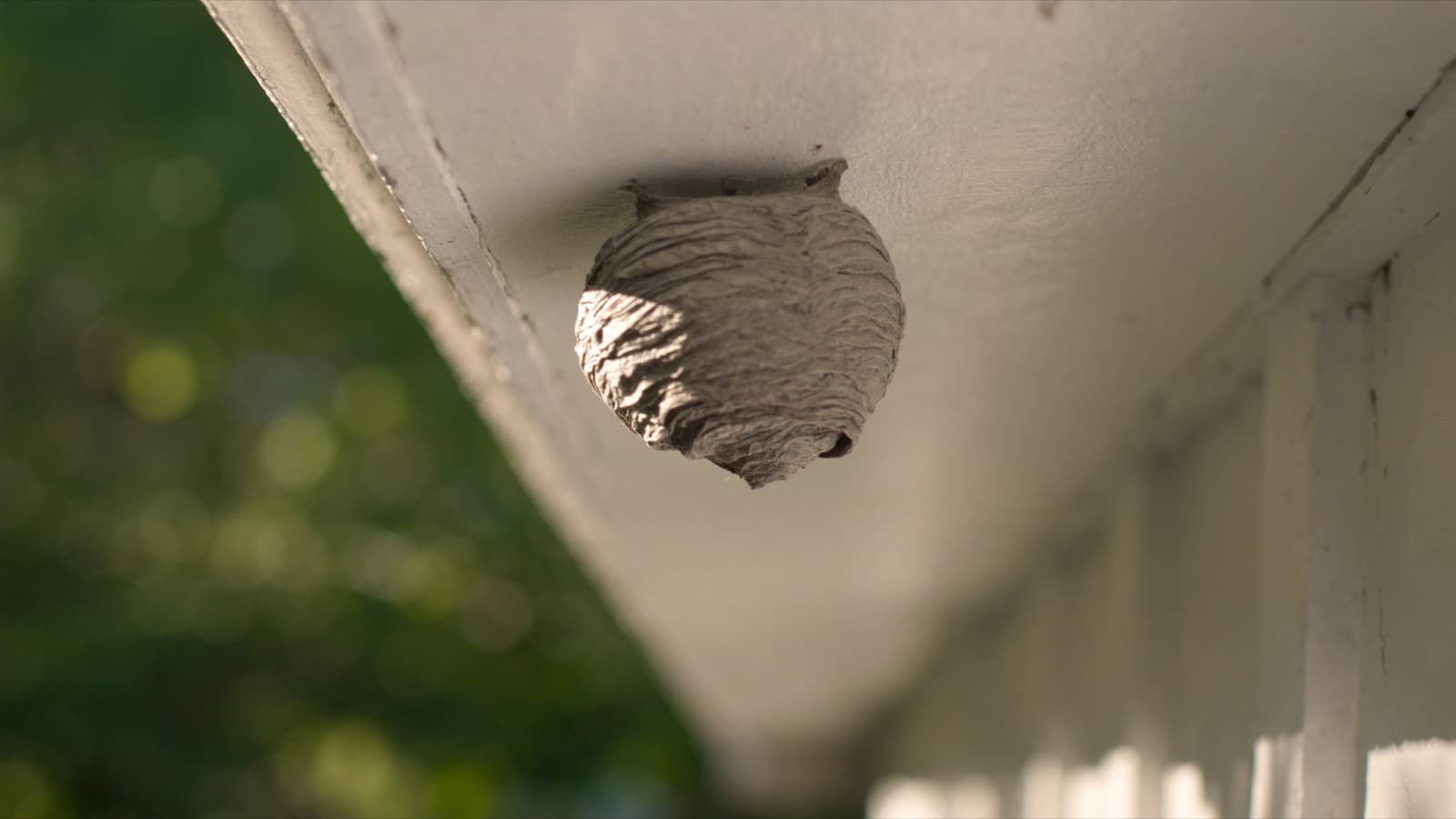
Can Wasps Nest Inside Walls or Attics, and How Should I Address That?
At a Glance
- The call: Yellowjackets readily nest in wall voids and attics — and the single most important fact is what NOT to do: never seal the entry hole on an active nest.
The short of it
Yellowjackets readily nest in wall voids and attics — and the single most important fact is what NOT to do: never seal the entry hole on an active nest.
The full picture
Why walls and attics are a genuinely different situation
A wall void or attic gives a colony a protected, temperature-buffered cavity to build in, reached through gaps as small as a few millimeters around siding, soffits, or utility penetrations. In New Hampshire the species that most often exploits these structural cavities is the eastern yellowjacket (Vespula maculifrons), which Cornell IPM describes as a common Northeast nester that readily uses voids as well as ground burrows, its colony building toward peak size in late summer before the region's first sustained hard freeze ends it. Once inside, the nest itself is invisible from outside, and the only visible sign is often wasps entering and leaving through what looks like a minor crack. Penn State and Ohio State Extension both note that consumer aerosol treatments, designed for exposed nests, generally can't reach the actual nest core inside a wall or attic cavity — which is a structural problem, not a product-strength one.
The one thing never to do
Sealing the visible entry hole on an active nest feels like the obvious fix, and it's the wrong move. Penn State Extension warns that trapped wasps inside a sealed void will often chew through interior sheetrock or wallboard to find another way out, which can put agitated wasps directly into a living space rather than resolving the problem. Any sealing has to happen after the colony is confirmed inactive, not as a first response to an active nest.
Why this is treated as a professional job
Between the concealment defeating standard sprays and the real risk of forcing wasps into the house by sealing too early, wall and attic nests are handled as a professional situation on this hub, consistent with /top-diy-methods rating yellowjacket colonies as pro-recommended generally. If the nest has caused any visible damage to siding, drywall, or insulation, that's a separate question owned by /faq-pest-damage-and-risks.
The honest line — Yellowjackets readily nest in wall voids and attics — and the single most important fact is what NOT to do: never seal the entry hole on an active nest.
Key takeaways
- Yellowjackets readily nest in wall voids, attics, and gaps between floors, entering through small cracks.
- Consumer aerosol sprays generally can't reach a nest concealed inside a wall or attic cavity.
- Never seal the entry hole on an active nest — trapped wasps can chew through into living space.
- Sealing the opening is appropriate only after the colony is confirmed inactive, not as a first response.
- This is treated as a professional job because of concealment, not because of nest size alone.
Where to go next
Identification, sting treatment, per-species DIY viability, and nest-reuse facts each live on the hub that owns them. We route, we don't rebuild.
DIY viability by species
The router's source of truth — which nests are DIY-able.
Go thereIdentify the species
Tell the wasps, hornets, and lookalikes apart.
Go thereSting & allergy treatment
What to do about a sting or a reaction.
Go thereNest reuse & winter
The colony dies at frost; the nest is never reused.
Go thereDamage & structural risk
Nests in walls and siding — the real risk.
Go there
Wasps going in and out of a wall or vent?
This is one of the clearer professional situations on this hub. Anchor can locate and treat it without sealing anything prematurely.
Frequently asked questions
Sources(4)
- [1]Penn State Extension — Getting Rid of Paper Wasps, Yellowjackets and Other Stinging Insects
Never seal an active wall-void entry hole; trapped wasps can chew through into living space
extensionverified 2026-07-17 - [2]Ohio State University Extension — Wasp and Bee Control
Concealed wall-void and attic nests require professional treatment methods
extensionverified 2026-07-17 - [3]Michigan State University Extension — Getting Rid of Wasp Nests
Aerosol sprays generally cannot reach a nest core concealed inside a structure
extensionverified 2026-07-17 - [4]Cornell IPM — Yellowjackets and baldfaced hornets
Eastern yellowjacket (Vespula maculifrons) common in the Northeast; nests in structural voids as well as ground burrows
extensionverified 2026-07-17
Written & reviewed by
VerifiedDaniel Brady
NH-Licensed Pesticide Applicator · License #782664 (NHDAMF, RSA 430)
Daniel Brady is the New Hampshire–licensed applicator behind Anchor Pest Services, a family-owned pest control company serving the Manchester area since 2017.
Last updated 2026-07-17
Concealed nests need a different approach
Don't seal it before it's confirmed dead
A licensed technician can confirm the nest is inactive before any opening gets sealed, and treat it properly if it isn't.
- Family-owned since 2017
- NH License #782664, category F1 (RSA 430, NHDAMF)
- Member, NEPMA
Your next step
- Next step
Can wasp nests damage siding or drywall?
Read the answer - What to do next
Where Do Wasps Go in the Winter? NH Wasp Timing Guide
Read the answer - Also relevant
How Long Do Wasps Live? Lifespan, Life Cycle & the NH Season
Read the answer - Also relevant
Do wasps chew on wood to build nests?
Read the answer - Also relevant
Can yellowjackets build nests inside walls?
Read the answer - Related guide
Do pests target attics and crawl spaces more often?
Read the answer