
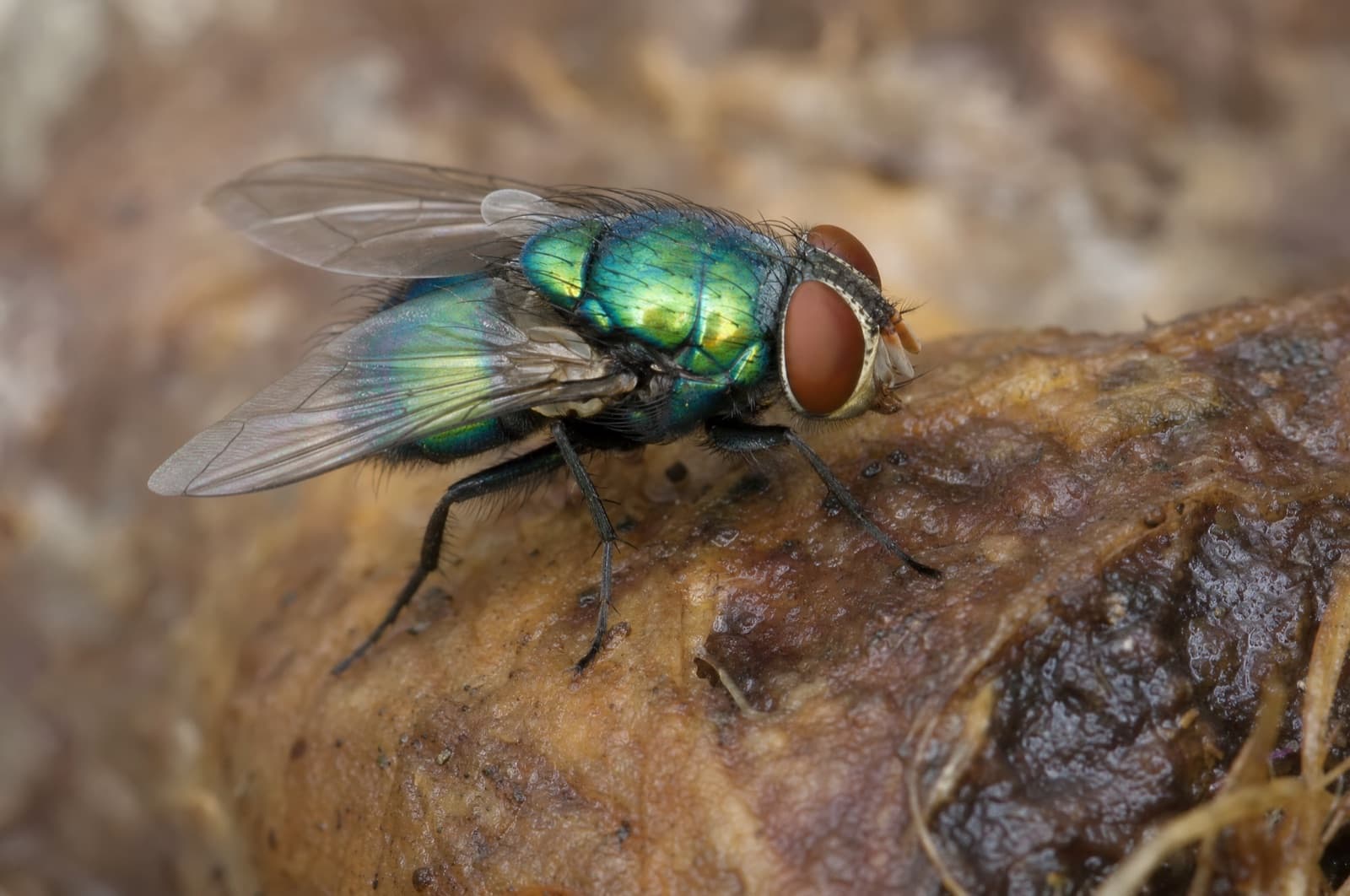
What Attracts Blow Flies to Your House?
At a glance
- Short answer: Blow flies indoors usually mean something has died in the structure — they're following the smell of decay, not looking for your kitchen.
- The verdict: Something specific
The attractant verdict
Four possible answers to why this species turned up. Three stay unlit — and that's the argument: the honest answer could have been any of them, and for this species it wasn't.
Blow flies indoors usually mean something has died in the structure — they're following the smell of decay, not looking for your kitchen.
Most advice, including our own previous page, says blow flies are attracted to a house by "specific odors and the availability of food sources," grouping decaying matter in with general household food. That framing undersells how specific the actual driver is.
Blow flies (family Calliphoridae) are among the very first insects to find and colonize dead animal tissue. Adult females detect the odor of decomposition from a distance and lay eggs directly on carrion; the maggots that hatch feed on the decaying flesh. A persistent, worsening blow fly presence indoors — especially with adults clustering at a window or appearing suddenly in numbers — points to a dead animal somewhere in the structure: a mouse, bird, or squirrel that died in a wall void, chimney, attic, or crawlspace. It is not a general dirt or garbage problem.
“Blow flies indoors usually mean something has died in the structure — they're following the smell of decay to lay eggs, not looking for your kitchen.”
Decaying animal tissue — most often a dead rodent, bird, or small mammal inside a wall void, chimney, attic, or crawlspace — that blow fly females detect and lay eggs on.
It turns a vague 'why do I have flies' question into a specific, locatable one: where in the structure did something die. That's a very different search than checking for spills or garbage, and it usually resolves once the source is found and removed.
Calibrated from: University of Maine Cooperative Extension: blow flies and flesh flies are drawn to decaying organic matter, especially dead animals, to lay eggs; larvae develop on the decomposing tissue.
Why it's here, in full
Why 'decaying organic matter' means something specific here
Blow flies belong to a group of insects that specialize in finding dead animal tissue quickly, often within minutes of death outdoors. University of Maine Cooperative Extension groups blow flies with flesh flies as species whose larvae develop on decomposing tissue, reached by adults that key in on the smell of decay itself. Indoors, that same specialization means a real, sustained blow fly presence is a strong signal that a small animal — commonly a mouse, squirrel, or bird — has died somewhere inside the structure, most often a wall void, attic, chimney, or crawlspace where it went to escape weather or a predator and couldn't get back out.
This is a different mechanism than "dirt" or "garbage," which is the vaguer explanation the folk version leans on. A kitchen with food waste can certainly draw flies, but a specifically blow fly problem — clustering at a window, appearing suddenly, tracking with a bad smell in one location — is a decay signal, and the honest next step is locating the source rather than general cleaning. Confirming and tracing an odor like this is covered in more depth at /smell-faq.
How to tell it's actually this species
Real signs only — a species with four honest tells gets four, and stops. Where a sign is weak on its own, we say so.
A cluster of adult blow flies repeatedly gathering at one window or in one room, rather than scattered evenly through the house
A persistent, unpleasant odor concentrated in one area — a wall, closet, chimney, or attic access point — that gets worse over a few days
Could be something else: A similar odor can come from other sources such as sewer gas or mold; the odor question specifically is covered at /smell-faq, which owns the dead-animal odor diagnostic in more detail.
Small, pale, rice-grain-shaped larvae found near a baseboard, vent, or the base of a wall
A sudden increase in fly numbers appearing over a few days rather than a gradual, steady presence
Want blow fly gone?
This page only answers why it's here. Every removal step for this exact species — what to seal, what to set, what actually works — lives on its own dedicated guide.
Two questions, two pages
Here: why it turned up at all — the honest answer, blame removed.
There: the step-by-step removal guide for this exact species.
Key takeaways
- A real blow fly problem indoors usually points to a dead animal in the structure, not general dirt.
- Adults are drawn to the smell of decay specifically, to lay eggs on decaying tissue.
- Clustering at one window or room, plus a localized odor, are the useful clues.
- The odor itself is covered at /smell-faq; removal is covered at /top-diy-methods/blow-fly.
Smell decay but can't find the source?
Tracing the odor is covered at /smell-faq. Once located, removal steps are at /top-diy-methods/blow-fly.
Frequently asked
Sources(2)
- [1]University of Maine Cooperative Extension — Blow Flies and Flesh Flies
Blow flies are drawn to decaying organic matter, especially dead animals, to lay eggs; larvae develop on the decomposing tissue
extensionverified 2026-07-17 - [2]Nature Scitable — The Ecology of Carrion Decomposition
Blow flies are among the first colonizers of vertebrate carrion, locating it via odor cues
academicverified 2026-07-17
Written & reviewed by
VerifiedDaniel Brady
NH-Licensed Pesticide Applicator · License #782664 (NHDAMF, RSA 430)
Daniel Brady is the New Hampshire–licensed applicator behind Anchor Pest Services, a family-owned pest control company serving the Manchester area since 2017.
Last updated Jul 2026
It's decay, not dirt
We find what died, not just the flies
Inspections across southern and central New Hampshire to trace a blow fly problem back to its actual source.
- Family-owned in Manchester since 2017
- NH commercial applicator #782664, category F1
- We will tell you when the answer is do nothing
NH License #782664 · No obligation · We answer in person
Your next step
- What to do next
Blow Flies in New Hampshire — ID, Signs & How to Get Rid of Them
Read the answer - What to do next
Bottle Flies in New Hampshire — ID, Signs & Control
Read the answer - Also relevant
How to Get Rid of Blow Flies
Read the answer - Also relevant
How to Get Rid of Flesh Flies
Read the answer - Also relevant
How to Get Rid of Bottle Flies
Read the answer