
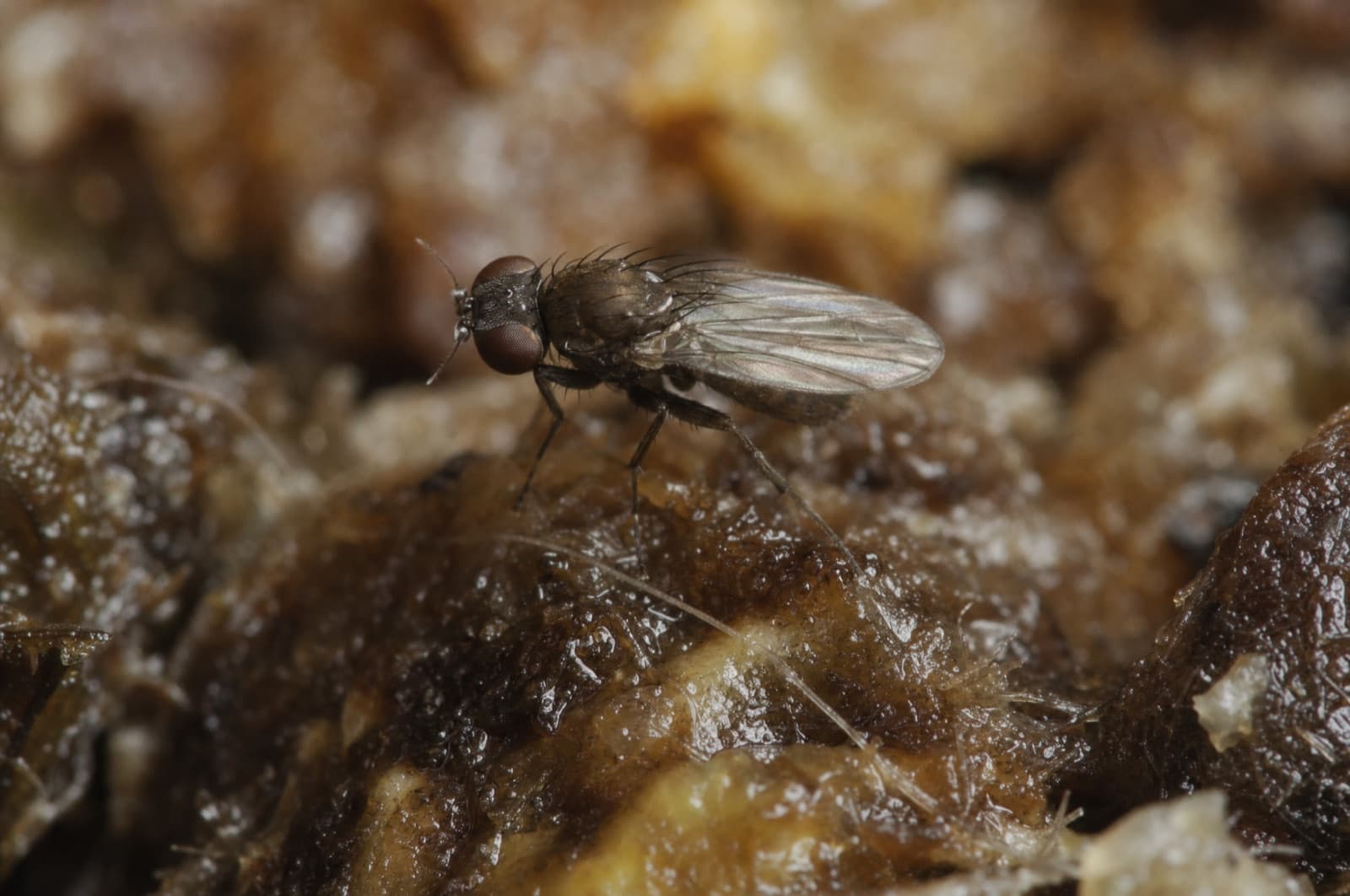
How to Get Rid of Phorid Flies
At a glance
- Difficulty: Intermediate
- Time: A few hours of inspection, then ongoing drain maintenance
- Cost: Low — flashlight, tape, drain brush, enzymatic cleaner
- Success: Good once the source is found; sprays alone rarely work
Can you DIY Phorid Fly?
The verdict on Phorid Fly DIY
Solvable DIY — but only if you find the hidden breeding source first.
Phorid flies ("scuttle flies," recognizable by their hump-backed run instead of flight) breed in decaying organic matter you usually can't see: drain biofilm, garbage buildup, or sometimes a dead animal or a cracked sub-slab sewer line. A homeowner who methodically traces the source with a flashlight and a clear-tape test over drains can usually solve this. The complication is when the source is a broken pipe under the slab — that's a job for a plumber or pest pro, not a spray bottle.
The 5 DIY methods — honestly graded
Every approach graded for this species, in IPM order — prevention first, chemistry late. Pick a method to see how it works, the steps, and what it actually takes.
Prevention / Exclusion
Works wellThe whole job is locating the source — do this before anything else.
Phorid flies lay eggs in wet, decaying organic matter. Finding exactly where that matter is (a slow drain, a garbage staging area, a forgotten dead mouse) and removing it stops the breeding cycle at the root.
Best for: Every case — this is the method that actually solves it
Inspect the likely sources
Check drains, garbage cans, recycling bins, and any area with wet organic buildup with a flashlight. Look for a gelatinous film or unusual moisture.
TipPhorid flies stay close to their breeding site, so cluster locations near sinks or trash areas are a strong clue.Confirm the drain with a clear-tape test
Tape a piece of clear tape sticky-side down over a suspect drain overnight. Emerging flies get stuck underneath, confirming that drain as the source.
CautionPersistent flies despite a clean kitchen and no drain hits can point to a dead animal or a cracked line under the slab — that's a call-a-pro situation, not a DIY one.Fix leaks and broken lines
Repair any dripping pipes or slow leaks feeding organic buildup once the source is confirmed.
Tools & materials
Why DIY falls short here
Not scare tactics — the specific, proportionate reasons a home attempt can stall for this species.
Spraying the adults you see
Larvae keep developing in hidden organic matter regardless of how many adults you kill — only removing the breeding source ends the problem.
A sub-slab or sewer-line source
A broken pipe under the slab is beyond typical DIY reach and needs a plumber or pest professional to diagnose and fix.
How risky is it, really?
An honest read — most nuisance species are genuinely low risk, and we say so.
Phorid flies are chiefly a nuisance and a sanitation indicator, not a health threat for a typical home. Documented larval infestation of wounds or body orifices (myiasis) is rare and generally tied to unsanitary medical or institutional settings, not residential exposure.
- Nuisance / sign of a hidden sanitation problemCommon
Their presence is most useful as a signal to find and fix the source
NC State Extension
- Mechanical pathogen transfer in food-handling settingsRare
More relevant to commercial kitchens than typical homes
NC State Extension
- Myiasis (larval infestation of wounds/orifices)Rare
Rare and generally associated with unsanitary conditions, not casual home exposure
NC State Extension
Phorid Flies Keep Coming Back?
When the breeding source is under a slab or inside a wall, DIY inspection hits its limit. Anchor Pest Services traces stubborn phorid fly sources across southern and central New Hampshire. Family-owned since 2017, NH license #782664.
Call a pro when…
- You suspect a cracked sub-slab sewer line or septic connection
- The source is in a wall void, crawlspace, or other spot you can't safely access
- Flies persist after a full drain-cleaning and sanitation effort
General Pest Control
Call a pro when you've checked every visible source and flies keep coming back — that usually means the source is somewhere you can't reach on your own, like under a slab or deep in a wall void.
Keep them out
- Clean drains regularly with a brush, not just liquid cleaner
- Keep garbage and recycling areas dry and free of organic residue
- Fix slow leaks before they create standing organic buildup
Phorid flies in New Hampshire homes
In NH homes, phorid flies most often trace back to a slow kitchen or bathroom drain, a garbage staging area, or — less commonly — a dead rodent in a wall void during the colder months when mice move indoors. Warm months tend to accelerate breeding in any organic buildup, so a spring drain-cleaning pass heads off summer flare-ups.
Peak season
Warm months, with occasional cold-season spikes tied to rodent activity
Make sure it's a Phorid Fly
Two quick detours worth taking — confirm the ID, then learn what drew it in so it doesn't come back.
Frequently asked
Sources & further reading(3)
- [1]NC State Extension — Phorid Flies
Breeding sources, biology, risk framing
extensionverified 2026-07-13 - [2]mypmp.net — Understanding and Managing Phorid Flies
Enzymatic/microbial drain treatment mechanism
industryverified 2026-07-13 - [3]Orkin — Phorid (Humpbacked) Flies
Identification and source-finding guidance
industryverified 2026-07-13
Written & reviewed by
VerifiedDaniel Brady
NH-Licensed Pesticide Applicator · License #782664 (NHDAMF, RSA 430)
Daniel Brady is the New Hampshire–licensed applicator behind Anchor Pest Services, a family-owned pest control company serving the Manchester area since 2017.
Last updated July 2026
Professional Pest Control
Phorid Flies Keep Coming Back?
When the breeding source is under a slab or inside a wall, DIY inspection hits its limit. Anchor Pest Services traces stubborn phorid fly sources across southern and central New Hampshire. Family-owned since 2017, NH license #782664.
- NH-licensed applicators (#782664)
- Free inspection — same-day service across southern NH
NH License #782664 · No obligation · We answer in person
Your next step
- Book a NH pro
Pest Control Services
Licensed, family-owned pest control across southern NH.
Book now - What to do next
Phorid Flies in New Hampshire — ID, Signs & How to Get Rid of Them
Read the answer - What to do next
Drain Flies in New Hampshire — ID, Signs & How to Get Rid of Them
Read the answer - Also relevant
Phorid Flies in New Hampshire — ID, Signs & How to Get Rid of Them
Read the answer - Also relevant
Filth Fly Prevention: Sanitation Stops Flies at the Source
Read the answer - Related guide
How to Get Rid of Drain Flies
Read the answer