
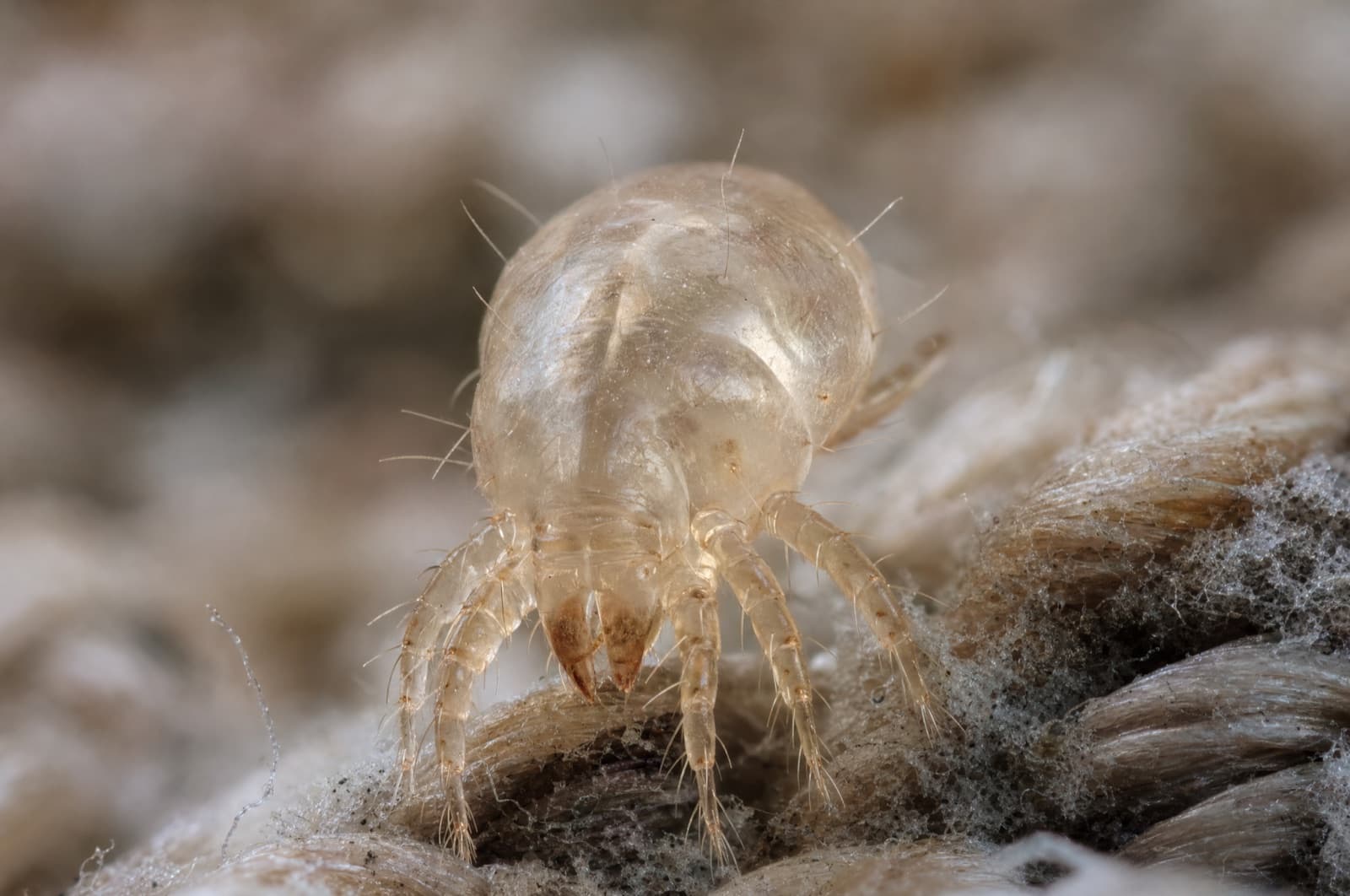
What Attracts Dust Mites to Your House?
At a glance
- Short answer: Dust mites aren't drawn to your house at all — they're drawn to humidity, because they can't drink water.
- The verdict: Something specific
6-11 days
How long active dust mites survive once relative humidity drops to 50% or below
Arlian
70-75%
Share of a dust mite's body that is water, which it must maintain to reproduce
Arlian
The attractant verdict
Four possible answers to why this species turned up. Three stay unlit — and that's the argument: the honest answer could have been any of them, and for this species it wasn't.
Dust mites aren't drawn to your house at all — they're drawn to humidity, because they can't drink water.
Our own previous page said dust mites ‘love to live in our homes, especially in places where they can find food, warmth, and moisture’ — close, but it undersells how absolute the humidity requirement actually is.
Relative humidity above roughly 50-65% in bedding, mattresses, upholstered furniture, and carpet — the specific microhabitats where dust mites can extract enough water vapor from the air to survive, since they have no other way to drink. Shed human and pet skin cells are their food, but food without adequate humidity isn't enough to sustain them.
“A dust mite doesn't care what your house looks like. It cares what the air holds — because it can't drink water any other way.”
Sustained relative humidity above roughly 50-65%, absorbed directly from the air as water vapor rather than drunk as liquid water.
It shifts the entire question from ‘food and shelter’ to a single measurable condition: dust mite populations collapse when indoor relative humidity is kept low, independent of how much dander is present, because the mites physically cannot maintain their body's water balance in dry air.
Calibrated from: Arlian, L.G., 'Water balance and humidity requirements of house dust mites,' Experimental and Applied Acarology (1992): active mites 'do not survive longer than 6-11 days at relative humidities <=50%' and their bodies 'contain 70-75% water by weight, which must be maintained in order to reproduce.'
Why it's here, in full
Why humidity, not food, is the actual driver
Dust mites feed on shed skin cells, which are abundant in almost any home with people or pets, so food is essentially never the limiting factor. What actually determines whether a population thrives or collapses is relative humidity: mites lack the ability to drink liquid water and instead pull water vapor directly from the surrounding air, a process that only works well above roughly 50-65% relative humidity. Below that threshold, active mites die off within days to about two weeks, no matter how much dander is available. That's why populations concentrate in mattresses, pillows, and upholstered furniture — fabric that traps both moisture from sleeping bodies and the skin cells mites feed on — and why a drier home consistently has fewer of them regardless of how much dust is present.
How to tell it's actually this species
Real signs only — a species with four honest tells gets four, and stops. Where a sign is weak on its own, we say so.
Ongoing allergy or asthma symptoms — sneezing, congestion, itchy eyes — noticeably worse in the bedroom or after vacuuming or changing sheets
Could be something else: Similar symptoms can come from seasonal allergies, mold, or pet dander; a pattern tied specifically to bedding and upholstery is the stronger clue for dust mites.
Consistently high indoor humidity (a hygrometer reading above roughly 55-60%) in a bedroom or other soft-furnished room
Visible dust buildup on mattresses, upholstered furniture, or carpet that has gone a long time between deep cleaning
Could be something else: Visible dust alone doesn't confirm mite presence — many dusty surfaces have few or no mites if the air stays dry.
Want dust mites gone?
This page only answers why it's here. Every removal step for this exact species — what to seal, what to set, what actually works — lives on its own dedicated guide.
Two questions, two pages
Here: why it turned up at all — the honest answer, blame removed.
There: the step-by-step removal guide for this exact species.
Already dealing with dust mite?
This page is about why it's there. Getting rid of it is covered at /top-diy-methods/dust-mite.
Frequently asked
Sources(2)
- [1]Arlian, L.G. — Water balance and humidity requirements of house dust mites, Experimental and Applied Acarology (1992)
Active dust mites cannot survive beyond 6-11 days at relative humidity <=50% and require 70-75% body water content
academicverified 2026-07-17 - [2]University of Kentucky Entomology — House Dust Mites (ENTFACT-646)
Dust mite diet (shed skin cells) and humidity-dependent microhabitats in bedding and upholstery
extensionverified 2026-07-17
Written & reviewed by
VerifiedDaniel Brady
NH-Licensed Pesticide Applicator · License #782664 (NHDAMF, RSA 430)
Daniel Brady is the New Hampshire–licensed applicator behind Anchor Pest Services, a family-owned pest control company serving the Manchester area since 2017.
Last updated Jul 2026
Food, water, warmth, shelter — the usual four
If it's already inside, we handle the rest
Same-day inspections across southern and central New Hampshire.
- Family-owned in Manchester since 2017
- NH commercial applicator #782664, category F1
- We will tell you when the answer is do nothing
NH License #782664 · No obligation · We answer in person
Your next step
- What to do next
Dust Mites in NH: The Allergen You Can't See or Find
Read the answer - Also relevant
How to Get Rid of Dust Mites
Read the answer - Also relevant
Do Mites Die in the Winter? NH Mite Activity Guide
Read the answer - Also relevant
Mechanical Tick & Mite Control: Barriers, Removal, Heat
Read the answer - Related guide
What Attracts Clover Mites to Your House?
Read the answer