
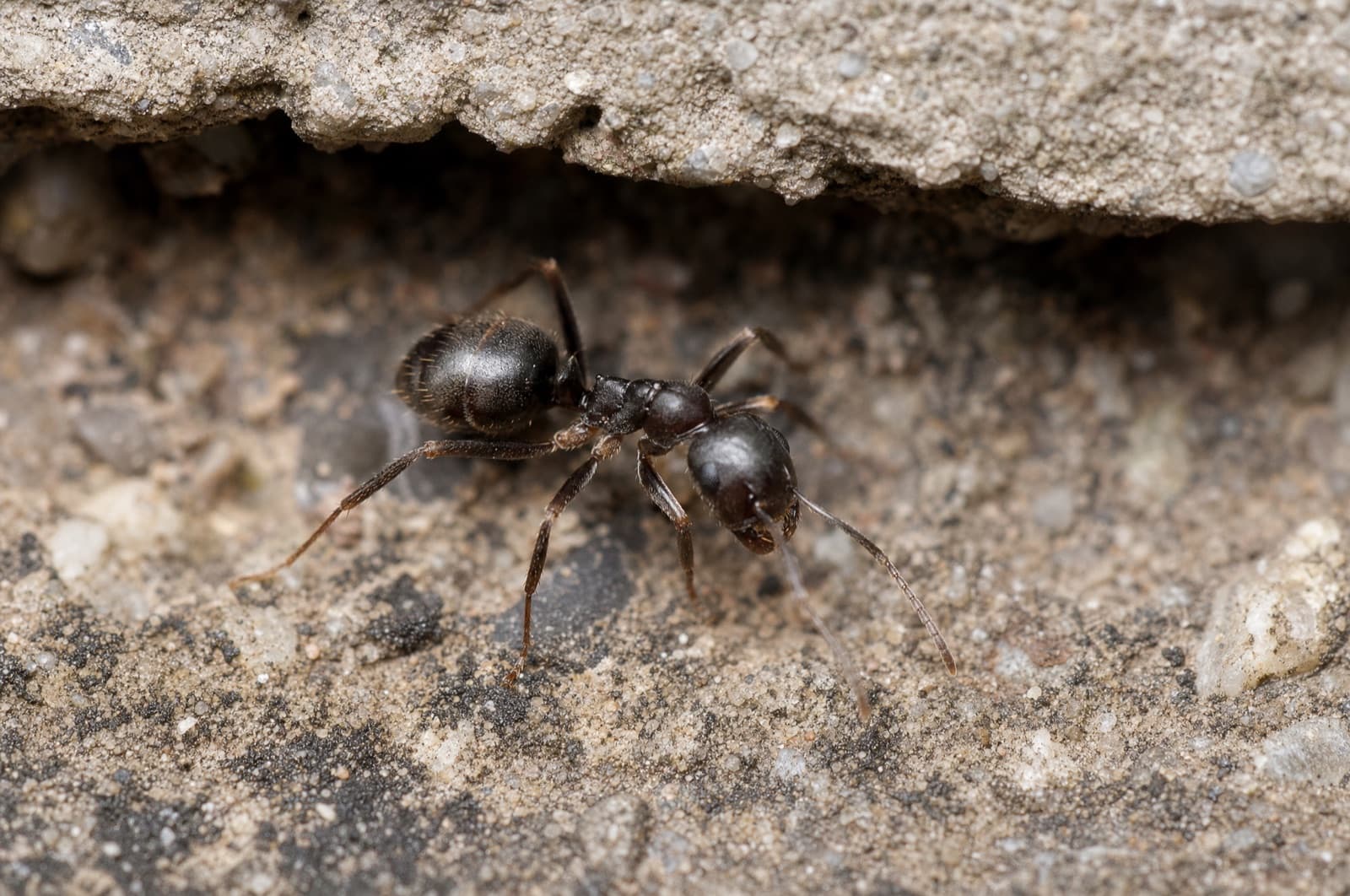
How to Get Rid of Pavement Ants
At a glance
- Difficulty: Beginner
- Time: Days to a few weeks for bait to work; an afternoon to seal entry points
- Cost: Low — a few labeled bait stations and some caulk
- Success: High with bait and patience; low if you rely on spraying trails
Can you DIY Pavement Ant?
The verdict on Pavement Ant DIY
Genuinely DIY-friendly — bait beats spray, and patience is the only hard part.
Pavement ants nest in soil under slabs, driveways, and foundation edges, and forage indoors for food. Slow-acting labeled bait exploits their biology directly: workers carry it back to the nest and feed the queen, which is the only way to actually end a colony. This is one of the most common structural ants a NH homeowner meets, and it's also one of the easiest to manage correctly.
The 5 DIY methods — honestly graded
Every approach graded for this species, in IPM order — prevention first, chemistry late. Pick a method to see how it works, the steps, and what it actually takes.
Prevention / Exclusion
ModerateReduces how many ants get inside to forage, but won't eliminate an established outdoor colony under the slab.
Pavement ants nest in soil along the edges and cracks of driveways, patios, sidewalks, and foundations. Closing the gaps they use to move indoors cuts recruitment, even though the colony itself lives outside in soil you can't seal.
Best for: Cutting down indoor foraging alongside a bait program
Seal foundation cracks and gaps
Caulk cracks in the foundation and gaps around pipe and utility penetrations where ants slip inside to forage.
Reduce slab-edge moisture and food access
Sweep up crumbs and spills, store food in sealed containers, and address standing water near slab edges and driveway joints — pavement ants nest right where soil meets concrete.
Tools & materials
Why DIY falls short here
Not scare tactics — the specific, proportionate reasons a home attempt can stall for this species.
Spraying instead of baiting
Killing foragers on contact leaves the queen laying eggs undisturbed; the trail typically returns within days.
One bait placement for a territorial colony
Pavement-ant colonies don't share resources across colony boundaries, so a single bait station may only knock down one of several colonies foraging your property.
Impatience
Colony collapse from bait takes weeks. Pulling the bait at the first sign of improvement lets the colony rebuild.
How risky is it, really?
An honest read — most nuisance species are genuinely low risk, and we say so.
Pavement ants are a nuisance, not a health threat. They can technically sting but rarely do so against people, and the effect is negligible. They don't damage concrete or structural wood.
- Contamination of exposed foodCommon
Discard exposed food and store dry goods sealed
Penn State Extension
- A rare, trivial sting if handled directlyRare
Pavement ants carry a stinger but seldom use it against people
Penn State Extension
- No structural damageOccasional
They remove loose soil under slabs, but do not chew through concrete or structural wood
Penn State Extension
Pavement Ants Keep Coming Back?
When bait alone isn't cutting it or trails cross a large property, Anchor Pest Services handles targeted treatment across southern and central New Hampshire. Family-owned since 2017, NH license #782664.
Call a pro when…
- Trails persist after several weeks of correctly placed bait
- Activity across a large yard suggesting several colonies
- You'd rather not identify and monitor nest sites yourself
General Pest Control
Most pavement-ant activity is a solvable DIY bait job. A pro is worth calling when trails keep returning despite a proper bait program, or when multiple colonies span a large property and you want professional-grade placement and follow-up.
Keep them out
- Seal foundation cracks and utility penetrations
- Keep slab edges and driveway joints dry
- Store food in sealed containers and clean up crumbs promptly
Pavement ants in New Hampshire
Pavement ants are among the most commonly encountered structural ants at NH homes, nesting in the soil under driveways, patios, sidewalks, and foundation slabs — you'll often spot small mounds of excavated soil pushing up through cracks in the pavement. They forage indoors most actively in warmer months, entering through foundation cracks and utility gaps in search of food.
Peak season
Spring through fall foraging; most visible after rain when soil mounds appear
First-frost anchor
Manchester first hard frost ~Oct 19 (50%) / Oct 29 (80%), NOAA 1991–2020
Make sure it's a Pavement Ant
Two quick detours worth taking — confirm the ID, then learn what drew it in so it doesn't come back.
Frequently asked
Sources & further reading(3)
- [1]Penn State Extension — Pavement Ants
Bait vs. spray mechanism, queen-kill requirement, nesting habitat
extensionverified 2026-07-13 - [2]Pest Control Technology — "Pound the Pavement"
Purdue survey data on pavement-ant prevalence; territorial colony bait behavior
industryverified 2026-07-13 - [3]
Written & reviewed by
VerifiedDaniel Brady
NH-Licensed Pesticide Applicator · License #782664 (NHDAMF, RSA 430)
Daniel Brady is the New Hampshire–licensed applicator behind Anchor Pest Services, a family-owned pest control company serving the Manchester area since 2017.
Last updated July 2026
Other species you can tackle
Same category — the dot shows each one's DIY verdict at a glance (green = friendly, amber = doable with care, red = call a pro).
Professional Pest Control
Pavement Ants Keep Coming Back?
When bait alone isn't cutting it or trails cross a large property, Anchor Pest Services handles targeted treatment across southern and central New Hampshire. Family-owned since 2017, NH license #782664.
- Bait-first, science-based approach
- NH-licensed applicators (#782664)
- Free inspection — same-day service across southern NH
NH License #782664 · No obligation · We answer in person