
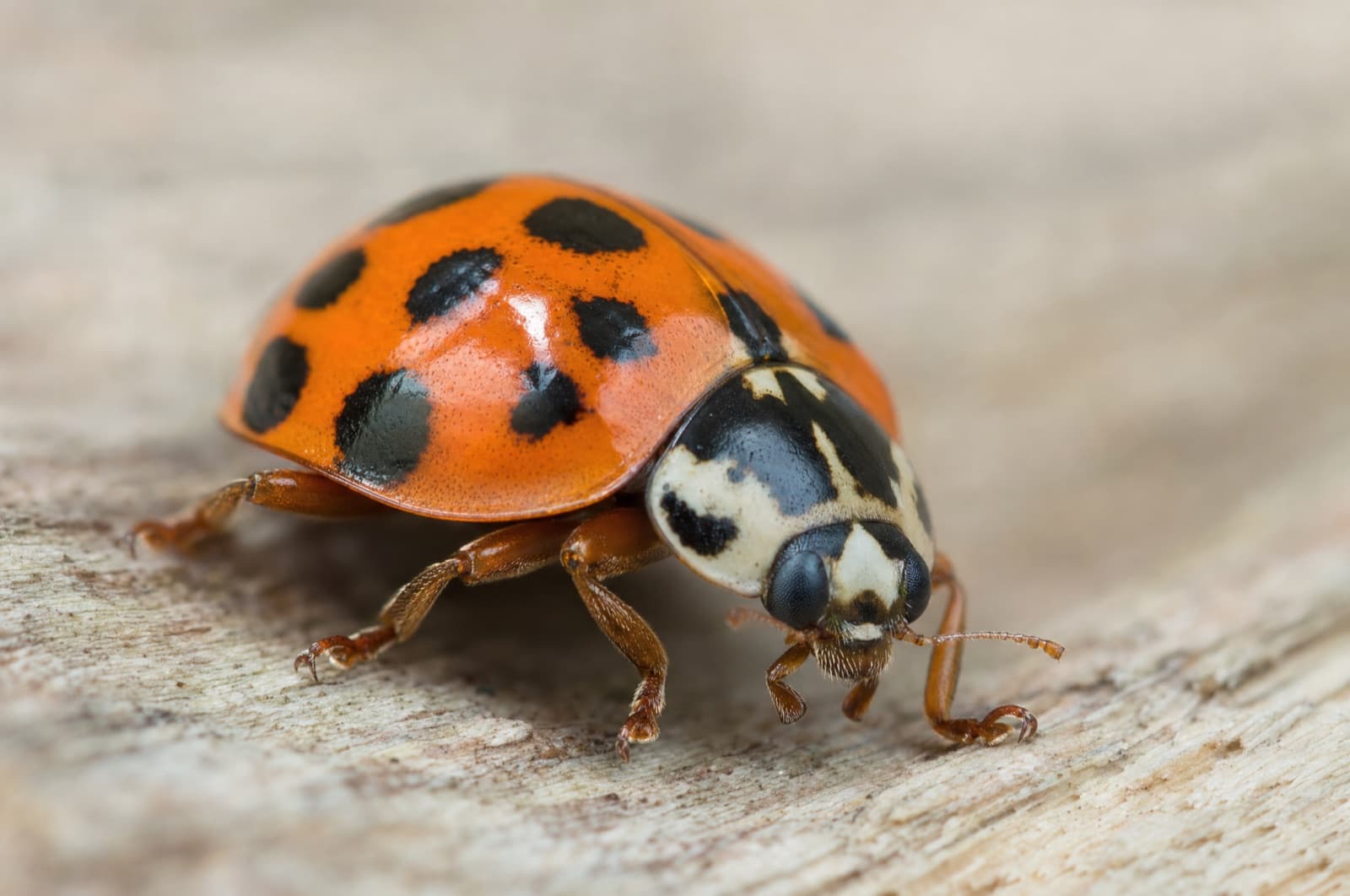
Do Asian Lady Beetles Bite?
At a glance
- The short answer: Yes — and the bigger issue is the allergen, not the nip
- How to tell: Behaviour, not colour — see The Split
- Where removal lives: We route it out — this hub owns identity
One animal, one honest answer
The verdict on Do Asian lady beetles bite?
Yes, they bite — a minor, pinprick-like nip — and for sensitized people the more consequential fact is a documented indoor allergen, confirmed in peer-reviewed research.
Native ladybug vs. the Asian lady beetle
Two names, one animal. Both columns always render — and they always converge on the same resolution. The tell is behaviour, not colour.
The native ladybug
(the one you're picturing)
- Overwinters outdoors and rarely comes into direct contact with people at all
- Present in NH gardens through summer without functioning as an indoor nuisance
- Not the species implicated in the peer-reviewed bite and allergen research this page cites
The Asian lady beetle
(Harmonia axyridis)
- Has functional chewing mandibles and documented bite reports when searching for moisture (Koch 2003)
- Reflex-bleeds a staining, foul-smelling defensive fluid when disturbed or handled
- Confirmed indoor allergen source — two purified proteins bind IgE antibody in exposed patients
If something is nipping you indoors each fall, it's the Asian lady beetle. Both are ladybugs; only one aggregates in your house in numbers.
What's actually going on
Yes — and this is the one place the common fear is accurate
Most of what this hub corrects is an overblown fear about a harmless insect. This question is the exception, and it deserves a straight answer instead of a reflexive debunking. Koch's standard peer-reviewed review of the species' biology states plainly that Harmonia axyridis "has been reported to bite humans," consistent with its functional chewing mandibles (Koch 2003, Journal of Insect Science). University of Minnesota Extension is specific about the circumstances: individuals searching skin for moisture or salt "can bite hard enough to break human skin, causing minor, short-lived discomfort." UNH Cooperative Extension describes the sensation as roughly equivalent to a pinprick — not a puncture wound, not venom, and gone quickly, but a genuine bite rather than a myth. A beetle simply crawling on skin isn't biting; the nip happens when one is pressed against skin or trapped against it, which is also often the moment a disturbed beetle reflex-bleeds its defensive fluid at the same time, adding a foul smell and a yellow stain to the encounter. In New Hampshire the encounters cluster in fall, when UNH Cooperative Extension reports the beetles are most numerous on the sunny side of buildings on mild days from mid-September through early November and begin working their way indoors — which is when a household is most likely to feel one of these nips at all.
The bigger issue is the allergen, not the nip
The bite itself is minor. What makes this beetle a genuine, documented health consideration is the allergen. Nakazawa et al. purified two proteins from Harmonia axyridis, Har a 1 (about 10 kDa) and Har a 2 (about 55 kDa), and found they "bound IgE antibody in 65% and 75% of the sera, respectively," from patients living in infested homes (Nakazawa et al. 2007, Journal of Allergy and Clinical Immunology). A clinical review in Allergy and Asthma Proceedings confirms the beetle has become a recognized seasonal indoor allergen capable of producing rhinoconjunctivitis, asthma, and skin reactions in sensitized people (Goetz 2008). That allergen risk, not the nip, is the more consequential half of this page's answer, and it is covered in full depth — including who's most at risk and what symptoms look like — on this hub's page about whether they can cause allergies. None of this makes the beetle dangerous in the venomous or disease-carrying sense: it is a real nip plus a real, but bounded and well-characterized, allergen.
Key takeaways
Yes, Asian lady beetles bite — functional chewing mandibles deliver a real, if minor and short-lived, pinprick-like nip.
The more consequential fact is the documented allergen: two purified proteins, Har a 1 and Har a 2, bind IgE antibody in exposed patients.
The bite is not venomous and the species does not transmit disease — the allergen is the genuine health consideration, not the nip itself.
This page replaces 10 of our own legacy pages that asked this same harm question by pet-free framing and by both species names.
These questions all land here
We asked this more than once, under more than one name, and printed more than one answer. There was only ever one — so here's what this page replaces.
We asked this question twice — once about "ladybugs", once about "Asian beetles" — and printed two answers. There was only ever one.
Looking to get rid of them?
This hub answers what it is — not how to remove it. Most people who land here actually want one of these next steps, so we hand you straight to the hub that owns it.
A real nip, a real allergen — a real reason to call.
If Asian lady beetles are massing on your New Hampshire home this fall, we can help before the nips and the allergen exposure add up.
Frequently asked
Sources & further reading(6)
- [1]Koch 2003 — Journal of Insect Science, "The Multicolored Asian Lady Beetle, Harmonia axyridis: A Review"
Documented reports of biting behavior in humans
academicverified 2026-07-17 - [2]Nakazawa et al. 2007 — Journal of Allergy and Clinical Immunology
Purification of allergens Har a 1 and Har a 2; IgE binding rates in exposed patients
academicverified 2026-07-17 - [3]Goetz 2008 — Allergy and Asthma Proceedings 29:123-129
Clinical review of ladybug-induced rhinoconjunctivitis, asthma, and urticaria
academicverified 2026-07-17 - [4]University of Minnesota Extension — Multicolored Asian Lady Beetles
Circumstances and severity of bites; moisture-seeking behavior
extensionverified 2026-07-17 - [5]UNH Cooperative Extension — "How can I get rid of Asian ladybugs in my house?"
Bite sensation described as equivalent to a pinprick
extensionverified 2026-07-17 - [6]UNH Cooperative Extension — Multicolored Asian Ladybug fact sheet
NH fall window: most numerous on sunny building sides mid-September through early November
extensionverified 2026-07-17
Written & reviewed by
VerifiedDaniel Brady
NH-Licensed Pesticide Applicator · License #782664 (NHDAMF, RSA 430)
Daniel Brady is the New Hampshire–licensed applicator behind Anchor Pest Services, a family-owned pest control company serving the Manchester area since 2017.
Last updated July 2026
Honest pest ID for New Hampshire homes
One Honest Yes, Ten Pages We Deleted
The bite is real and so is the allergen — we say so plainly rather than debunking a fear that happens to be accurate. Family-owned since 2017, NH license #782664, based at 700 Harvey Rd in Manchester.
- NH-licensed applicators (#782664) — free inspection, same-day service
- We consolidated 10 of our own pages rather than soften a documented risk
- Family-owned, Manchester NH, since 2017
NH License #782664 · No obligation · We answer in person
Your next step
- Fall guide
Fall Pest Control in New Hampshire
What matters before frost: the fall invader window, mice at the foundation, and what to seal first.
Read the answer - What to do next
Do lady beetles bite or cause reaction?
Read the answer - What to do next
What Attracts Asian Lady Beetles to Your House?
Read the answer - What to do next
When Are Asian Lady Beetles Active? NH Ladybug Timing
Read the answer - What to do next
How to Get Rid of Asian Lady Beetles
Read the answer - Also relevant
Asian Lady Beetle in New Hampshire: Honest ID & What to Do
Read the answer