
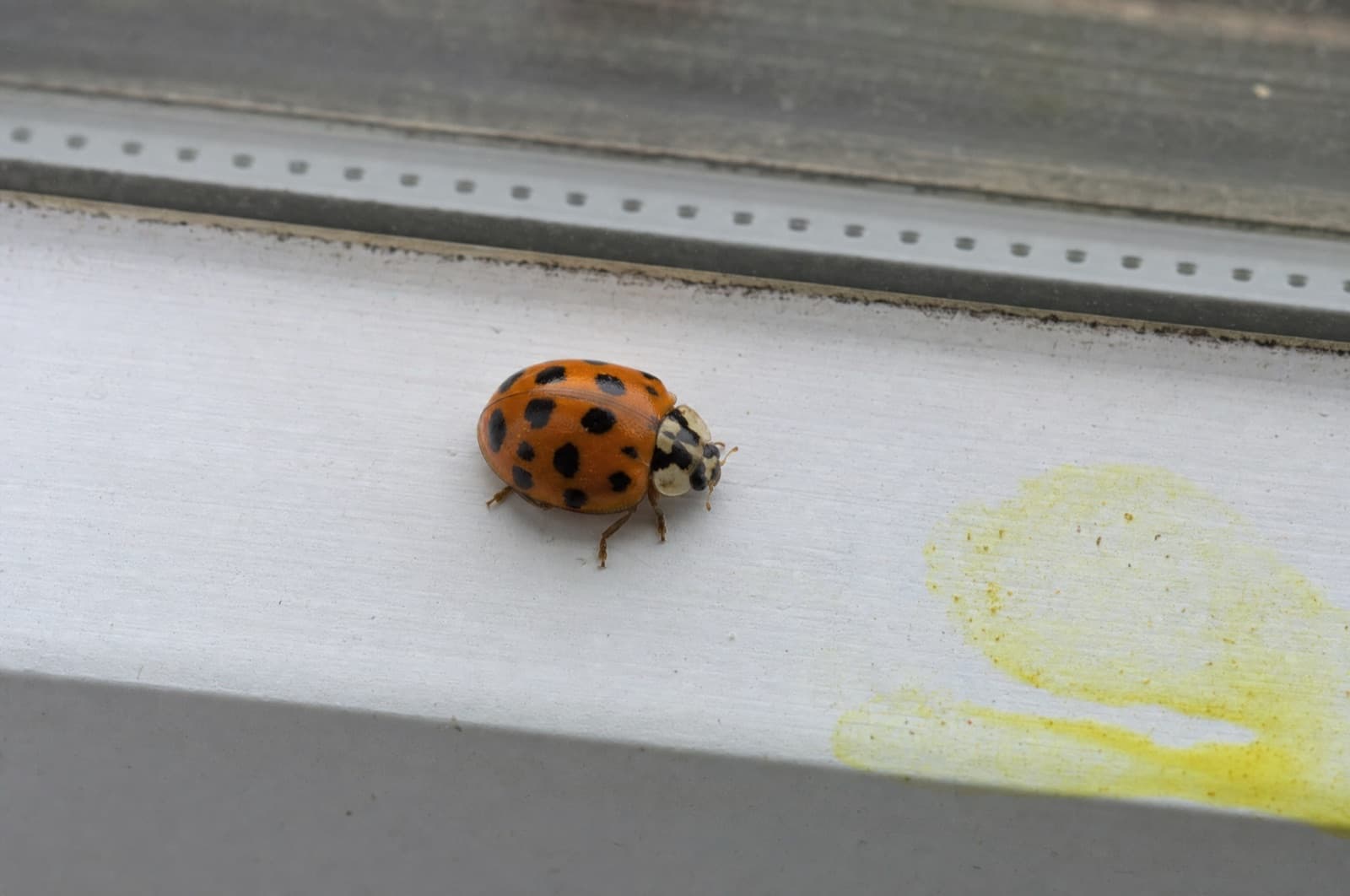
Why Do They Smell, and What Is the Yellow Stain?
At a glance
- The short answer: One mechanism: reflex bleeding
- How to tell: Behaviour, not colour — see The Split
- Where removal lives: We route it out — this hub owns identity
One animal, one honest answer
The verdict on Why do they smell, and what is the yellow stain?
The smell and the yellow stain are the same event — a defensive fluid the beetle releases from its leg joints when it's disturbed, not two separate problems.
Native ladybug vs. the Asian lady beetle
Two names, one animal. Both columns always render — and they always converge on the same resolution. The tell is behaviour, not colour.
The native ladybug
(the one you're picturing)
- Shares the same general reflex-bleeding defense found across the ladybug family
- Rarely aggregates indoors in numbers large enough for the smell or stain to be noticeable
- Not the source of the fall staining and odor complaints this page addresses
The Asian lady beetle
(Harmonia axyridis)
- Reflex-bleeds a defensive hemolymph carrying alkaloids and foul-smelling compounds
- Aggregates indoors in numbers large enough to make the smell and staining noticeable
- Disturbing or crushing beetles triggers the strongest release of fluid
If a stain or smell like this is showing up indoors in numbers, it's the Asian lady beetle — not because it's the only species that reflex-bleeds, but because it's the one that aggregates where you'd notice.
What's actually going on
One mechanism: reflex bleeding
The smell, the yellow fluid, and the stain are not three separate topics — they're one defensive reaction, described in peer-reviewed detail as reflex bleeding: hemolymph released from the tibio-femoral leg joints of a threatened beetle, in a quantity that can amount to a substantial fraction of its body weight (Schmidtberg et al. 2019, Ecology and Evolution). That hemolymph carries the defensive alkaloid harmonine along with volatile alkyl-methoxypyrazines at high concentration, which is where the foul odor and bitter taste come from, and the same fluid is what stains porous, light-coloured materials on contact. UNH Cooperative Extension confirms the practical result: the yellowish fluid "can damage light colored rugs and upholstery." It's worth correcting one specific folk mix-up folded into this question: the yellow substance some homeowners describe finding indoors is this defensive fluid, not fecal waste — the beetles are not "pooping" on walls or furniture, they're reflex-bleeding when disturbed.
Why crushing makes it worse, and what to do instead
Because the strongest release of fluid happens when a beetle is crushed, crushing is exactly the wrong response to a cluster — /fall-invaders-faq grades crushing counterproductive, and this page agrees rather than re-litigating it: crushing maximizes staining, releases the most odor, and adds allergen-carrying dust to indoor air. There's a second reason to avoid leaving dead beetles in place: accumulations of dead insects in wall voids and around windows are a known food source for scavenging dermestid beetles, commonly called carpet beetles, which is one more reason dead clusters shouldn't be left where they fell (Colorado State University Extension). Vacuuming, rather than sweeping or crushing, reduces staining considerably, per UNH Extension's own guidance — but the full step-by-step removal approach belongs to /top-diy-methods/asian-lady-beetle, not to this page, which exists to explain the mechanism, not to walk through a cleanup procedure.
Key takeaways
The smell, the yellow fluid, and the stain are one mechanism — reflex bleeding from the leg joints of a disturbed beetle — not three separate problems.
What some homeowners describe as the beetles "pooping" indoors is this same defensive fluid, not waste.
Crushing triggers the strongest release of fluid, which is exactly why crushing is graded counterproductive rather than a fix.
This page replaces 7 of our own legacy pages that split one mechanism across two names and two topics — smell and stain.
These questions all land here
We asked this more than once, under more than one name, and printed more than one answer. There was only ever one — so here's what this page replaces.
We asked this question twice — once about "ladybugs", once about "Asian beetles" — and printed two answers. There was only ever one.
Looking to get rid of them?
This hub answers what it is — not how to remove it. Most people who land here actually want one of these next steps, so we hand you straight to the hub that owns it.
One mechanism, and we know how to handle it.
If a cluster is already staining a windowsill or filling a room with odor, we can help before more fluid ends up on your walls or fabric.
Frequently asked
Sources & further reading(4)
- [1]Schmidtberg et al. 2019 — Ecology and Evolution, reflex-bleeding and defensive chemistry study
Reflex bleeding mechanism, hemolymph volume, harmonine and methoxypyrazine defensive chemistry
academicverified 2026-07-17 - [2]UNH Cooperative Extension — "How can I get rid of Asian ladybugs in my house?"
Staining fluid can damage light-coloured rugs and upholstery; vacuuming reduces staining versus crushing
extensionverified 2026-07-17 - [3]Colorado State University Extension — Dermestid (Carpet) Beetles fact sheet
Accumulations of dead insects behind walls and around windows as a dermestid food source
extensionverified 2026-07-17 - [4]UNH Cooperative Extension — Multicolored Asian Ladybug fact sheet
NH fall aggregation window: most numerous on sunny building sides mid-September through early November
extensionverified 2026-07-17
Written & reviewed by
VerifiedDaniel Brady
NH-Licensed Pesticide Applicator · License #782664 (NHDAMF, RSA 430)
Daniel Brady is the New Hampshire–licensed applicator behind Anchor Pest Services, a family-owned pest control company serving the Manchester area since 2017.
Last updated July 2026
Honest pest ID for New Hampshire homes
One Mechanism, Seven Pages We Deleted
The smell and the yellow stain are the same defensive fluid, released the same way, whether you call the insect a ladybug or an Asian beetle. Family-owned since 2017, NH license #782664, based at 700 Harvey Rd in Manchester.
- NH-licensed applicators (#782664) — free inspection, same-day service
- We consolidated 7 of our own pages that split one mechanism across smell and stain
- Family-owned, Manchester NH, since 2017
NH License #782664 · No obligation · We answer in person
Your next step
- Fall guide
Fall Pest Control in New Hampshire
What matters before frost: the fall invader window, mice at the foundation, and what to seal first.
Read the answer - What to do next
When Are Asian Lady Beetles Active? NH Ladybug Timing
Read the answer - What to do next
Will lady beetles damage furniture or wood?
Read the answer - Related guide
Can They Damage My House?
Read the answer - Also relevant
Asian Lady Beetle in New Hampshire: Honest ID & What to Do
Read the answer - Related guide
Is It a Ladybug or an Asian Beetle?
Read the answer