
Why Are They Orange and Not Red?
At a glance
- The short answer: Both — colour won't settle it, and that's the honest answer
- How to tell: Behaviour, not colour — see The Split
- Where removal lives: We route it out — this hub owns identity
One animal, one honest answer
The verdict on Why are they orange and not red?
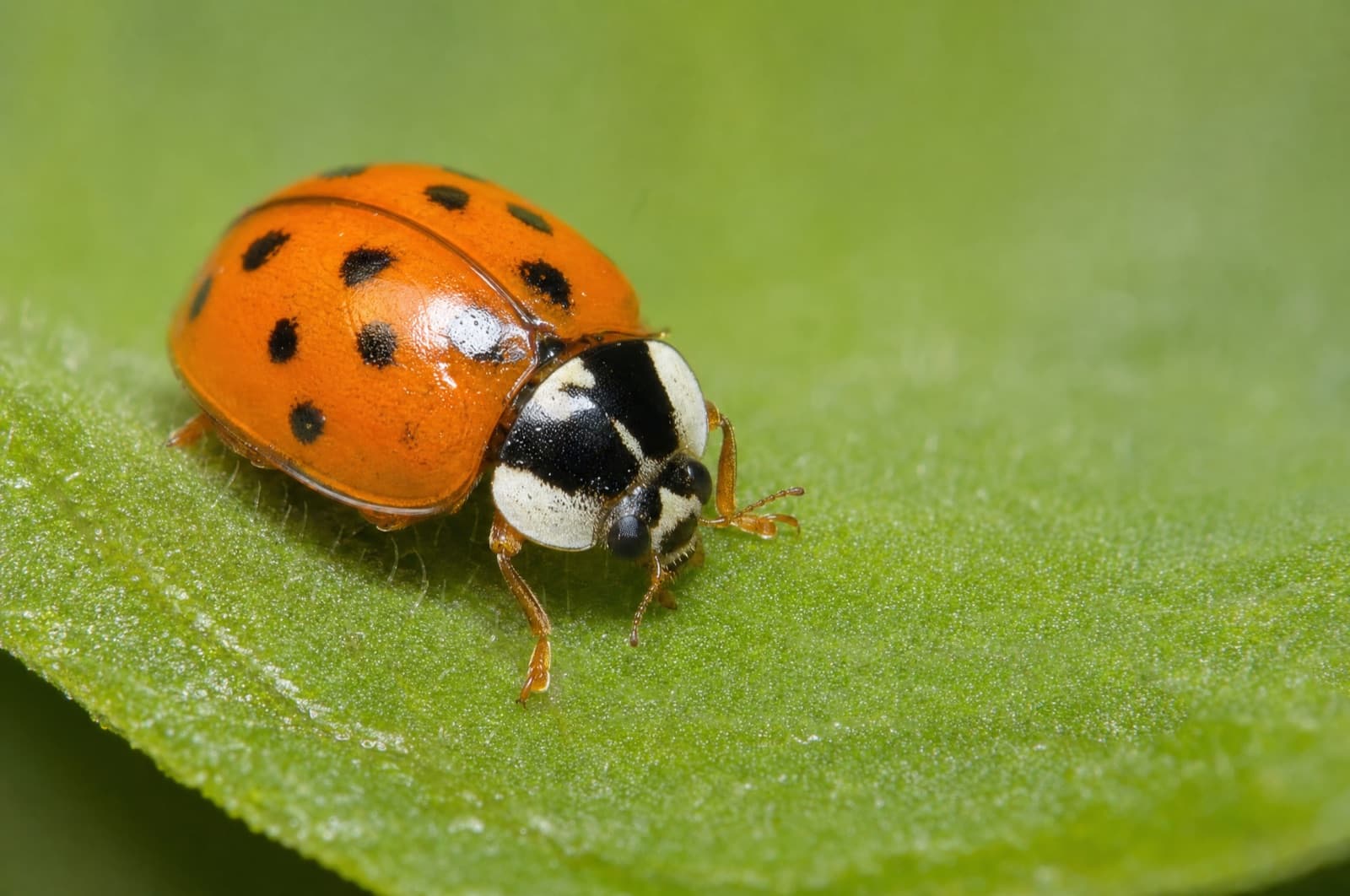
Colour doesn't settle it — Harmonia axyridis itself ranges from pale yellow-orange to deep red to solid black, so there is no reliable orange-versus-red rule.
Native ladybug vs. the Asian lady beetle
Two names, one animal. Both columns always render — and they always converge on the same resolution. The tell is behaviour, not colour.
The native ladybug
(several New Hampshire species)
- Also spans a range of reds, oranges, and spot counts depending on species
- Does not gather on houses to overwinter, regardless of its colour
- Colour overlaps heavily with the Asian lady beetle's range — no visual shortcut separates them
The Asian lady beetle
(Harmonia axyridis)
- Ranges from pale yellow-orange through deep red to fully black — genuinely, not just occasionally
- Carries anywhere from zero to nearly twenty black spots on the same body plan
- Aggregates on sun-warmed walls each fall — that behavior identifies it, not its shade
If it's aggregating on or inside your house in numbers, it's the Asian lady beetle — whatever colour it happens to be. Both are ladybugs. Only one does this.
What's actually going on
Colour is genetics, not a species label
The honest answer to "why orange and not red" starts by questioning the premise: this beetle isn't reliably orange, or reliably red, or reliably anything. Gautier et al. (2018, Current Biology) report that "more than 200 distinct color forms have been described" in Harmonia axyridis, arising from allelic variation at a single genetic locus the researchers identified as the transcription factor pannier, which controls where black melanin gets deposited on the wing covers. Four dominant natural forms follow from that one gene — pale yellow-orange with black spots (form succinea), and three progressively more melanic, largely black forms with only a few pale markings (conspicua, spectabilis, axyridis). One species, one gene, one enormous range of outcomes. Iowa State University Extension puts a number on the spot count specifically: the common orange-to-red form carries anywhere from zero to nineteen black spots, and UNH Cooperative Extension's New Hampshire field data lines up with that — specimens running "orange to reddish-orange, sometimes tan," with none to as many as eighteen spots on the same beetle. There is no reliable rule that orange means invasive and red means native; the biology simply won't carry a rule that clean.
Spot count doesn't help either — behavior does
It's tempting to reach for a second shortcut once colour fails — surely spot count settles it? It doesn't. The same genetic variation that produces the colour range also produces the spot range, and a native New Hampshire ladybug can carry a spot count that overlaps this beetle's entirely. Treating either trait as diagnostic just relocates the same mistake from one visual feature to another. What actually separates the two is behavior, covered in full on this hub's native-versus-Asian comparison: a lady beetle aggregating on or entering a house in numbers each fall is essentially always the Asian lady beetle, regardless of its shade or spot count that day. The one physical cue worth knowing, if you want something beyond behavior, is the white pronotum marked with a black "M" or "W" — UNH Extension and the wider literature treat it as more consistent than colour — but a full identification key belongs to /pests, not to this page.
Key takeaways
There is no reliable "orange means invasive, red means native" rule — the evidence will not carry it.
Harmonia axyridis ranges from pale yellow-orange through deep red to fully black, with zero to nearly twenty spots, all from one gene (pannier).
A native New Hampshire ladybug can show a very similar colour and spot count — colour and spot count are both weak tells.
This page replaces 5 of our own legacy pages that asked the colour and spot-count question under two different names.
These questions all land here
We asked this more than once, under more than one name, and printed more than one answer. There was only ever one — so here's what this page replaces.
We asked this question twice — once about "ladybugs", once about "Asian beetles" — and printed two answers. There was only ever one.
Looking to get rid of them?
This hub answers what it is — not how to remove it. Most people who land here actually want one of these next steps, so we hand you straight to the hub that owns it.
Whatever colour it is, we know what it is.
Orange, red, or nearly black — if it's massing on your New Hampshire home this fall, it's essentially always the Asian lady beetle, and we handle it.
Frequently asked
Sources & further reading(4)
- [1]Gautier et al. 2018 — Current Biology, "The Genomic Basis of Color Pattern Polymorphism in the Harlequin Ladybird"
Over 200 documented colour forms arising from variation at the pannier gene
academicverified 2026-07-17 - [2]Iowa State University Extension and Outreach — Ladybug (Multicolored Asian Lady Beetle)
Colour range and zero-to-nineteen spot count of the common form; melanic forms
extensionverified 2026-07-17 - [3]UNH Cooperative Extension — Multicolored Asian Ladybug fact sheet
New Hampshire specimen colour and spot-count range; white pronotum/black M marking
extensionverified 2026-07-17 - [4]PMC — pannier and melanin patterning in Harmonia axyridis
Genetic mechanism underlying elytral colour-pattern variation
academicverified 2026-07-17
Written & reviewed by
VerifiedDaniel Brady
NH-Licensed Pesticide Applicator · License #782664 (NHDAMF, RSA 430)
Daniel Brady is the New Hampshire–licensed applicator behind Anchor Pest Services, a family-owned pest control company serving the Manchester area since 2017.
Last updated July 2026
Honest pest ID for New Hampshire homes
One Colour Question, Five Pages We Deleted
Colour was never a reliable way to tell these beetles apart — Harmonia axyridis itself spans yellow-orange to solid black. Family-owned since 2017, NH license #782664, based at 700 Harvey Rd in Manchester.
- NH-licensed applicators (#782664) — free inspection, same-day service
- We consolidated 5 of our own pages rather than ship a colour rule the evidence won't carry
- Family-owned, Manchester NH, since 2017
NH License #782664 · No obligation · We answer in person
Your next step
- Fall guide
Fall Pest Control in New Hampshire
What matters before frost: the fall invader window, mice at the foundation, and what to seal first.
Read the answer - What to do next
What do Asian lady beetles look like indoors?
Read the answer - What to do next
When Are Asian Lady Beetles Active? NH Ladybug Timing
Read the answer - Also relevant
Asian Lady Beetle in New Hampshire: Honest ID & What to Do
Read the answer - Related guide
Is It a Ladybug or an Asian Beetle?
Read the answer - Related guide
Native Ladybug or Asian Lady Beetle — Which One Do I Have?
Read the answer