
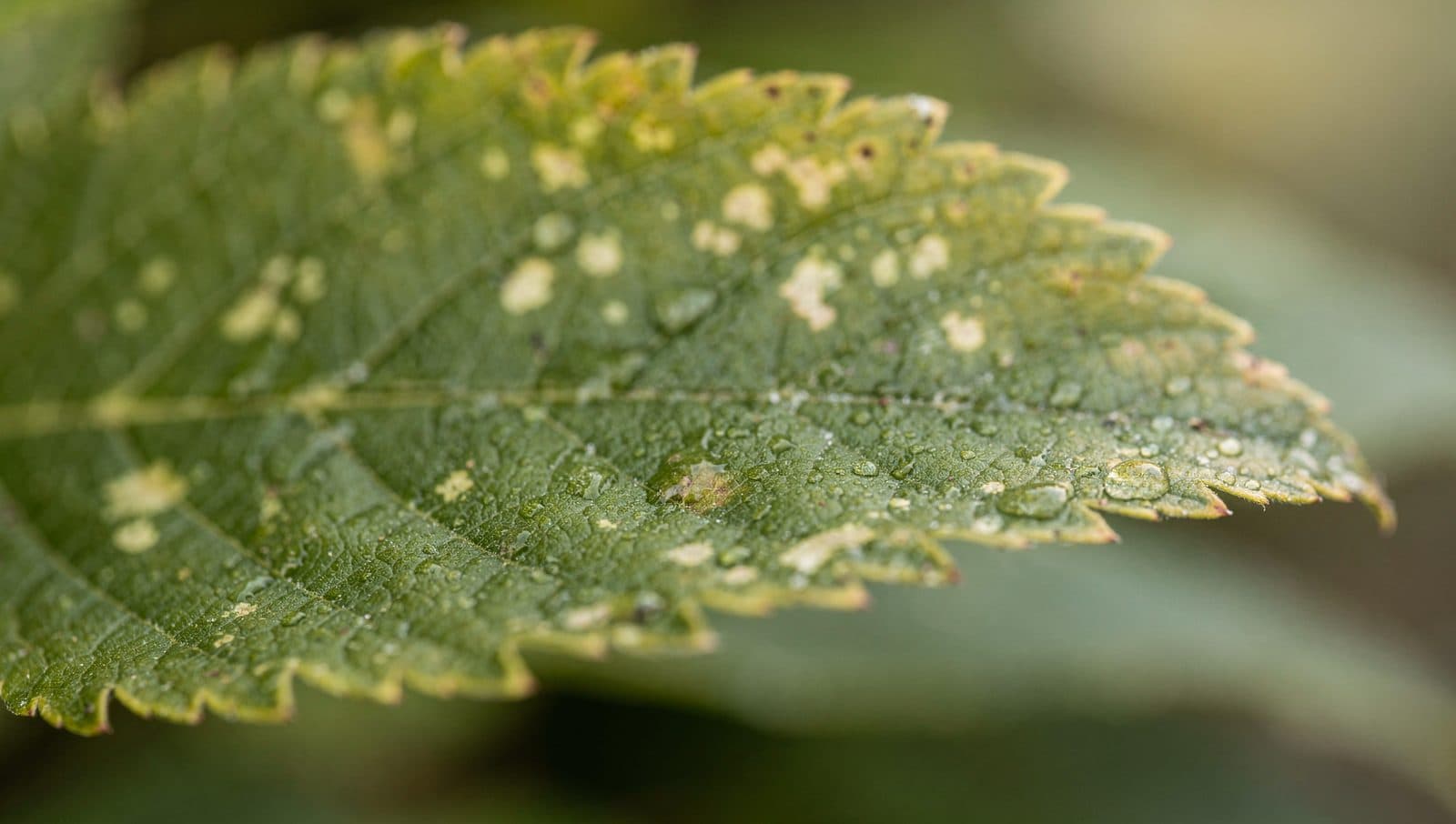
Why Do Leaves Get Powdery Mildew?
White powder on leaves is a fungal disease, not a bug and not dust — the canonical case where the honest answer is 'disease, not a pest,' and no pest-control spray treats it.
At a glance
- The verdict: It's a disease, not a bug
- Who fixes it: You
- Category: Leaf Disease & Fungus Management
The short answer
Powdery mildew is a fungal disease caused by a group of related fungi in the family Erysiphaceae, per University of Minnesota Extension. It shows up as white-to-gray, talcum-powder-like patches on leaves, shoots, and buds, per Colorado State University Extension. Unusually for a fungal disease, it does not need wet leaves — it thrives in high humidity with warm days and cool nights, and is worse in shade and crowded, low-airflow spots, per UMN and West Virginia University Extension. The fungi are largely host-specific, so mildew on one plant won't necessarily spread to a different species. It is not an insect problem, and a pest-control company is the wrong call.
Pest, disease, or how you're caring for it?
Most leaf problems aren't pests at all. Here's the honest split — the most likely cause, the less likely ones, and how to tell them apart before you treat anything.
- DiseaseMost likelythe usual cause
White to grayish, powdery or felt-like patches on upper or lower leaf surfaces, shoots, and buds; leaves may yellow, distort, or drop, and some plants show purple or red tints around the infected area, per UMN Extension.
Erysiphaceae-family fungi on lilac, bee balm (Monarda), phlox, peony, rose, and zinniaPowdery mildew on cucurbits (squash, cucumber, pumpkin)Powdery mildew on dogwood, ninebark, and turfgrassThe tell:The powder rubs off with a finger because it's surface growth (the fungus only feeds via structures into the outer leaf cells, per Colorado State). It shows up in warm-day, cool-night, humid conditions, is worse in shade and crowded plantings, and does NOT require standing water on the leaf.
- Care / environmenta less common cause
A white or grayish film or residue that is not a living fungus at all, or growing conditions that make the real disease more likely.
Dried hard-water or mineral spray residuePesticide or dust deposits on leavesOccasional edema or leaf-scorch discoloration mistaken for mildewThe tell:The residue doesn't regrow after wiping and isn't concentrated on new growth, unlike true mildew. Separately, excess shade, poor airflow, and heavy nitrogen fertilization are cultural conditions that promote the real disease — UC IPM notes too much nitrogen causes lush foliage and shade that favors fungal growth.
- Pesta rare cause
White, powdery or cottony material that is actually insects or their waste, not a fungus at all.
Woolly aphidsMealybugsWhitefly wax and fine cast skins or webbing from heavy spider mite activityThe tell:Look for moving insects, sticky honeydew, or cottony bodies clustered at stems and leaf axils — mildew doesn't move, isn't sticky, and spreads as flat surface patches rather than clustered bodies. This is the only bucket a pest-control pro would ever actually touch, and it's uncommon.
Rub the white patch with a fingertip. If it's a dry powder that smears off the leaf surface and is worst on shaded, crowded, new growth, that's powdery mildew (disease). If it doesn't rub off cleanly, or you find moving insects, sticky honeydew, or cottony bodies, look at a pest or residue cause instead. Powdery mildew needs no standing water and is host-specific — West Virginia University Extension notes mildew "from a sycamore tree is not going to spread to a rose bush."
Powdery mildew is the hub's canonical 'white powder = disease, not a bug' reference case — it is overwhelmingly the correct call for this symptom.
Who actually fixes this?
Start here
You
Improving airflow, spacing, and sunlight, avoiding excess nitrogen, and choosing resistant varieties handles most cases — there's no insect to treat and no structural-pest angle at all.
- Garden center — a labeled, low-impact preventive fungicide (such as sulfur, potassium bicarbonate, or horticultural oil) is warranted; applied before infection, not as a cure for existing patches
- UNH Extension — you want to confirm it's actually mildew rather than a look-alike residue or insect
- Certified arborist — the affected plant is a tree
The details, straight
What powdery mildew actually is
Powdery mildew isn't one single fungus — it's a group of related fungi in the family Erysiphaceae, per University of Minnesota Extension, each fairly specific to certain host plants. Colorado State University Extension describes the visible symptom as white-to-gray, talcum-powder-like patches on leaves, stems, buds, and sometimes flowers, and notes the fungus grows mostly on the leaf surface, feeding via structures into the outermost cells rather than deep inside the tissue.
Why it doesn't need wet leaves — unlike almost every other leaf fungus
Most foliar fungal diseases need many hours of leaf wetness to infect, but powdery mildew is the exception. West Virginia University Extension notes "high relative humidity and temperatures from 60 to 80°F favor powdery mildew development," while "temperatures below 50°F and above 90°F will significantly curb the disease." It thrives on the classic warm-day, cool-night humidity pattern, and needs no standing water on the leaf at all — dry conditions with high humidity are enough.
Shade and crowding make it worse
Powdery mildew is consistently worse in shaded, crowded plantings with poor airflow, since those conditions trap humidity right at the leaf surface. UC IPM notes that overdoing nitrogen fertilizer compounds the problem by producing lush, dense foliage that shades itself, creating exactly the humid, still micro-climate the fungus favors.
It's mostly host-specific, so it rarely jumps between unrelated plants
West Virginia University Extension makes the point plainly: mildew "from a sycamore tree is not going to spread to a rose bush," because the fungus itself is adapted to a fairly narrow set of host plants. That's genuinely reassuring news if you see it on one plant and are worried about the rest of your garden — the risk to unrelated species is generally low.
Why this is never a pest-control question
There's no insect anywhere in this chain — it's a surface-growing fungus, full stop. The fix is airflow, spacing, sunlight, and avoiding excess nitrogen, sometimes backed by a preventive, garden-center fungicide. A pest-control company has no product or service that addresses this, and an honest one will tell a caller with white powder on their leaves to skip pest control entirely.
Key takeaways
- Powdery mildew is a fungal disease (Erysiphaceae family), not an insect and not dust — about 90% of 'white powder on leaves' cases.
- Unlike most foliar fungi, it doesn't need wet leaves — warm days, cool nights, and high humidity are enough.
- It's worse in shade, crowded plantings, and with excess nitrogen fertilization.
- It's largely host-specific, so mildew on one plant rarely spreads to an unrelated species.
- Rub the white patch with a finger: if it smears off as dry powder on shaded, crowded new growth, it's mildew, not a pest.
Ready to stop the fungal growth, not just ID it?
See the full cultural-first routine for stopping fungal growth on leaves, including which home remedies actually work.
See how to stop fungal growthPowdery mildew conditions in New Hampshire
Warm days paired with humid, cool nights are ideal for powdery mildew, and southern and central New Hampshire's summer nights routinely deliver exactly that — which is why it turns up so predictably on lilac, phlox, roses, cucurbits, and other garden plants here. UNH Cooperative Extension covers powdery mildew as a common regional disease and can confirm the diagnosis through its plant diagnostic services if better airflow and a fungicide aren't turning it around. This is squarely a plant-disease question, not a pest-control one — Anchor handles the structural and yard pests around your home, and we'll point you to UNH Extension for the foliage side.
NH-licensed applicator #782664 (NHDAMF, RSA 430) · NEPMA member · family-owned since 2017.
Related questions
Sources(6)
- [1]University of Minnesota Extension — Powdery Mildew in the Flower Garden
Erysiphaceae fungi identity, host examples, symptom description
extensionverified 2026-07-14 - [2]University of Minnesota Extension — Powdery Mildew on Trees and Shrubs
Rarely significant damage; fungicide as preventive, not curative
extensionverified 2026-07-14 - [3]Colorado State University Extension — Powdery Mildews
Surface-feeding growth habit; resistant varieties and site selection
extensionverified 2026-07-14 - [4]West Virginia University Extension — Powdery Mildew
Temperature/humidity favoring mildew; host-specificity example
extensionverified 2026-07-14 - [5]University of Maryland Extension — Powdery Mildew Disease of Trees and Shrubs
Rarely lethal; yellowing, distortion, premature leaf drop
extensionverified 2026-07-14 - [6]UC Statewide IPM Program — Powdery Mildew Quick Tips
Excess nitrogen and shade favoring fungal growth
extensionverified 2026-07-14
Written & reviewed by
VerifiedDaniel Brady
NH-Licensed Pesticide Applicator · License #782664 (NHDAMF, RSA 430)
Daniel Brady is the New Hampshire–licensed applicator behind Anchor Pest Services, a family-owned pest control company serving the Manchester area since 2017.
Last updated 2026-07-14
Honest pest help for New Hampshire homes
Leaf Diseases Are Plant Care — But Your Home Is Our Job
Diagnosing and treating a plant disease is garden and tree care, and we'll always tell you so. Where Anchor Pest Services genuinely helps is the pests around your home — rodents, ants, ticks, and moisture pests drawn to leaf litter and debris against the foundation. Family-owned since 2017, NH license #782664, serving Manchester, Nashua, Concord and nearby towns.
- We call powdery mildew a fungal disease — airflow and care, not a spray-for-hire
- NH-licensed applicators (#782664) — same-day help, quote at no charge
- Rodent, ant, tick, and moisture-pest control across southern and central NH
NH License #782664 · No obligation · We answer in person
Your next step
- Related guide
Why Do Leaves Have White Powder on Them?
Read the answer - Related guide
What Causes White Spots on Rose Leaves?
Read the answer - Related guide
Can Neem Oil Help With Leaf Problems?
Read the answer - Related guide
How Does Humidity Affect Leaf Health?
Read the answer - Related guide
Can Leaf Fungus Kill a Plant?
Read the answer - Related guide
Can Pruning Stop Leaf Diseases?
Read the answer