
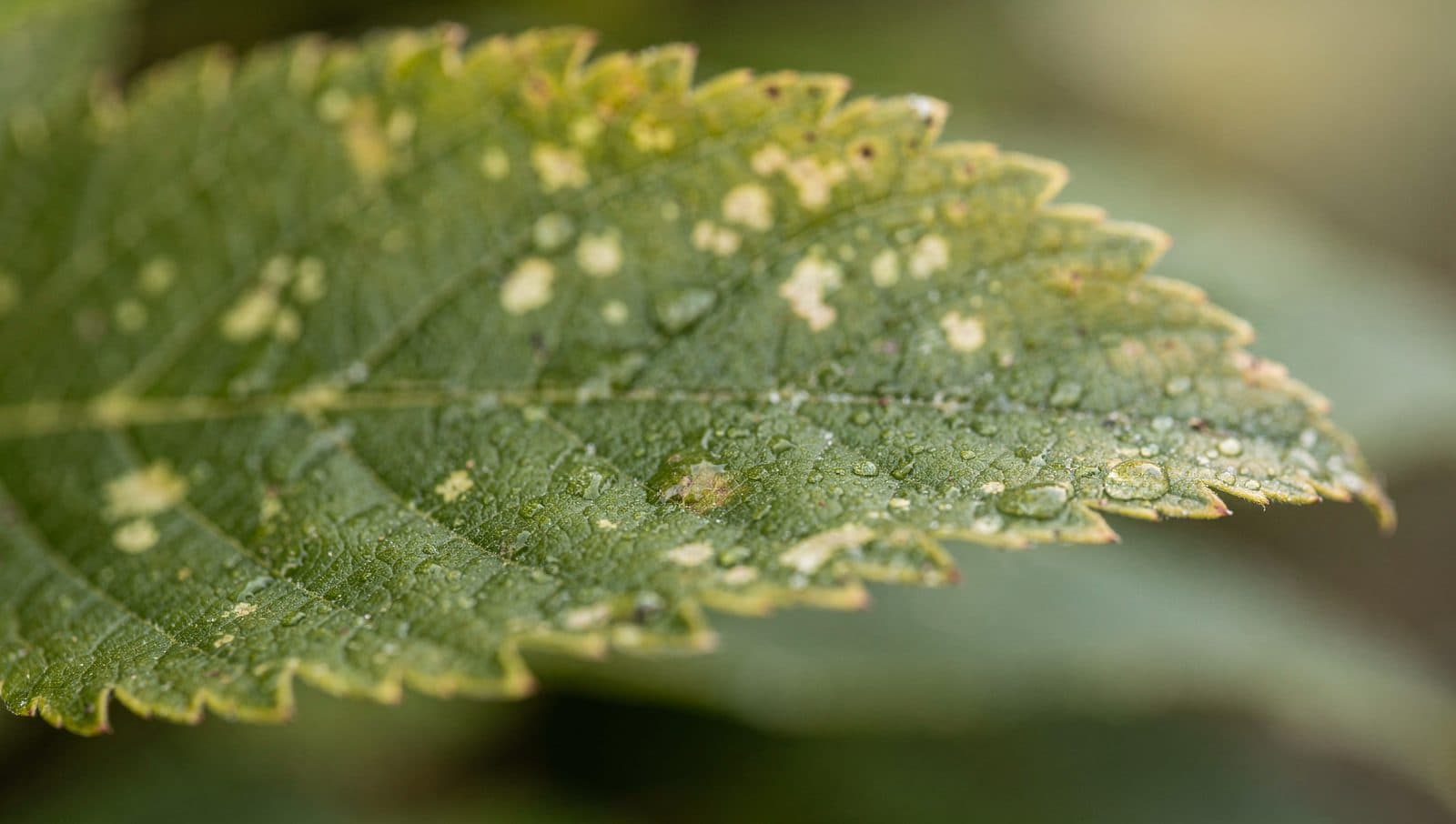
What Causes White Spots on Rose Leaves?
White spots on rose leaves are almost always powdery mildew — a fungal disease, not a bug you can spray off.
At a glance
- The verdict: Usually a disease
- Who fixes it: You
- Category: Leaf-Symptom Diagnosis (pest vs disease vs care)
The short answer
White, powdery spots or coating on rose leaves are the classic sign of powdery mildew, a fungal disease that favors warm days and cool, humid nights. It typically shows up first on young leaves, buds, and new shoots, sometimes twisting or reddening the newest growth before the powder appears. The powder rubs off like talc and comes back within days if untreated, which is the fastest way to rule out mineral residue or a pest. This is a garden-care and garden-center problem, not a pest-control one — better airflow, morning watering, resistant varieties, and a fungicide labeled for roses handle it.
Pest, disease, or how you're caring for it?
Most leaf problems aren't pests at all. Here's the honest split — the most likely cause, the less likely ones, and how to tell them apart before you treat anything.
- DiseaseMost likelythe usual cause
Rose powdery mildew (Podosphaera pannosa): a white-to-gray dusty coating on the upper leaf surface, buds, and shoots, often starting on new growth, which can look reddish and puckered before the powder shows.
Rose powdery mildewdowny mildew (less common, undersurface/angular)early rust (orange, not white)The tell:The powder rubs off like chalk or talc and reappears within a few days; it thrives on warm days with cool, humid nights and doesn't need standing water on the leaf to develop.
- Care / environmenta less common cause
A mineral or hard-water spray deposit, a fungicide/pesticide residue, or light sunscald fleck that can look pale or whitish from a distance.
hard-water spotting from overhead wateringspray/fertilizer residuesunscald on stressed foliageThe tell:It rinses off cleanly with a damp cloth or hose, doesn't return within days, and matches your watering or spraying pattern rather than spreading to new leaves.
- Pesta rare cause
Heavy two-spotted spider mite stippling can coalesce into a pale, almost powdery-looking flecking, and mealybugs or cottony scale leave waxy white tufts.
spider mite stipplingmealybug/cottony scale waxThe tell:Flip the leaf: mites bring fine webbing and tiny moving specks, mealybugs/scale are visible waxy bumps or cotton-like clusters — neither smears into a fine powder the way mildew does.
Rub the white coating between your fingers. If it smears like talc, comes back within a few days, and is worst on the newest leaves and buds, it's powdery mildew. If it wipes away clean and doesn't return, it's residue. If you find fine webbing or waxy clumps on the underside instead of a dusty film, look at a pest first.
Powdery mildew is by far the leading cause of this exact symptom on roses in humid Northeast summers; the other two buckets are worth ruling out but are comparatively rare.
Who actually fixes this?
Start here
You
Powdery mildew on roses is managed with home garden care — improving airflow and light, watering the soil instead of the foliage, removing and disposing of infected leaves, and applying a fungicide labeled for roses from a garden center. It is not a structural or yard pest issue.
- Garden center — You want a fungicide product recommendation or a mildew-resistant rose variety for next season.
- UNH Extension — The problem is severe, spreading fast, or you're not sure it's mildew — UNH Cooperative Extension's plant diagnostic services and the Infoline (1-877-EXT-GROW) can confirm it.
The details, straight
Powdery mildew, the leading cause
Rose powdery mildew is caused by the fungus Podosphaera pannosa (formerly Sphaerotheca pannosa). Oregon State University's SolvePestProblems resource and the Pacific Northwest Plant Disease Management Handbook both identify it as the classic cause of a white-to-gray powdery coating on rose leaves, buds, and young shoots. The fungus's spores germinate best on nights with high humidity or heavy dew and temperatures near 70°F — meaning, unlike many fungal diseases, it doesn't need free water sitting on the leaf to spread. New leaves and shoots are usually hit first and can appear reddish, curled, or stunted before the powder is even visible.
Why it's not usually a bug
The powder itself is fungal mycelium and spores, not insect residue or waxy pest secretions, and that's the key reason to rule out the pest bucket first. Spider mites can cause a pale stippled look under heavy infestation, and mealybugs or cottony scale leave visible waxy masses, but neither produces a fine, chalky coating that smears when rubbed. If you flip the leaf and see live insects, webbing, or waxy bumps instead of a dusty film, you're likely looking at a pest problem instead — but for the classic 'white powder on rose leaves' complaint, disease is the far more common answer.
What actually helps
Cultural fixes come first: space and prune roses for airflow, water the soil (not the foliage) in the morning so leaves dry quickly, and remove and dispose of (don't compost) heavily infected leaves. Choose mildew-resistant rose varieties when replanting. For active outbreaks, a garden-center fungicide labeled for rose powdery mildew, applied per the product label, is the standard next step — University of Tennessee's rose disease guidance and WSU Hortsense both frame sanitation plus a labeled fungicide as the working combination, since cool, dry, cloudy conditions favor the disease and consistent airflow reduces reinfection.
Key takeaways
- White powdery spots on rose leaves are almost always powdery mildew — a fungal disease, not a bug.
- It rubs off like talc and returns within days; that's the tell that separates it from mineral residue.
- New leaves, buds, and shoots are usually hit first, sometimes looking reddish or puckered before the powder shows.
- Fix it with airflow, morning soil watering, sanitation, resistant varieties, and a labeled fungicide from a garden center.
- This is a home garden-care job, not pest control — Anchor handles structural and yard pests, not rose disease.
Not sure if it's mildew or a pest?
Rubbing the powder is the fastest way to tell. If it smears and comes back, it's a fungus — not something to spray for bugs.
See the full pest-vs-disease triageA note for New Hampshire rose gardeners
Southern and central New Hampshire's humid summer nights are a good match for the conditions rose powdery mildew favors. If a fungicide and better airflow aren't turning it around, UNH Cooperative Extension's plant diagnostic services and the free Ask UNH Extension Infoline (1-877-EXT-GROW) can help confirm the diagnosis (note: UNH's plant-disease lab has at times referred physical samples to University of Maine or Cornell labs — worth checking current status). Anchor Pest Services focuses on the structural and yard pests around your home, not disease on your roses, but we're glad to point you to the right resource.
NH-licensed applicator #782664 (NHDAMF, RSA 430) · NEPMA member · family-owned since 2017.
Related questions
Sources(5)
- [1]Oregon State University — SolvePestProblems: Powdery Mildew on Roses
Rose powdery mildew identification and symptoms
extensionverified 2026-07-14 - [2]PNW Plant Disease Management Handbook — Rose Powdery Mildew
Podosphaera pannosa biology, spore germination conditions near 70°F
academicverified 2026-07-14 - [3]WSU Hortsense — Rose: Powdery Mildew
Cool, dry, cloudy conditions favor disease development
extensionverified 2026-07-14 - [4]University of Tennessee Extension — Rose Diseases: Identification and Management (W833)
Powdery mildew and black spot management on roses
academicverified 2026-07-14 - [5]UNH Cooperative Extension — Soil Testing, Insect & Arthropod ID, and Plant Diagnostic Lab
NH plant diagnostic services and free Infoline
extensionverified 2026-07-14
Written & reviewed by
VerifiedDaniel Brady
NH-Licensed Pesticide Applicator · License #782664 (NHDAMF, RSA 430)
Daniel Brady is the New Hampshire–licensed applicator behind Anchor Pest Services, a family-owned pest control company serving the Manchester area since 2017.
Last updated 2026-07-14
Your next question
Honest pest help for New Hampshire homes
Rose Disease Is Garden Care — Your Home Is Our Job
Powdery mildew on your roses is a fungal disease, and we'll always say so rather than overselling a pest treatment you don't need. Where Anchor Pest Services genuinely helps is the structural and yard pests around your home — rodents, ants, ticks, and moisture pests. Family-owned since 2017, NH license #782664, serving Manchester, Nashua, Concord and nearby towns.
- Honest read — powdery mildew on roses is disease management, not pest control
- NH-licensed (#782664) for structural and yard pests around the home, not ornamental fungus
- Rodent, ant, tick, and moisture-pest coverage across southern and central NH
NH License #782664 · No obligation · We answer in person
Your next step
- Related guide
Why Do Leaves Get Powdery Mildew?
Read the answer - Related guide
Why Do Leaves Have White Powder on Them?
Read the answer - Related guide
What Are Those Tiny White Bugs on Leaves?
Read the answer - Related guide
What Causes Brown or Black Leaf Spots?
Read the answer - Related guide
Why Do Leaves Get Brown Edges or Spots?
Read the answer