
Clothes Moths in New Hampshire: Holes in Wool & How to Stop Them
Also called Common clothes moth · Clothing moth
The webbing clothes moth is a small, golden, light-shy moth whose larvae eat wool, cashmere, silk, fur, and feathers — leaving holes, silk webbing, and grazed patches in stored or undisturbed clothing. It is not the moth you see fluttering around kitchen lights (that's the Indian meal moth, a food pest). Clothes moths avoid light, fly weakly, and hide in dark closets. The fix is clean-store-heat-or-freeze, not spraying garments.
- Adult size
- Body ~6–8.5 mm; wingspan about 1/2 inch
- UC IPM; Insects Limited
- Adults don't feed
- Vestigial mouthparts — adults cannot eat; only larvae cause damage
- UC IPM
- Larval diet
- Keratin — wool, cashmere, silk, fur, feathers; also soiled natural fibers
- UC IPM; Penn State Extension
- Eggs
- ~40–50 eggs per female over 2–3 weeks
- Extension biology sources
- Heat treatment
- Above 120°F for at least 30 minutes kills all life stages
- UC IPM
- Freeze treatment
- Below 18°F (0°F safer) for several days kills all life stages
- UC IPM
The moth at your lamp is not eating your sweaters
A moth flying around your kitchen light at night is almost certainly an Indian meal moth — a pantry pest. The clothes moth is an entirely different insect with opposite behavior: it avoids light, flies weakly, and hides in the darkest, most undisturbed corners of your closets. If you never see a moth at your lights but your wool sweaters have holes and silk webbing, you have clothes moths.
The webbing clothes moth (Tineola bisselliella) is the more common of the two clothes-moth species and is better adapted to the northern states. Its larvae eat keratin — the protein in wool, cashmere, silk, fur, and feathers — and they concentrate their damage in the places that go undisturbed longest: under collars and cuffs, in upholstery folds, and in carpet beneath furniture. The damage appears as irregular holes and a distinctive silk webbing or mat left behind as larvae feed.
Crucially, adults do not feed at all — they have vestigial mouthparts and survive on stored fat from their larval stage. Control targets larvae and storage conditions, not flying adults. The fix is clean-store-heat-or-freeze, not spraying garments. Pheromone traps can monitor adult male activity but won't eliminate an infestation without source removal.
In New Hampshire, long sealed-storage seasons — coats, sweaters, and blankets packed away from October to April — give clothes moths exactly the dark, undisturbed conditions they need.
How to identify the clothes moth — and separate it from the Indian meal moth
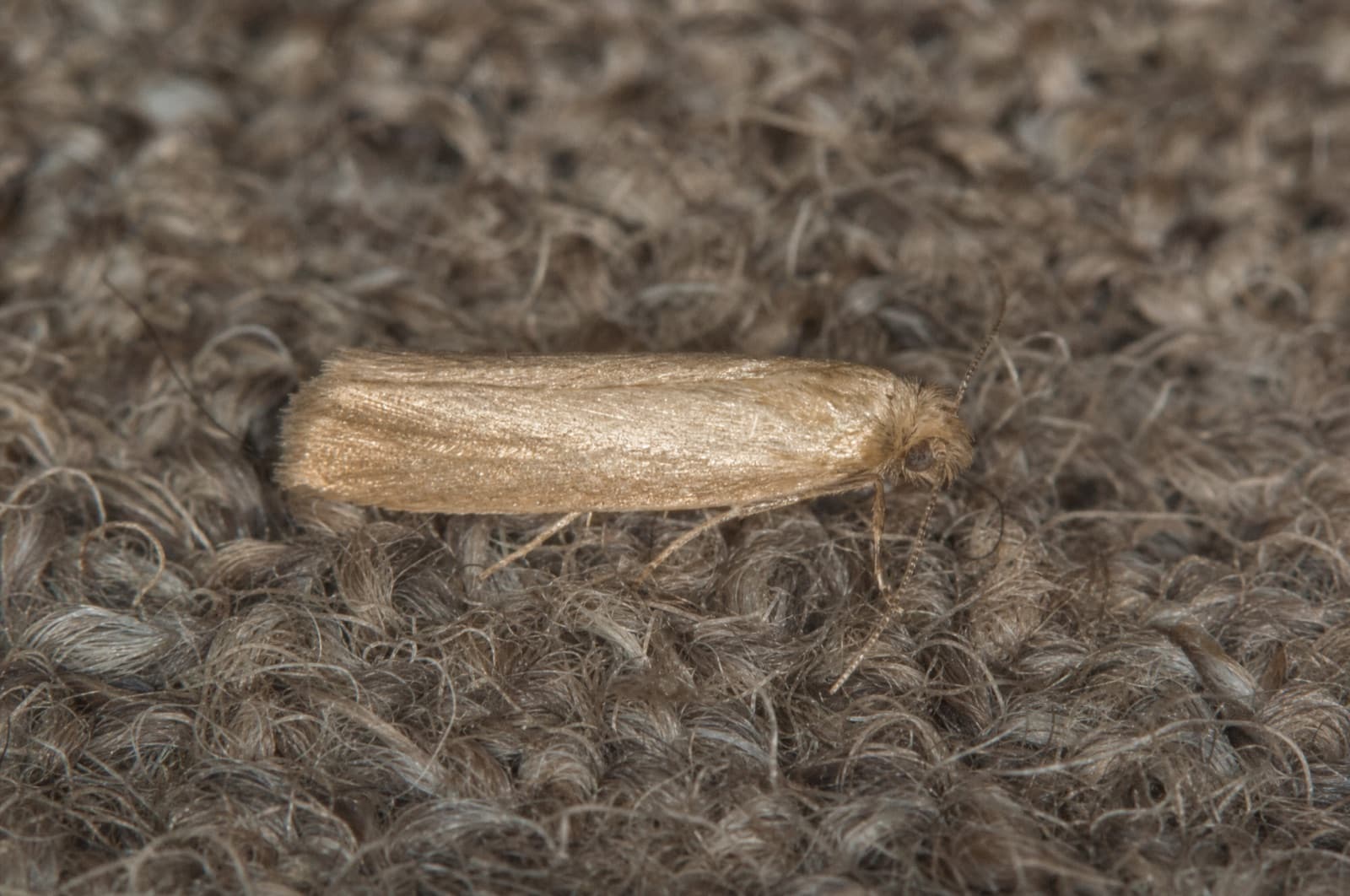
The clothes moth is small, uniform golden-buff, and moves by scurrying on fabric rather than flying to lights. Its most reliable visual cues are the golden color with no wing markings, the reddish hair tuft on the head, and the behavior of hiding in dark areas. The Indian meal moth — most people's mental image of 'the pantry moth' — is larger, has a distinctive two-tone wing (pale gray base, coppery-bronze outer tip), and actively flies toward kitchen lights at dusk. The damage they cause also differs: clothes moths attack wool and fabric; Indian meal moths attack food.
Webbing clothes moth
- Scientific name
- Tineola bisselliella
- Family
- Tineidae
- Size
- Body ~6–8.5 mm; wingspan approximately 1/2 inch
- Coloration
- Uniform golden/buff; reddish hairs on head; no wing markings or spots
- Habitat
- Dark closets, drawers, stored woolens, upholstery, carpet under furniture
- Active season
- Year-round indoors; up to approximately 2 generations per year
- Diet
- Larvae eat wool, cashmere, fur, feathers, silk, and soiled natural fibers; adults don't feed
- Reproduction
- ~40–50 eggs per female over a 2–3 week period
- Lifespan
- Adults short-lived; larvae feed for weeks to months
Worldwide; the webbing species is the more common northern-state clothes moth
The tells — key ID features
- Silk webbing or silken tubes on fabric, combined with irregular holes in wool or silk — the signature damage pattern.
- Small, uniform golden moth with reddish head hairs and no wing spots or markings.
- Avoids light and flies weakly; seen scurrying on fabric, not circling kitchen lamps.
- Tiny cream-colored caterpillar larvae leaving silk threads and frass on fabric.
- Damage concentrated under collars, cuffs, in upholstery folds, and carpet beneath furniture.
- Soiled or sweat-stained woolens are attacked before clean items.
Size, to scale
~6–8.5 mm body; ~1/2-inch wingspan
About the size of a grain of rice with wings spread
Indian meal moth
How to tell — Larger, with a two-tone wing (pale gray at the base, coppery-bronze at the outer tip); flies actively toward kitchen lights at dusk; infests food not fabric.
Carpet beetle
How to tell — Damages the same fabrics but is a hard-bodied beetle (not a moth); leaves shed larval skins instead of silk webbing; adult is a tiny calico beetle found at windows, not a golden moth.
Casemaking clothes moth (Tinea pellionella)
How to tell — Similar damage, but the larva carries a portable silk case around its body — the case is visible on the fabric and confirms casemaking rather than webbing species.
Signs of a problem
Clothes moths work slowly and stay hidden — these signs are often the first thing homeowners notice, sometimes months after the infestation began.
Irregular holes and silk webbing in stored wool or silk
What it means — Active larval feeding — the primary damage sign; the webbing distinguishes this from carpet beetle damage (which leaves shed skins, not webbing).
Small golden moths scurrying on fabric in a closet (not flying to lights)
What it means — Adult clothes moths — confirming the species. They run across fabric and hide quickly when the closet light is turned on.
Silken tubes or mats under collars, cuffs, or in upholstery folds
What it means — Larval feeding galleries — the silk is produced as larvae feed and is often the first sign in stored clothing.
Grazed, threadbare patches on carpet under furniture
What it means — Larvae feeding on the undisturbed pile — the rug section under a sofa is a classic hidden site.
Tiny cream-colored caterpillars or frass in drawers or closet corners
What it means — Larvae present and actively feeding nearby.
Damage concentrated on soiled or stored items, not freshly worn ones
What it means — Larvae prefer food-stained or sweat-contaminated fiber; clean, recently laundered woolens are passed over.
The real risks, calibrated
Clothes moths are a fabric-loss pest, not a health threat. The damage to cherished textiles is the entire risk.
Irreparable fabric loss
HighOnset: Over weeks to months of undisturbed larval feeding
Holes and threadbare patches in wool, cashmere, silk, fur, and feathers — impossible to fully repair.
Heirloom and textile damage
HighOnset: Over months
Antique rugs, tapestries, felt (including piano felts), and taxidermy feathers are particularly vulnerable.
Recurrence from missed eggs or larvae
ModerateOnset: Ongoing
A single missed egg batch or larva in a crack can restart the cycle; thorough treatment is essential.
Spread to multiple garments or rooms
ModerateOnset: Over weeks
Larvae crawl to adjacent garments; an infestation in one closet can spread to upholstery and rugs.
Misdiagnosis from carpet beetles
Low riskOnset: Low
Webbing = clothes moth; shed skins = carpet beetle. Getting this wrong wastes treatment effort.
Biting or disease
Low riskOnset: N/A
None — clothes moths are harmless to people and pets.
DIY — what works, what backfires
Clothes-moth control is clean-store-heat-or-freeze — not spraying garments. Target larvae and their food source.
What actually works
- Locate infested items — inspect stored wool, cashmere, silk, fur, feather-filled items, and felt, especially items that haven't been moved or worn in months.
- Launder washable woolens in hot water (≥120°F); dry-clean items that can't be washed.
- Freeze infested items at 0°F (or below 18°F) for several days to kill all life stages; seal in a bag before freezing.
- Heat items in an oven at above 120°F for 30+ minutes if the fabric can tolerate it.
- Vacuum closet floors, corners, baseboards, upholstery folds, and carpet undersides — the physical removal of larvae, eggs, frass, and debris is critical.
- Store clean woolens in tightly sealed bags or airtight containers.
- Use clothes-moth pheromone traps (not pantry-moth lures — different pheromone) to monitor male activity and gauge when the infestation is clearing.
What backfires
- Don't spray insecticide on garments or bedding — not recommended; risks contaminating clothing and doesn't reach larvae in hiding.
- Don't store soiled woolens — sweat, food oil, and body oils on fabric attract larvae before they attack the fiber itself.
- Don't rely on cedar or mothballs alone — effective only in fully sealed containers and unreliable at closet concentrations.
- Don't use pantry-moth pheromone traps for clothes moths — the pheromones are species-specific; the wrong trap catches nothing useful.
Clothes moths in New Hampshire
New Hampshire's wool-heavy wardrobes and long storage seasons — coats, sweaters, and blankets packed away for months through the NH winter — give clothes moths ideal conditions: dark, undisturbed, and full of natural fiber. The webbing clothes moth is the more common northern species and is well documented in NH homes. UNH Cooperative Extension recommends garment cleaning, sealed storage, and structural sanitation over spraying clothing. A critical NH-specific detail: use clothes-moth pheromone traps, not pantry-moth lures — the pheromones are different species and won't attract clothes moths.
Peak season
Year-round indoors; damage most often discovered spring when storage items are retrieved; up to 2 generations per year
You might actually have
- Indian meal moth (light-seeking, food pest — the moth around kitchen lights; two-tone coppery wing)
- Carpet beetles (same fabrics; leave shed larval skins, not silk webbing)
We serve these communities
- NH-licensed applicator · #782664
- Same-day service
- Family-owned since 2017
Service Area Map
Southern New Hampshire
When to call a pro for clothes moths
If damage spreads into carpets, upholstery, or multiple rooms, or if larvae are embedded in furniture or built-in storage, a licensed technician can treat structural harborage — cracks, baseboards, voids — without spraying the fabrics. Anchor Pest Services (NH #782664, F1) offers General Pest Control with a free quote and same-day service.
When to call a pro
- Damage appears in wall-to-wall carpeting, upholstered furniture, or multiple rooms despite closet treatment.
- Larvae are embedded in upholstery or furniture that can't be heat or freeze-treated.
- The infestation involves irreplaceable antique rugs, tapestries, or taxidermy requiring careful professional handling.
- Damage recurs after a thorough DIY treatment, suggesting larvae in cracks, wall voids, or ductwork.
Store clean woolens sealed before the NH winter
Launder or dry-clean all wool, cashmere, and natural-fiber items before storing for the season. Seal in airtight bags or containers — a soiled sweater packed in a drawer in October is exactly what clothes moths target.
Vacuum closets and under furniture regularly
Target the undisturbed zones: closet floors and corners, rug undersides, and the carpet under sofas and beds. This removes larvae, eggs, and the organic debris (lint, pet hair) that feeds them.
Monitor with clothes-moth pheromone traps
Use species-specific clothes-moth pheromone traps (not pantry-moth lures) to detect adult male activity in closets. Traps don't eliminate an infestation but tell you whether adults are still present after treatment.
Not sure it's a webbing clothes moth?
A licensed NH technician can confirm the species and tell you honestly whether it's a DIY fix or a job for a pro — free inspection, same-day service across Southern New Hampshire.
Frequently asked questions
Sources(7)
- [1]UC IPM — Clothes Moths
adult size, vestigial mouthparts, larvae attack keratin, heat/freeze treatment, damage in hidden spots
extensionverified 2026-06-30 - [2]UC IPM Pest Note 7435 — Clothes Moths
treatment protocol, egg count, prevention guidance
extensionverified 2026-06-30 - [3]Penn State Extension — Clothes Moth
larvae digest keratin, soiled fabric preference, northern species note
extensionverified 2026-06-30 - [4]Insects Limited — Webbing Clothes Moth
adult size and wingspan, pheromone trap monitoring
industryverified 2026-06-30 - [5]Northwest Center for Alternatives to Pesticides — Clothes Moths
mothball limitations, non-chemical treatment guidance
industryverified 2026-06-30 - [6]NMSU Extension — Clothes Moths (C504)
supplemental biology and control overview
extensionverified 2026-06-30 - [7]UNH Cooperative Extension — Kitchen Pests Fact Sheet
NH context, cleaning and sealed-storage recommendation
extensionverified 2026-06-30
Written & reviewed by
VerifiedDaniel Brady
NH-Licensed Pesticide Applicator · License #782664 (NHDAMF, RSA 430)
Daniel Brady is the New Hampshire–licensed applicator behind Anchor Pest Services, a family-owned pest control company serving the Manchester area since 2017.
Last updated 2026-06-30

New Hampshire pest control
Dealing with webbing clothes moths in your home?
Anchor Pest Services identifies and handles webbing clothes moth problems across southern and central New Hampshire. Family-owned since 2017, NH license #782664.
- NH-licensed applicators (#782664)
- Same-day service · free inspection
- Family-owned since 2017
Your next step
- What to do next
How to Get Rid of Clothes Moths
Read the answer - What to do next
What Attracts Clothes Moths to Your House?
Read the answer - What to do next
Where Do Moths Go in the Winter? NH Moth Timing Guide
Read the answer - Also relevant
Can moths destroy clothes or carpets?
Read the answer - Related guide
Indian Meal Moths in New Hampshire: Find the Source & Stop Them
Read the answer