
Voles in New Hampshire — Lawn Runways, Not House Mice
Also called Meadow mouse · Field mouse
Voles (meadow vole, Microtus pennsylvanicus) are stocky, short-tailed outdoor rodents that are not indoor pests — Iowa State Extension notes they 'almost never enter houses.' They cut 1–2-inch surface runways across NH lawns and girdle young trees, damage that appears dramatically at the March–April snowmelt. This is a landscaping fix, not an indoor exclusion problem.
- Best tell
- Short ~1-inch tail; stocky body with blunt snout
- UNL Extension
- Body size
- 4½–7 in body, ~1-inch tail; 1–2 oz
- UNL Extension
- Runways
- 1–2 in wide surface runways of clipped grass; most visible at snowmelt
- UNL / UMass Extension
- Indoor risk?
- Almost never enters houses
- Iowa State Extension
- Density
- Up to 300 per acre in prime habitat
- UMass Extension / Mass Audubon
- NH presence
- Very common in NH lawns, fields, and gardens
- UNH Cooperative Extension
Voles in NH — the outdoor rodent that has nothing to do with mice in your house
The meadow vole (Microtus pennsylvanicus) and its close relatives are among the most commonly misidentified lawn pests in New Hampshire — homeowners find surface runways and assume 'mice,' then spend money on indoor mouse control that has no effect. Voles are biologically distinct from mice, they almost never enter houses (Iowa State Extension), and the fix is a landscaping job, not an indoor exclusion.
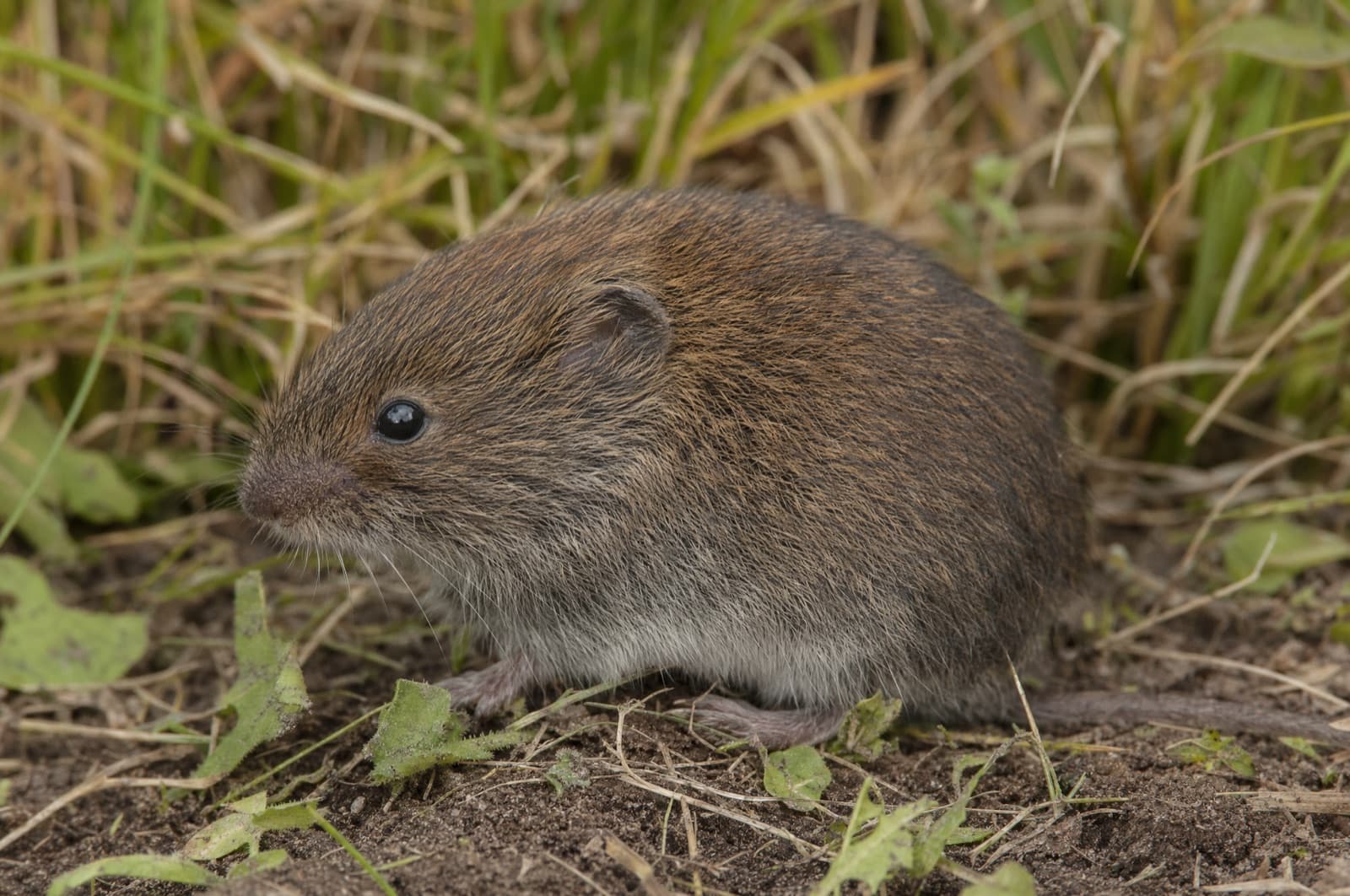
Fast ID: voles are stocky and compact, with a short tail of about 1 inch (roughly a third of the body length) — the short tail is the single best tell. Small ears and eyes are nearly hidden in longer chestnut-to-gray fur. A blunt, rounded snout. Mice have long tails (nearly as long as the body), large visible ears, and pointed noses.
The vole-mole-mouse decoder that competitors omit: 1–2-inch surface runways of clipped grass with no mounds = vole; raised subsurface ridges and conical dirt mounds = mole; droppings indoors = mouse. Three completely different problems, three different fixes.
The NH timing that makes this damage so striking: voles remain active under snow all winter (subnivean behavior), cutting runways and girdling bark. When the snow melts in March–April, NH lawns reveal the full extent of winter damage all at once — a dramatic sight that drives a lot of spring search traffic. Most turf recovers within weeks; girdled young trees do not, and tree protection in fall is the prevention that matters most.
How to identify a vole — and tell it from a mouse or a mole
Three field marks separate voles from the other rodents they are confused with: the short tail (about 1 inch, roughly a third of the body length), the stocky compact build with a blunt rounded snout, and the small ears and eyes nearly hidden in longer fur. Moles do not produce surface runways — they push subsurface ridges. Mice have long tails, large visible ears, and pointed noses.
Meadow vole
- Scientific name
- Microtus pennsylvanicus
- Family
- Cricetidae
- Size
- 4½–7 in body; ~1-inch tail; 1–2 oz
- Coloration
- Chestnut to gray-brown with longer, coarser fur; lighter belly
- Habitat
- Grassy and weedy areas, lawns, garden edges, orchards; active under snow in winter
- Active season
- Year-round — active under snow (subnivean) during NH winters
- Diet
- Strict herbivore — grasses, clover, bark, roots, bulbs; does not eat insects
- Reproduction
- Several litters per year; matures in ~32 days; peak spring and summer
- Lifespan
- Usually less than 1 year in the wild
Common throughout New Hampshire in lawns, fields, and gardens; native to the Northeast
The tells — key ID features
- Short tail (~1 inch, roughly one-third of body length) — the single most reliable tell vs. mice.
- Stocky, compact body — noticeably more robust than a house or deer mouse.
- Small ears and eyes nearly hidden in longer, coarser fur.
- Blunt, rounded snout (vs. the pointed nose of mice).
- Chestnut-to-gray coat; herbivore (does not eat insects or stored grain).
Size, to scale
4½–7 in body; ~1-inch tail; 1–2 oz
Slightly larger than a house mouse in body but with a tail only about a third as long — the short tail is immediately obvious when you compare them.
House mouse / deer mouse
How to tell — Long tails (nearly as long as the body), large visible ears, pointed noses — and they go indoors. Voles have a stubby tail, hidden ears, a blunt snout, and almost never enter houses.
Meadow mole
How to tell — Moles never produce surface runways — they push subsurface soil ridges and create conical dirt mounds. Moles eat insects; voles eat plants. If you see a mound, it is a mole; if you see surface runways, it is a vole.
Shrew
How to tell — Shrews have a very pointed snout, are smaller, and are rarely seen because they tunnel in leaf litter and soil. Shrews eat insects; voles eat plants.
Signs of a problem
The vole-mole-mouse decoder: surface runways with no mounds = vole. The timing — most visible at snowmelt — and the outdoor-only context are the other key signals.
1–2-inch-wide paths of closely clipped dead grass across the lawn
What it means — Vole surface runways — the definitive sign; revealed at spring snowmelt after winter activity under snow. Not mole (no mounds), not mouse (no indoor droppings).
Golf-ball-sized (1–2 in) round burrow openings with NO dirt mound at the lawn surface
What it means — Vole burrow entrance — distinguish from chipmunk (similar size but with no runway) and from groundhog (10–12 in with a large dirt fan).
Gnawed bark at the base of young trees or shrubs, with irregular marks at varied angles
What it means — Vole girdling — bark stripped in a band around the trunk at snow-surface level during winter; can kill young saplings and ornamental shrubs.
Extensive surface runway network appearing suddenly at snowmelt in March–April
What it means — Subnivean winter activity — voles were active under the snowpack all season; the full damage extent is only visible when snow melts.
The real risks, calibrated
Voles present no meaningful health risk to people or pets. The risks are entirely to lawn, garden, and landscape plants.
Lawn and turf scarring
Low riskOnset: Revealed at spring snowmelt (March–April in NH)
Surface runways leave dead-grass paths across the lawn. Most NH turf recovers within 2–4 weeks of snowmelt once growth resumes — this is a cosmetic issue in most cases.
Girdling and killing young trees and shrubs
ModerateOnset: Fall through early spring — during active snow cover
Bark stripped in a complete ring around the trunk at snow-surface level prevents sap movement and kills the tree above the wound. Young fruit trees, ornamentals, and newly planted shrubs are most vulnerable.
Bulb and root crop loss
ModerateOnset: Fall through winter
Voles feed on tulip bulbs, vegetable roots, and other underground plant material — a common frustration in NH gardens.
DIY — what works, what backfires
Vole control is a landscaping job, not an indoor pest control job. The most effective approach combines habitat reduction, tree protection, and targeted trapping. Indoor exclusion does not help.
What actually works
- Mow lawns short in fall — tall grass provides the cover voles need for their runways; reducing cover also reduces breeding density.
- Pull mulch and ground cover back from tree trunks at least 3–4 inches — voles use dense mulch as protective cover while girdling bark in winter.
- Install hardware cloth tree guards (¼-inch mesh, 18 inches tall, buried 1–2 inches in the soil) around young trees and ornamentals before the first NH snowfall.
- Set mouse snap traps perpendicular to active runways — bait with apple or peanut butter; check and reset daily.
- Remove woodpiles, brush piles, and debris from adjacent to lawn areas — these are harborage for high vole densities.
What backfires
- Don't treat voles as an indoor mouse problem — indoor exclusion, mouse traps inside the home, and poison bait stations indoors have no effect on a vole population in the lawn.
- Don't expect repellents (castor oil, predator urine, ultrasonic devices) to solve turf damage — no repellent has consistent evidence of effectiveness against established vole populations.
- Don't wait until snowmelt to protect young trees — by then the girdling is already done; apply tree guards in October before the first snow.
- Don't panic about lawn runways — most turf recovers within weeks of spring growth; focus attention on protecting trees, which can be permanently killed.
Voles in New Hampshire lawns and gardens
New Hampshire's long winters with persistent snow cover create ideal subnivean conditions — voles remain active under the insulating snowpack all season, cutting runways and feeding on bark. The damage appears suddenly at the March–April snowmelt, often covering large swaths of NH lawns in a network of dead-grass paths that surprises homeowners. Vole pressure is worst near stone walls, woodpiles, brushy field edges, and unmowed areas adjacent to lawns — classic southern NH residential landscapes. Population densities can peak in high-quality habitat, making a landscape-level approach more effective than spot treatment.
Peak season
Year-round outdoors; damage most visible at March–April snowmelt
You might actually have
- Meadow mole (Scalopus aquaticus) — subsurface ridges and mounds, no surface runways; eats insects
- House mouse and deer mouse — indoor pests with long tails and large ears; go indoors
We serve these communities
- NH-licensed applicator · #782664
- Same-day service
- Family-owned since 2017
Service Area Map
Southern New Hampshire
When to call Anchor Pest Services for voles
For large properties with repeated spring vole damage, repeated girdling of young trees, or high-density populations along field and stone-wall edges, a professional habitat assessment and targeted control program achieves better results than seasonal DIY trapping alone.
When to call a pro
- Repeated spring runway damage season after season, suggesting a high-density resident population that DIY trapping has not reduced.
- Girdled or killed trees — a sign the population reached the landscape damage threshold before protection was in place.
- Large lawn areas with extensive runway networks that warrant a systematic trapping program.
Fall habitat reduction before NH snowfall
Mow short, clear dense ground cover, and pull mulch back from tree bases before October. Vole damage happens under the snowpack; these steps are the prevention window.
Tree guards before the first snow
Install ¼-inch hardware cloth guards around every young tree and ornamental shrub you value, 18 inches tall and buried 2 inches in the soil, before NH's first snowfall — the point at which vole girdling begins.
Manage edge habitat
Stone walls, woodpiles, and brushy edges adjacent to lawns sustain high vole densities. Keep these features as far from the lawn as practical, or manage the grass immediately adjacent to them short year-round.
Not sure it's a meadow vole?
A licensed NH technician can confirm the species and tell you honestly whether it's a DIY fix or a job for a pro — free inspection, same-day service across Southern New Hampshire.
Frequently asked questions
Sources(6)
- [1]UNL Extension — Voles (G887)
body size, tail length, weight, general biology
extensionverified 2026-06-30 - [2]UMass Extension — Vole Damage to Lawns
runway width (1–2 in), density (up to 300/acre), subnivean behavior
extensionverified 2026-06-30 - [3]Iowa State Extension — Vole Tracks in Grass
'almost never enter houses' — outdoor-only characterization
extensionverified 2026-06-30 - [4]Penn State Extension — Voles
damage to trees, shrubs, and lawns; control recommendations
extensionverified 2026-06-30 - [5]UNH Cooperative Extension
NH presence and seasonal context; habitat management guidance
extensionverified 2026-06-30 - [6]NOAA Climate Normals 1991–2020
NH winter snow conditions context; Manchester frost dates
govverified 2026-06-30
Written & reviewed by
VerifiedDaniel Brady
NH-Licensed Pesticide Applicator · License #782664 (NHDAMF, RSA 430)
Daniel Brady is the New Hampshire–licensed applicator behind Anchor Pest Services, a family-owned pest control company serving the Manchester area since 2017.
Last updated 2026-06-30

New Hampshire pest control
Dealing with meadow voles in your home?
Anchor Pest Services identifies and handles meadow vole problems across southern and central New Hampshire. Family-owned since 2017, NH license #782664.
- NH-licensed applicators (#782664)
- Same-day service · free inspection
- Family-owned since 2017
Your next step
- Book a NH pro
Rodent Control in New Hampshire
Mice and rats move indoors every fall. We trap, seal entry points and keep them out.
Book now - Next step
What Materials Can Rats Not Chew Through?
Read the answer - Also relevant
What damage do voles and gophers cause outdoors?
Read the answer - Also relevant
Can moles ruin lawns and gardens?
Read the answer - Also relevant
What Is the Difference Between a Mouse and a Rat?
Read the answer - Related guide
House Mouse in New Hampshire — ID, Signs & Control
Read the answer