
What Attracts Carpet Beetles to Your House?
At a glance
- Short answer: Carpet beetles are a genuine exception: adults really do fly toward light and flowers, then enter on their own.
- The verdict: Something specific
The attractant verdict
Four possible answers to why this species turned up. Three stay unlit — and that's the argument: the honest answer could have been any of them, and for this species it wasn't.
Carpet beetles are a genuine exception: adults really do fly toward light and flowers, then enter on their own.
Our own previous page said carpet beetles are "drawn to your home mainly because of their need for food and the right environment to survive and reproduce" — vague enough to miss the actual, more specific mechanism entirely: adult beetles flying toward light.
Adult carpet beetles that were feeding on flowers outdoors and flew toward a lit window or open door, entering on their own rather than arriving as cargo. Secondhand furniture, cut flowers, and old bird or rodent nests in or on the structure are real secondary routes, but extension sources describe active adult flight as the dominant one for most household infestations.
“Most fabric pests are pure hitchhikers. Carpet beetles are the exception — the adults really do fly toward your windows.”
Adult carpet beetles feed on pollen and nectar outdoors and are attracted to light; multiple land-grant extension services report that most household infestations originate when adults fly indoors through open windows and doors rather than arriving on a carried object.
This means carpet beetles don't fit the same not-attracted-carried story as clothes moths and other fabric pests — there's a real, sourced attraction component (light, and proximity to outdoor flowering plants) that the flat carried-in framing would misrepresent if applied here without qualification.
Calibrated from: Colorado State University Extension — Dermestid Beetles (Carpet Beetles), Fact Sheet 5.549, https://extension.colostate.edu/topic-areas/insects/carpet-beetles-5-549/
Why it's here, in full
Where the research pushes back on "carried in"
For nearly every other fabric or pantry pest on this hub, the dominant arrival story is that eggs or larvae rode in on an object. Carpet beetles are the exception, and it would be dishonest to flatten them into the same story. Colorado State University Extension states that "many infestations originate from wild populations" of adult beetles that move into homes, and describes adults as active outdoor fliers that feed on flower pollen and nectar before entering structures — commonly through open windows and doors, drawn by light. University of Kentucky Entomology's carpet beetle fact sheet likewise distinguishes adult carpet beetles, which feed on flowers outdoors and don't damage fabric themselves, from the fabric-feeding larval stage that develops once eggs are laid indoors.
Secondhand furniture, cut flowers brought in as décor, and old bird, rodent, or wasp nests in eaves or vents are all real secondary routes for eggs or larvae to arrive already on an object — so the carried-in pathway isn't wrong, exactly, it's just not the whole story here the way it is for clothes moths.
Arrival and persistence are still different questions
Even with a real attraction-and-entry component, what happens after an adult beetle gets indoors and lays eggs is a separate matter from why it came in. Larvae persist wherever keratin-rich material — wool, fur, feathers, pet hair, lint — sits undisturbed, exactly as with clothes moths. So the honest, two-part answer for carpet beetles is: adults are genuinely drawn in by light and proximity to outdoor flowering plants, or arrive on a secondhand item or old nest; and once eggs are laid, an undisturbed fabric or fiber source is what lets the population grow. Neither half of that is about the house being dirty or cluttered in the food-and-mess sense that drives ants or cockroaches.
How to tell it's actually this species
Real signs only — a species with four honest tells gets four, and stops. Where a sign is weak on its own, we say so.
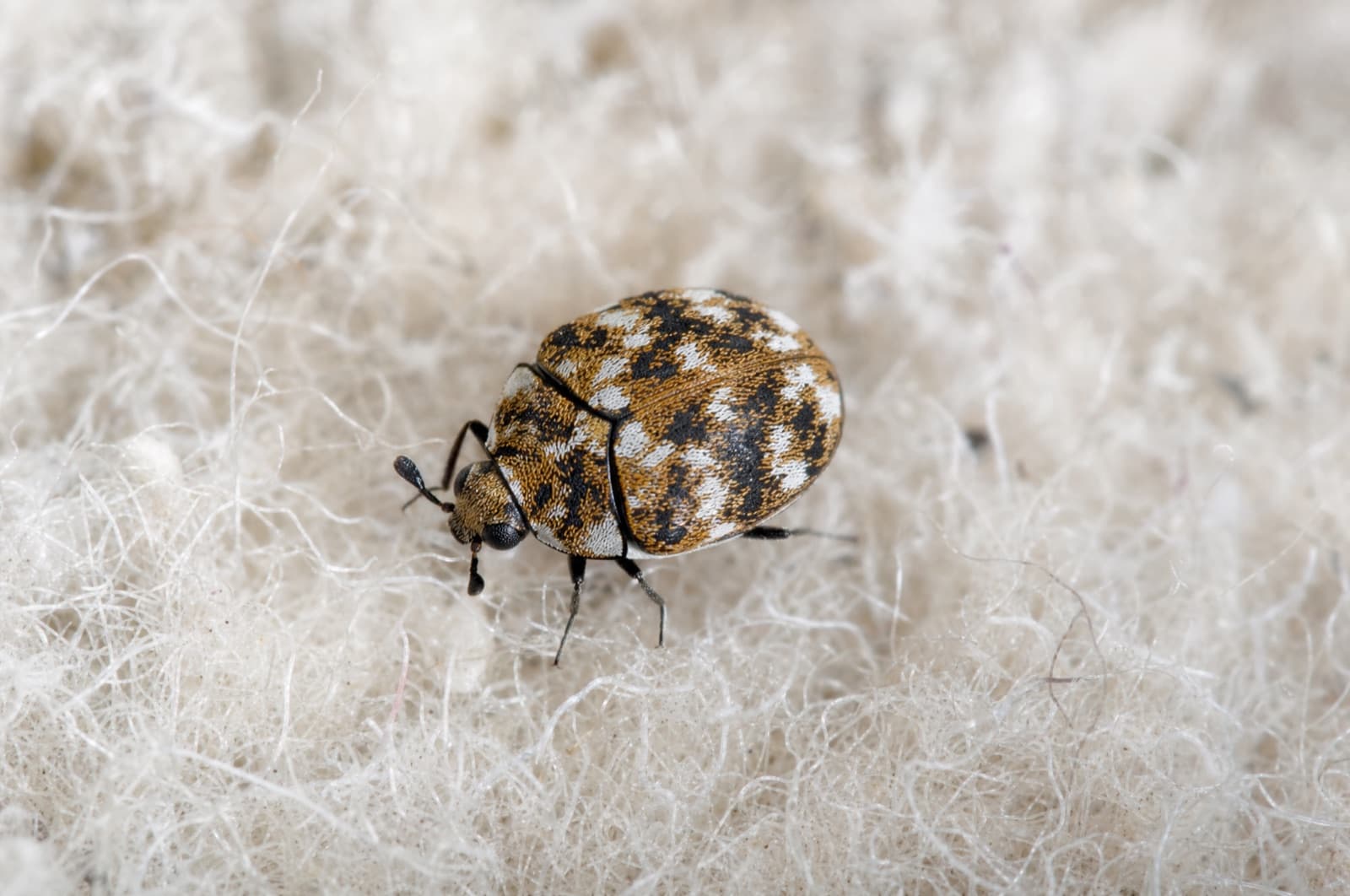
Adult beetles — small, oval, mottled or scaly-patterned — seen at windowsills or near light fixtures
Could be something else: Finding adults at a window is consistent with active flight-and-entry, but doesn't by itself confirm an indoor larval infestation is underway.
Irregular feeding damage to wool, fur, feathers, or stored plant products, often in undisturbed spots
Small, bristly, cast-off larval skins in closets, along baseboards, or under furniture
Larvae found near a window, vent, or old bird or wasp nest in or on the structure, pointing to entry from outside or an animal-nest source
Want carpet beetles gone?
This page only answers why it's here. Every removal step for this exact species — what to seal, what to set, what actually works — lives on its own dedicated guide.
Two questions, two pages
Here: why it turned up at all — the honest answer, blame removed.
There: the step-by-step removal guide for this exact species.
Key takeaways
- Most fabric pests are pure hitchhikers. Carpet beetles are the exception — the adults really do fly toward your windows.
- This is a genuine exception among fabric and pantry pests — treat the sourced mechanism as the real answer.
- What actually matters: the outdoors nearby, secondhand items.
- If it's already inside, removal is a different question — see /top-diy-methods/carpet-beetle.
Seeing carpet beetle damage or adults at windows?
This page is about why they showed up. Treatment for an active infestation is covered at /top-diy-methods/carpet-beetle.
Frequently asked
Sources(2)
- [1]Colorado State University Extension — Dermestid Beetles (Carpet Beetles), Fact Sheet 5.549
Adult carpet beetles as outdoor fliers attracted to light; most infestations originating from wild populations entering through windows and doors
extensionverified 2026-07-17 - [2]University of Kentucky Entomology — Carpet Beetles (ENTFACT-601)
Adult carpet beetles feeding on flower pollen outdoors, distinct from the fabric-feeding larval stage
extensionverified 2026-07-17
Written & reviewed by
VerifiedDaniel Brady
NH-Licensed Pesticide Applicator · License #782664 (NHDAMF, RSA 430)
Daniel Brady is the New Hampshire–licensed applicator behind Anchor Pest Services, a family-owned pest control company serving the Manchester area since 2017.
Last updated Jul 2026
The one fabric pest that really does fly in
Dealing with carpet beetles at home?
Same-day inspections across southern and central New Hampshire — we'll tell you honestly whether it's a light-drawn nuisance or an established infestation.
- Family-owned in Manchester since 2017
- NH commercial applicator #782664, category F1
- We will tell you when the answer is do nothing
NH License #782664 · No obligation · We answer in person
Your next step
- Also relevant
How to Get Rid of Carpet Beetles
Read the answer - Also relevant
Where Do Beetles Go In The Winter?
Read the answer - Also relevant
How to remove lady beetles from windows?
Read the answer - Related guide
What Attracts Spider Beetles to Your House?
Read the answer - Related guide
What Attracts Asian Lady Beetles to Your House?
Read the answer