
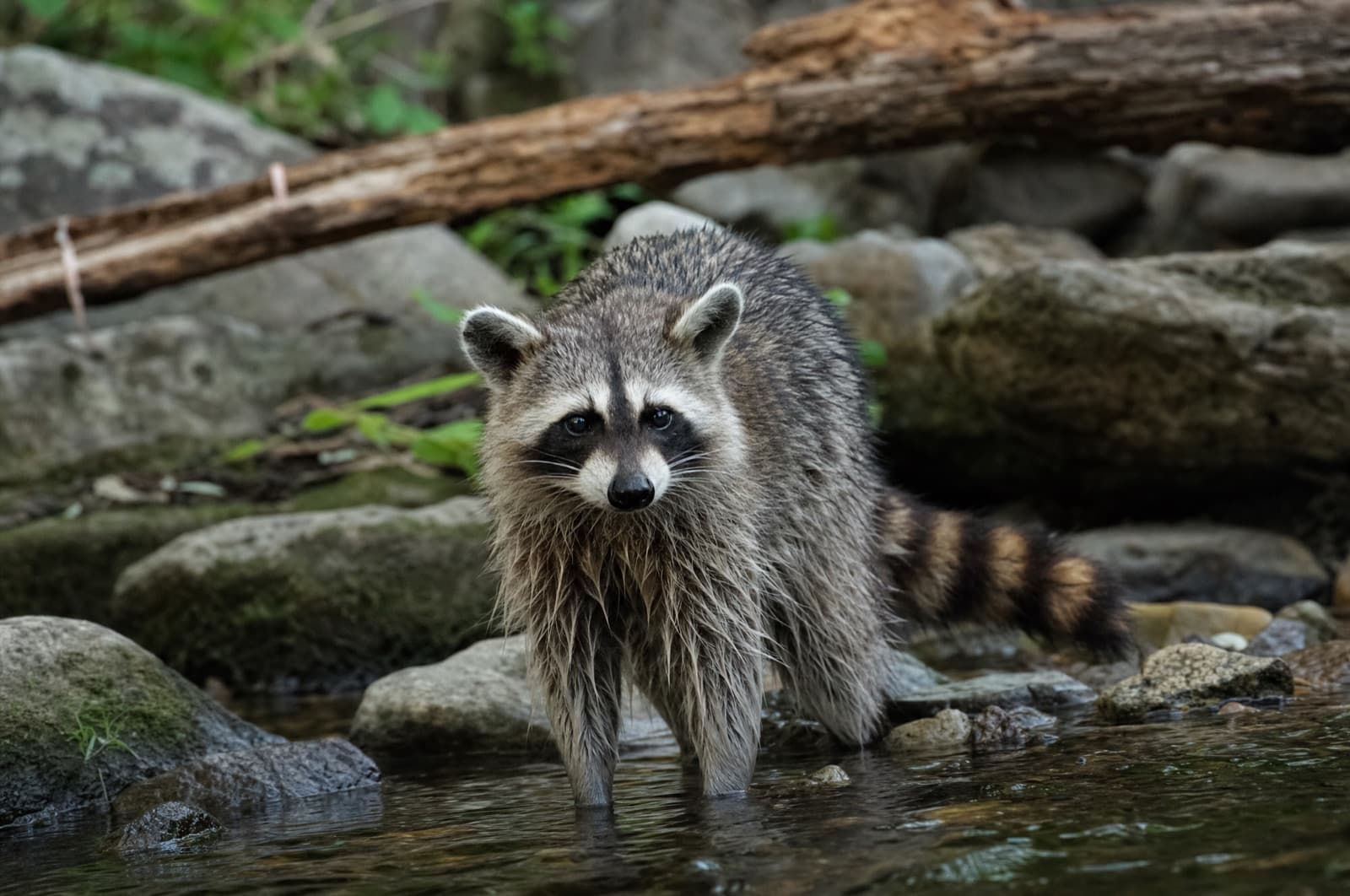
What Attracts Raccoons to Your House?
At a glance
- Short answer: To a raccoon your chimney is just a hollow tree that's warmer and safer — and your trash can is a reliable meal.
- The verdict: Something specific
The attractant verdict
Four possible answers to why this species turned up. Three stay unlit — and that's the argument: the honest answer could have been any of them, and for this species it wasn't.
To a raccoon your chimney is just a hollow tree that's warmer and safer — and your trash can is a reliable meal.
Most advice, including our own previous page, says raccoons are drawn "due to the availability of food, shelter, and safety," listed as a general set. The specific, useful version names exactly which structural features and food sources matter and why.
Raccoons naturally den in tree hollows, and they readily substitute a chimney, attic, or the space under a porch or deck when one is available, because those spaces offer the same elevated, enclosed, predator-safe protection. Female raccoons in particular select these den sites to give birth and raise kits: Iowa State University Extension cites a New England suburban study finding that female raccoons actually prefer chimneys to trees during the first one to two months after giving birth, and often return to favored den sites in successive years. Separately, unsecured garbage, accessible pet food left outdoors, and birdseed spillage concentrate raccoons around a property as a reliable food source, independent of any denning behavior.
“To a raccoon your chimney is just a hollow tree that's warmer and safer — and your trash can is a reliable meal.”
A chimney, attic gap, or the enclosed space under a porch or deck functioning as a substitute for a natural tree-cavity den, especially favored by females raising kits, plus unsecured garbage, outdoor pet food, or birdseed as a separate food draw.
It splits one vague 'raccoons like my property' question into two specific, addressable ones: is there an accessible den-like opening, and is there an easy food source nearby. A property can have one problem without the other, and each has a different fix.
Calibrated from: Iowa State University Extension, Washington Department of Fish and Wildlife, and UC IPM: raccoons substitute chimneys and attics for tree-cavity dens, with females favoring chimneys for raising kits, while garbage and pet food are documented food-based draws.
Why it's here, in full
The chimney is a substitute tree, and the timing matters
Raccoons are natural tree-cavity denners, and a chimney or attic void offers essentially the same thing a hollow tree does: an elevated, fully enclosed space that's dry, insulated, and hard for predators to reach. Iowa State University Extension cites a New England study finding that female raccoons actually prefer chimneys to trees during the first one to two months after giving birth, and that they often return to favored den sites in successive years — which is why the same chimney or attic gap can become a repeat problem year after year rather than a one-time event.
Food is a separate and equally specific driver, not just a vague background factor. Washington Department of Fish and Wildlife and UC IPM both identify unsecured garbage, pet food left outdoors, and birdseed spillage as reliable food sources that concentrate raccoons around a property regardless of denning opportunities. A property can have a strong food draw with no den access at all, or a den site with no food draw nearby — treating the two as one blended "shelter and food" answer misses that they're independently checkable and fixable conditions.
How to tell it's actually this species
Real signs only — a species with four honest tells gets four, and stops. Where a sign is weak on its own, we say so.
Repeated scratching, thumping, or shuffling noises from a chimney or attic, most active at night
Handprint-like tracks with five long toes in soft soil, mud, or snow near a chimney, deck, or garbage area
A tipped-over or repeatedly raided trash can, especially one that's easy to open or not secured with a locking lid
Droppings left in one consistent spot (a latrine), often on a deck, roof, or at the base of a tree
Could be something else: Raccoon droppings can resemble those of other mammals; a consistent, repeated latrine location combined with tracks or den noises is more diagnostic than droppings alone.
A strong, musky odor near a chimney or attic access point, consistent with an active den
Want raccoon gone?
This page only answers why it's here. Every removal step for this exact species — what to seal, what to set, what actually works — lives on its own dedicated guide.
Two questions, two pages
Here: why it turned up at all — the honest answer, blame removed.
There: the step-by-step removal guide for this exact species.
Key takeaways
- Chimneys and attics function as substitute tree-cavity dens, especially for females raising kits.
- Unsecured garbage, pet food, and birdseed are a separate, specific food draw.
- Raccoons often return to the same favored den site in successive years.
- Exclusion and securing food sources are covered at /top-diy-methods/raccoon.
Hearing noises in the chimney or attic?
This page is about why raccoons chose the spot. Exclusion timing and methods are covered at /top-diy-methods/raccoon.
Frequently asked
Sources(3)
- [1]Iowa State University Extension — Raccoons: Damage Management
Female raccoons prefer chimneys to trees in the weeks after giving birth, and return to favored den sites
extensionverified 2026-07-17 - [2]Washington Department of Fish and Wildlife — Raccoon (Procyon lotor)
Raccoon denning behavior and food sources around structures
stateverified 2026-07-17 - [3]UC Statewide IPM Program — Raccoons
Raccoons den in chimneys, attics, and similar structures, and are drawn by unsecured food sources
extensionverified 2026-07-17
Written & reviewed by
VerifiedDaniel Brady
NH-Licensed Pesticide Applicator · License #782664 (NHDAMF, RSA 430)
Daniel Brady is the New Hampshire–licensed applicator behind Anchor Pest Services, a family-owned pest control company serving the Manchester area since 2017.
Last updated Jul 2026
It's the den, or the trash — sometimes both
We check den access and food sources together
Inspections across southern and central New Hampshire for raccoon activity in chimneys, attics, and yards.
- Family-owned in Manchester since 2017
- NH commercial applicator #782664, category F1
- We will tell you when the answer is do nothing
NH License #782664 · No obligation · We answer in person
Your next step
- What to do next
Raccoons in New Hampshire — Rabies, Removal & the Law
Read the answer - Also relevant
Where Do Raccoons Go In The Winter?
Read the answer - Also relevant
When Are Raccoons Active? Winter, Night & NH Timing
Read the answer - Also relevant
Why do raccoons break into attics?
Read the answer - Also relevant
Do raccoons damage soffits and eaves?
Read the answer - Related guide
Can raccoon damage lead to roof leaks?
Read the answer