
Skip to content
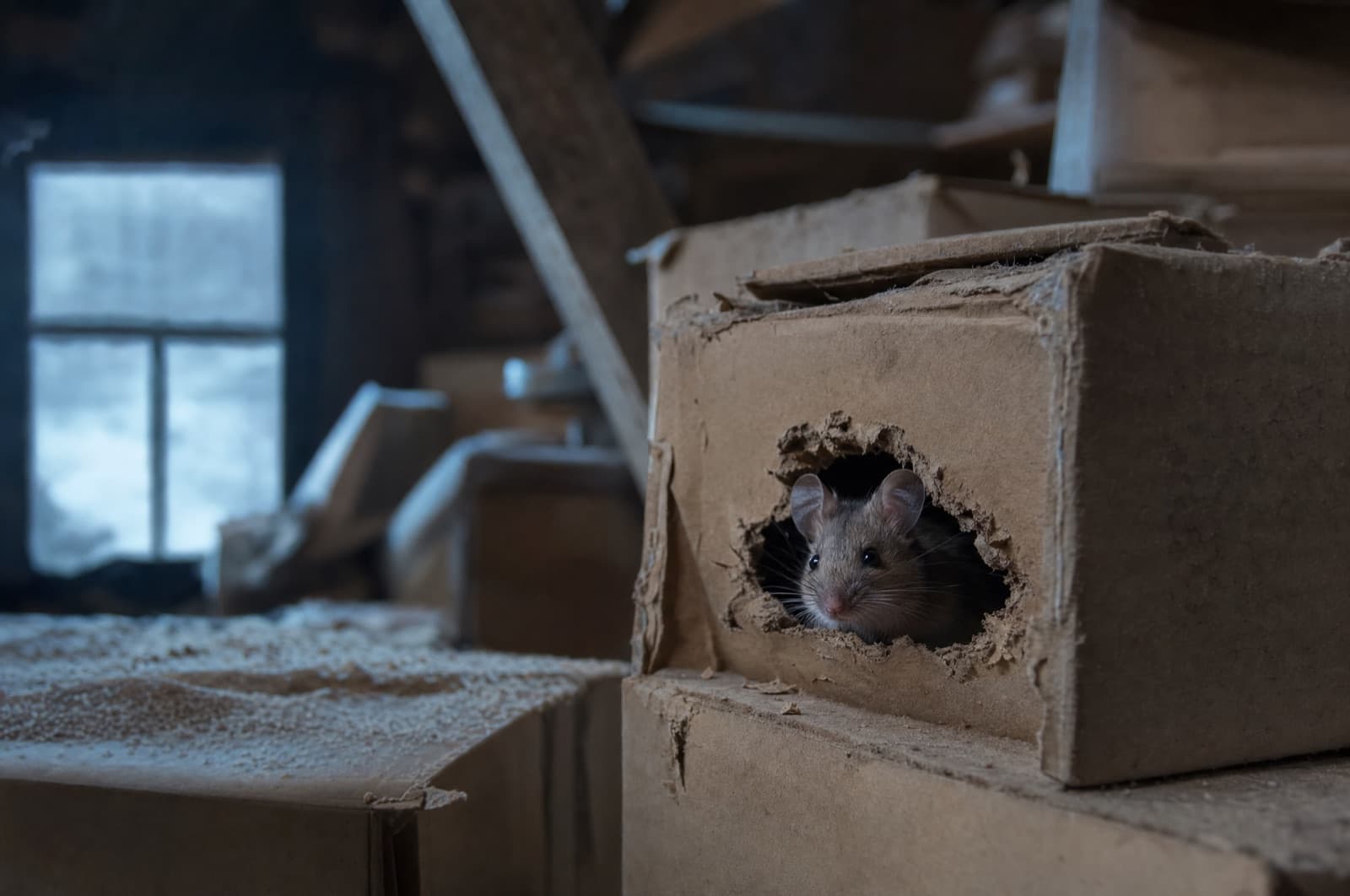
A house mouse in a gnawed cardboard storage box in a cold New Hampshire attic
Daniel Brady · NH-Licensed Pesticide Applicator · License #782664
Reviewed by Daniel Brady

What are the signs of mice infestation in winter?

Catches it early
Winter mouse infestation catches early on a short list of reliable signs: droppings (roughly 1/8 to 1/4 inch, dark and pointed at both ends when fresh), fresh gnaw marks about 1/32 inch wide, greasy rub marks along baseboards and runways, and nighttime scratching in walls or ceilings.UNH Extension notes it is entirely possible to have mice in a home and never see one. A single mouse produces 50 to 75 droppings a day, per NC State Extension, so a buildup is itself a strong early clue -- but each sign has an honest, non-pest look-alike worth ruling out first.

At a glance

  • The verdict: Catches it early
The honest answer

The short of it

The verdict
Catches it early

Droppings and night noise show up well before you ever see a mouse -- these signs genuinely catch activity early, if you check for them.

What you would actually see

The signs — and the honest limit

How much warning you get
Catches it early
  • Droppings

    First weeks

    Rice-grain-sized, pointed at both ends. Dark and glossy when fresh; gray, dry, and crumbly once they've aged. A concentration in one spot marks an active feeding or nesting zone, and volume matters -- a single mouse can leave 50 to 75 droppings a day, so more than a few is a real signal, not a coincidence.

    Easily confused with

    Cockroach droppings, spilled coffee grounds or potting-soil crumbs, or droppings a prior owner or tenant left behind long before you moved in.

  • Fresh gnaw marks

    First weeks

    Clean, light-colored chew marks roughly 1/32 inch wide in cardboard, wire insulation, or soft wood. Mouse incisors grow continuously, so gnawing is routine maintenance for the animal, not an occasional behavior -- fresh marks mean current activity, not an old scar.

    Easily confused with

    Mechanical damage from tools or shipping, or old chew marks left over from before you owned the item -- darker, worn-smooth marks are the tell for "old."

  • Greasy rub marks

    Already established

    Dark, oily smudges along baseboards, pipes, or wall corners where mice travel the same route repeatedly, transferring body oil from their fur. A visible runway usually means the activity has been going on for a while, not a single visit.

    Easily confused with

    Ordinary scuff marks, HVAC or pipe staining, or dirt tracked in from shoes and furniture.

  • Nighttime scratching or scurrying

    First weeks

    Scratching, light scurrying, or gnawing sounds concentrated after dark, since house mice are nocturnal. Sound alone can't tell you how many mice or exactly where they are, but it's often the earliest sign a homeowner notices.

    Easily confused with

    House settling and normal expansion/contraction ticking, HVAC ductwork cycling on and off, or tree branches brushing against siding.

  • A musky odor in enclosed spaces

    Already established

    A persistent musky smell in closets, under sinks, or in enclosed cabinets, from accumulated urine in a space mice are actively using. By the time odor is noticeable, activity has usually been present for some time.

    Easily confused with

    Mildew, a damp basement, or a dried-out sewer trap that's letting sewer gas escape.

What you cannot see
3
  • Nobody has X-ray vision into a wall cavity, under insulation, or beneath a slab -- droppings and noise tell you mice are active in a zone, not exactly where the nest is.
  • You cannot reliably estimate population size from signs alone. A heavy dropping count could be one mouse over several weeks or several mice over a few days.
  • You cannot see whether wiring or insulation inside a wall cavity has already been chewed without opening it up or using a scope -- that is squarely a professional-inspection question, not a checklist one.
How often to actually look
In New Hampshire, start checking pantry corners, under-sink cabinets, and the basement or garage weekly once the first sustained cold hits, typically mid-to-late October in Manchester. A quick fresh-vs-crumbly dropping check each week tells you whether what you're seeing is current activity or old sign.
In depth

The full picture

01

The signs that show up first

Droppings are usually the earliest and most reliable sign, because mice produce them constantly wherever they travel and feed -- NC State Extension notes a single mouse can leave 50 to 75 droppings in a single day. Fresh droppings are dark and glossy; older ones dry out to gray and crumbly, which is a useful, low-effort way to tell current activity from an old problem you've already dealt with.

Gnaw marks and nighttime scratching tend to follow close behind. Mouse incisors grow continuously, so gnawing isn't optional behavior for the animal -- it's a constant, low-level activity, and fresh, light-colored marks in cardboard or wire insulation mean the mouse was recently at that spot. Scratching concentrated after dark is consistent with mouse behavior specifically, since house mice are nocturnal.

02

What each sign is confusable with, and why that matters

None of these signs are unique to mice on their own, which is exactly why the honest checklist names the look-alike for each one rather than treating every dropping-shaped speck as proof. Coffee grounds, potting soil, and cockroach droppings all get mistaken for mouse droppings regularly. House settling and HVAC ductwork produce sounds people describe, almost word for word, the same way they'd describe scratching in a wall.

The practical fix is to look for more than one sign in the same area before concluding you have an active problem -- droppings plus a gnaw mark plus a rub mark in the same corner is a much stronger case than any single sign alone.

03

The honest limit: what a checklist cannot tell you

This is the part that's easy to skip and shouldn't be. Signs tell you mice are active in a general area -- they cannot tell you the nest location, the size of the population, or whether wiring inside a wall cavity has already been damaged. Nobody has X-ray vision into a stud bay or under a slab, and any claim to the contrary should be treated skeptically.

What that limit means practically: use the signs above to decide whether to act (set traps, seal obvious gaps) and where to focus, but don't expect them to tell you "how many" or "how bad" with any precision. That's a fundamentally different question, and it's the one a professional inspection is built to answer.

Key takeaways
5 points
  • Droppings and nighttime scratching are usually the earliest signs -- often before you ever see a mouse.
  • Fresh droppings are dark and glossy; old ones are gray and crumbly. That difference tells you whether activity is current.
  • A single mouse can leave 50 to 75 droppings a day, so a buildup is a strong signal, not a coincidence.
  • Every sign has an honest non-pest look-alike -- coffee grounds, HVAC noise, house settling -- worth ruling out before you assume mice.
  • Nobody can see population size, nest location, or in-wall wiring damage from signs alone. That's the honest limit of a checklist.
New Hampshire context

Checking for signs in a New Hampshire winter

Manchester's first hard frost typically lands between October 19 and 29 (NOAA), which is roughly when the cold pushes mice toward the nearest warm, food-adjacent structure. That makes the weeks around the first frost the highest-value time to start a weekly sign check in pantries, basements, and garages -- catching droppings and gnaw marks in October is a much smaller problem than finding the same signs in February after months of undisturbed activity.

If you're reading this mid-winter with fresh signs already in front of you, don't wait for spring: the signs above tell you where to look and where to set traps now, and the sooner activity is addressed the less time it has to become an established, in-wall population.

  • NH-licensed #782664

    Southern New Hampshire

  • Family-owned

    Since 2017

  • Honest routing

    Even when it isn’t us

We serve these communities

ManchesterNashuaConcordDerryBedfordSalemHudsonAmherst

Seeing more than one of these signs in the same spot?

Droppings plus a gnaw mark plus a rub mark in the same corner is a strong case for active mice -- worth a professional look if signs keep appearing after you've started trapping.

Follow-up questions

Frequently asked

Sources & citations(5)
  1. UNH Extension — How Can I Get Rid of the Mice in My House?

    It is possible to have mice in a home and never see one; sealing and sign-based detection

    extensionverified 2026-07-16
  2. University of Nebraska–Lincoln Extension — House Mouse (G1105)

    Gnaw-mark size (~1/32 inch) and continuous incisor growth

    extensionverified 2026-07-16
  3. UC Statewide IPM Program — House Mouse

    Nocturnal activity pattern and sign-based detection

    extensionverified 2026-07-16
  4. NC State Extension — Surveillance and Management of Common Structure-Invading Rats

    A single rodent can produce 50-75 droppings per day

    extensionverified 2026-07-16
  5. CDC — Hantavirus Prevention

    Never sweep or vacuum dry rodent droppings — airborne transmission risk

    govverified 2026-07-16

Written & reviewed by

Verified

Daniel Brady

NH-Licensed Pesticide Applicator · License #782664 (NHDAMF, RSA 430)

Daniel Brady is the New Hampshire–licensed applicator behind Anchor Pest Services, a family-owned pest control company serving the Manchester area since 2017.

Verify license

Last updated Jul 2026

Honest pest help for New Hampshire homes

Know the Signs. Call Us When They Don't Add Up.

The signs above are more than enough to catch a winter mouse problem early, and checking for them costs nothing. Where Anchor Pest Services helps is when signs persist despite trapping, or when you want a professional read on population size and entry points that a checklist can't give you. Family-owned since 2017, NH license #782664, serving Manchester, Nashua, Concord and nearby towns.

  • Honest advice — we'll tell you when the signs point to a DIY fix
  • NH-licensed applicators (#782664) — free inspection, same-day service
  • Rodent inspection and exclusion across southern and central New Hampshire

NH License #782664 · No obligation · We answer in person