
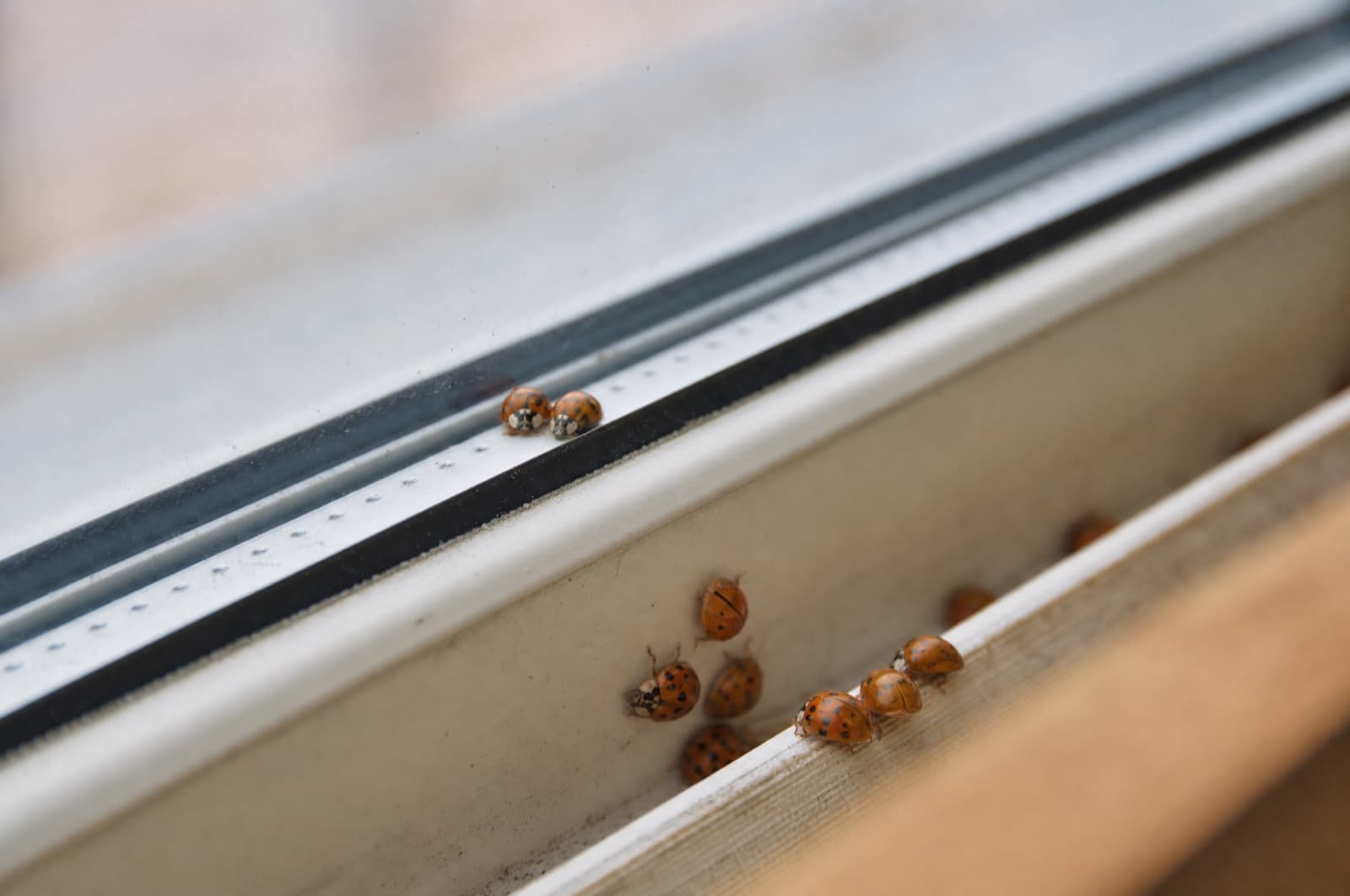
Can They Cause Allergies?
At a glance
- The short answer: Yes — a real, documented allergen
- How to tell: Behaviour, not colour — see The Split
- Where removal lives: We route it out — this hub owns identity
One animal, one honest answer
The verdict on Can they cause allergies?
Harmonia axyridis is an established seasonal indoor allergen with two characterized proteins — this is documented biology, not folklore, and this hub isn't going to debunk it.
Native ladybug vs. the Asian lady beetle
Two names, one animal. Both columns always render — and they always converge on the same resolution. The tell is behaviour, not colour.
The native ladybug
(the one you're picturing)
- Uses the same general reflex-bleeding defense found across coccinellids, but rarely builds up indoors in the volume that drives allergen exposure
- Not the species the allergy literature specifically characterizes
The Asian lady beetle
(Harmonia axyridis)
- The species behind the peer-reviewed allergen findings — its indoor mass overwintering is what creates sustained exposure in homes
- Colour runs pale yellow-orange to deep red to fully black — colour alone is a weak tell, not a diagnosis, and unrelated to allergen risk
Whichever name you use, the allergy finding is about the same insect and the same indoor aggregation behavior that puts its allergen in the air of a house in the first place.
What's actually going on
Yes — a real, peer-reviewed indoor allergen
This is one of the few home-invader health claims where the common fear turns out to be accurate, and this hub's job is to say so plainly rather than reflex-debunk it. Nakazawa and colleagues, writing in the Journal of Allergy and Clinical Immunology, purified two major beetle proteins — Har a 1, roughly 10 kilodaltons, and Har a 2, roughly 55 kilodaltons — and found they bound IgE antibody in 65 and 75 percent of sera, respectively, from patients living in beetle-infested houses. A clinical review by Goetz, in Allergy and Asthma Proceedings, describes ladybug-specific IgE hypersensitivity documented across all ages and both sexes, manifesting as rhinoconjunctivitis, asthma, urticaria, and angioedema, and notes that in some endemic areas ladybug allergy has been reported at a prevalence as high as 10 percent — with ladybug ranked alongside cat, cockroach, and house-dust mite among the allergens most likely to show up as an isolated positive skin test in an allergist's office. Exposure to accumulations of dead beetles indoors, not just live ones, can also provoke a reaction.
Separately: no, they are not a documented disease vector
This is a genuinely different claim from the allergen finding, and it shouldn't be blurred into one vague 'they're unhealthy' statement. Extension entomology sources are consistent that these beetles do not carry or transmit infectious disease to people or pets; the health concern here is an allergic and irritant response to the beetle's own proteins and defensive fluid, not a pathogen the beetle is spreading. If you or someone in the household has persistent respiratory or skin symptoms that track with a beetle aggregation, that's worth raising with a physician or allergist — this page describes the documented biology, it doesn't diagnose an individual case. In New Hampshire, the exposure window is predictable: UNH Cooperative Extension reports these beetles are most numerous on the sunny side of buildings on mild days from mid-September through early November, which is exactly when a sensitized household is most likely to notice symptoms flaring, and sealing entry points before mid-September is the extension-recommended way to keep that fall influx out of the indoor air. For the related bite and reflex-bleeding facts this allergen finding connects to, see do-they-bite and the-smell-and-the-yellow-stain.
Key takeaways
Yes — Harmonia axyridis is a peer-reviewed, established seasonal indoor allergen, with two characterized proteins, Har a 1 and Har a 2.
Reactions documented in the clinical literature range from rhinoconjunctivitis and asthma to hives and angioedema.
Separately: no, they are not documented to carry bacteria or spread infectious disease — that's a different claim from the allergen finding, not the same one restated.
This page replaces 3 of our own legacy pages that blurred allergy and disease-vector questions together across two species names.
These questions all land here
We asked this more than once, under more than one name, and printed more than one answer. There was only ever one — so here's what this page replaces.
Our old site blurred allergy, bacteria, and disease into one vague 'are these unhealthy' worry, split again across two species names. They're separate, separately sourced claims: yes to allergen, no to disease vector — and this page says both plainly instead of one fuzzy answer.
Looking to get rid of them?
This hub answers what it is — not how to remove it. Most people who land here actually want one of these next steps, so we hand you straight to the hub that owns it.
A real allergen is still worth reducing indoors.
Fewer beetles aggregating on and inside your home means less allergen exposure for anyone in the household who's sensitized.
Frequently asked
Sources & further reading(6)
- [1]Nakazawa et al. — Journal of Allergy and Clinical Immunology, characterization of ladybug allergens Har a 1 and Har a 2
Two purified proteins bound IgE antibody in 65% and 75% of sera from sensitized patients
academicverified 2026-07-17 - [2]Goetz — Allergy and Asthma Proceedings 2008;29:123-129, ladybug allergy clinical review
Documented reactions across ages and sexes: rhinoconjunctivitis, asthma, urticaria, angioedema; prevalence up to 10% in endemic areas
academicverified 2026-07-17 - [3]Joint Task Force on Practice Parameters — allergy diagnostic testing review
Ladybug among allergens most likely to present as an isolated single-positive skin test
academicverified 2026-07-17 - [4]University of Minnesota Extension — "Multicolored Asian Lady Beetles"
Exposure to accumulations of dead beetles indoors can also provoke allergic reactions
extensionverified 2026-07-17 - [5]Iowa State University Extension — "Ladybug, Multicolored Asian Lady Beetle"
Colour and spot-count variability of Harmonia axyridis
extensionverified 2026-07-17 - [6]UNH Cooperative Extension — Multicolored Asian Ladybug fact sheet
NH fall exposure window: most numerous on sunny building sides mid-September through early November; seal before mid-September
extensionverified 2026-07-17
Written & reviewed by
VerifiedDaniel Brady
NH-Licensed Pesticide Applicator · License #782664 (NHDAMF, RSA 430)
Daniel Brady is the New Hampshire–licensed applicator behind Anchor Pest Services, a family-owned pest control company serving the Manchester area since 2017.
Last updated July 2026
Health-conservative pest guidance for New Hampshire homes
The One Fear This Hub Confirms Instead of Debunking
The allergy is real and peer-reviewed; the disease-vector worry is not documented. We'll tell you which is which instead of blurring them into one vague health scare. Family-owned since 2017, NH license #782664, based at 700 Harvey Rd in Manchester.
- NH-licensed applicators (#782664) — free inspection, same-day service
- We consolidated 3 of our own pages rather than blur allergy and disease-vector claims together
- Family-owned, Manchester NH, since 2017
NH License #782664 · No obligation · We answer in person
Your next step
- Fall guide
Fall Pest Control in New Hampshire
What matters before frost: the fall invader window, mice at the foundation, and what to seal first.
Read the answer - What to do next
Do fall pests cause allergies?
Read the answer - What to do next
Do lady beetles bite or cause reaction?
Read the answer - What to do next
Could pests in winter exacerbate allergies or asthma indoors?
Read the answer - Also relevant
Asian Lady Beetle in New Hampshire: Honest ID & What to Do
Read the answer - Related guide
Do Asian Lady Beetles Bite?
Read the answer