
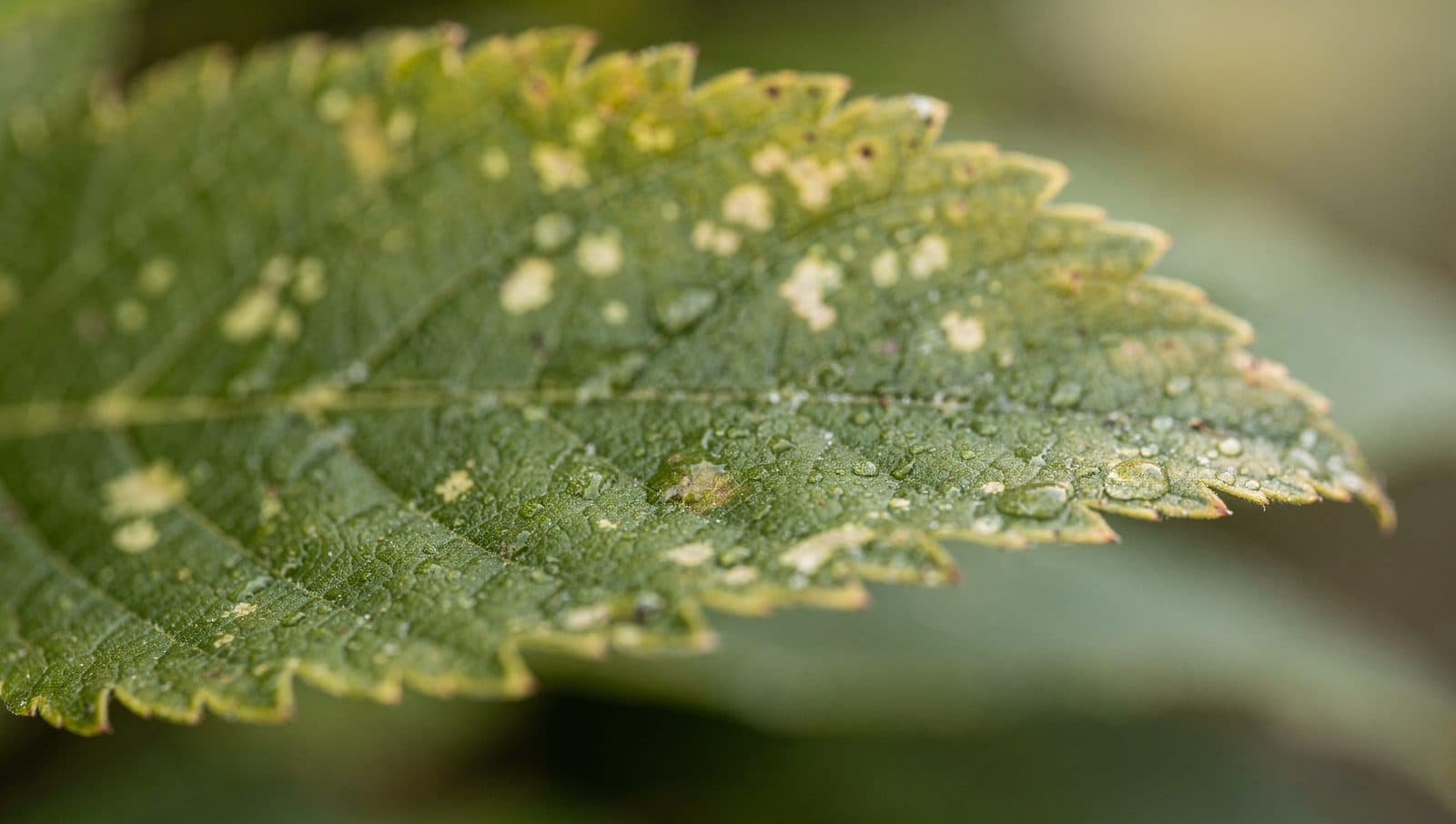
What Causes Brown or Black Leaf Spots?
Discrete brown or black spots on a leaf are usually a fungal or bacterial leaf-spot disease, not a bug.
At a glance
- The verdict: Usually a disease
- Who fixes it: Garden center
- Category: Leaf-Symptom Diagnosis (pest vs disease vs care)
The short answer
Well-defined brown or black spots — as opposed to crisp browning along the leaf edge — point most often to a fungal or bacterial leaf-spot disease such as Septoria, Cercospora, anthracnose, or maple tar spot. These spots typically have a distinct margin or yellow halo, spread fastest in wet or humid weather, and often show up on lower or older leaves first. Cultural causes like fungicide or pesticide burn and sunscald come next, matching a pattern of exposure rather than infection. Chewing pests are a distant third, and the tell there is a sunken feeding wound rather than a spreading, watery lesion.
Pest, disease, or how you're caring for it?
Most leaf problems aren't pests at all. Here's the honest split — the most likely cause, the less likely ones, and how to tell them apart before you treat anything.
- DiseaseMost likelythe usual cause
Defined, roughly round or irregular spots, often with a darker margin or a yellow halo, that spread across the plant fastest in wet or humid weather and tend to appear on lower or older leaves first.
Septoria leaf spot and Cercospora leaf spotAnthracnoseMaple tar spot (raised black spots with a yellow halo)The tell:Look for a defined edge, ring, or halo around the spot, and check whether new spots are appearing on nearby leaves after rain or humid stretches — that spreading pattern is the disease signature.
- Care / environmenta less common cause
Spotting or blotching that matches a specific exposure — a spray pattern, a sunny side of the plant, or a recent cold snap — rather than spreading outward over time.
Fungicide or pesticide spray burnSunscald on tissue with intense direct exposurePhysical or cold-related spottingThe tell:The pattern lines up with something that happened to the plant — a spray, a hot afternoon, a cold night — and it doesn't have the ringed or haloed look of a lesion, nor does it spread to untouched leaves.
- Pesta rare cause
Small, sunken, roundish spots concentrated where an insect has been feeding, sometimes with a slightly different texture than a fungal lesion.
Four-lined plant bug feeding (sunken round spots)Lace bug or mite feeding producing stippled, spotty bronzingThe tell:Sunken feeding wounds rather than a flat lesion, and often accompanied by the insect itself, cast skins, or fine stippling nearby.
Check whether the spot has a defined ring or yellow halo and whether new spots are appearing on other leaves after a wet or humid stretch — that pattern means disease. A spot that lines up with a specific exposure (a spray, intense sun, a cold night) and stays put is cultural. A sunken, feeding-type wound, especially with the insect nearby, points to a pest.
Who actually fixes this?
Start here
Garden center
Leaf-spot diseases are managed with sanitation (removing and disposing of affected leaves), improved airflow, and, where needed, a garden-center fungicide — not a structural pest treatment.
- UNH Extension — You want the specific disease confirmed, especially on a valuable ornamental or a tree — UNH Cooperative Extension's plant diagnostic services can help identify it.
- Certified arborist — The spotting is on a mature tree, particularly if it's spreading with twig dieback rather than staying purely cosmetic.
The details, straight
Why discrete spots usually mean disease
The distinguishing feature of a leaf-spot disease is that it's a lesion — living plant tissue killed by a fungal or bacterial pathogen — rather than damage from an outside cause. That's why these spots so often have a defined edge, sometimes ringed, sometimes haloed in yellow, and why they multiply and spread across a plant over the course of days or weeks, especially during wet or humid weather that favors fungal spore germination and bacterial spread. Common culprits include Septoria leaf spot and Cercospora leaf spot on many ornamentals and vegetables, anthracnose on trees and shrubs, and maple tar spot, whose raised, black, tar-like spots can reach up to an inch or more across by late summer.
Reading the pattern: spreading lesion vs. fixed mark
A genuine disease lesion behaves like an infection: it appears first on lower or older leaves, spreads to nearby foliage as conditions stay wet, and the spot itself has visible structure — a ring, a halo, sometimes a slightly fuzzy or raised texture. A cultural mark behaves differently: it appears wherever the exposure happened — the side of the plant that got the most sun, the leaves a spray drifted onto, the tissue hit hardest by a cold night — and it doesn't spread to leaves that weren't exposed to the same conditions. This distinction is the single most useful check for telling disease from a care-related mark.
When a spot is actually a feeding wound
Some insects create spot-like damage that can be mistaken for disease. Four-lined plant bug feeding, for example, leaves small, sunken, roughly circular spots where the insect has punctured the tissue and fed on the cell contents underneath — a wound rather than an infection. The tell is texture and company: a feeding wound tends to be sunken rather than flush with the leaf surface, and it's often accompanied by other signs of the insect, like cast skins, stippling, or the bug itself on nearby leaves.
What actually helps
For most leaf-spot diseases, sanitation does the heavy lifting: removing and disposing of (not composting) affected leaves as they drop, improving airflow around the plant, watering at the base rather than overhead, and cleaning up fallen leaf debris at the end of the season to reduce the amount of fungal spore material overwintering nearby. A garden-center fungicide can help on valuable ornamentals when applied early and per label directions, but on a large, mature tree with tar spot or anthracnose, sanitation and monitoring — not spraying — is typically the practical approach, since most cases are cosmetic rather than a threat to the tree's health.
Key takeaways
- A defined ring, margin, or yellow halo that spreads in wet weather is the disease signature — not a bug.
- A mark that lines up with a spray, sun exposure, or a cold snap and doesn't spread is cultural, not disease.
- Sunken, feeding-type wounds with the insect nearby point to a pest, but this is the least common cause of discrete spots.
- Sanitation — removing affected leaves, improving airflow, cleaning up fallen debris — is the core fix for most leaf-spot disease.
- This is a plant-disease question, not a pest-control question, though an arborist or UNH Extension can help confirm it on a valuable specimen.
Not sure it's disease?
Learn the five at-home checks that separate pests, disease, and care problems before you spray anything.
See how to tell pest from diseaseA note for New Hampshire gardeners
New England's humid summers and wet spring stretches are favorable conditions for many leaf-spot fungi, including maple tar spot, which is common on New Hampshire's maples and largely cosmetic. Raking and disposing of fallen leaves this fall — ahead of Manchester's typical first hard frost, with roughly a 50% chance of 32°F by October 19 per Garden.org's NOAA-based frost data — reduces the amount of fungal material that can reinfect trees and shrubs next season. UNH Cooperative Extension's plant diagnostic services can confirm the specific disease if you want certainty before treating.
NH-licensed applicator #782664 (NHDAMF, RSA 430) · NEPMA member · family-owned since 2017.
Related questions
Sources(4)
- [1]University of Maryland Extension — Key to Common Problems of Tomatoes
Septoria leaf spot and early blight as haloed, spreading fungal lesions distinct from cultural burn
extensionverified 2026-07-14 - [2]University of Wisconsin Horticulture — Tar Spot of Trees and Shrubs
Maple tar spot as a cosmetic, raised black fungal spot with a yellow halo
extensionverified 2026-07-14 - [3]University of Maine Cooperative Extension — Tar Spot Fungus
New England tar spot and anthracnose prevalence and fall sanitation as the practical control
extensionverified 2026-07-14 - [4]West Virginia University Extension — Septoria Leaf Spot
Septoria leaf spot progression versus early blight and cultural look-alikes
extensionverified 2026-07-14
Written & reviewed by
VerifiedDaniel Brady
NH-Licensed Pesticide Applicator · License #782664 (NHDAMF, RSA 430)
Daniel Brady is the New Hampshire–licensed applicator behind Anchor Pest Services, a family-owned pest control company serving the Manchester area since 2017.
Last updated 2026-07-14
Your next question
Honest pest help for New Hampshire homes
Leaf-Spot Disease Is Plant Care — But Your Home Is Our Job
Managing a fungal leaf spot is garden and tree care, and we'll always tell you so. Where Anchor Pest Services genuinely helps is the pests around your home — rodents, ants, ticks, and moisture pests drawn to leaf litter and debris against the foundation. Family-owned since 2017, NH license #782664, serving Manchester, Nashua, Concord and nearby towns.
- Honest read — most leaf spots are disease or care, and we'll say so plainly
- NH license #782664 for structural and yard pests, not fungal spots on plants
- Perimeter and structural pest control for southern and central New Hampshire
NH License #782664 · No obligation · We answer in person
Your next step
- Book a NH pro
Pest Control Services
Licensed, family-owned pest control across southern NH.
Book now - Related guide
Why Do Leaves Get Brown Edges or Spots?
Read the answer - Related guide
Why Are My Hydrangea Leaves Brown?
Read the answer - Related guide
Why Are There Black Dots or Mold on My Leaves?
Read the answer - Related guide
What Causes White Spots on Rose Leaves?
Read the answer - Related guide
Why Do Leaves Turn Black After Watering?
Read the answer