
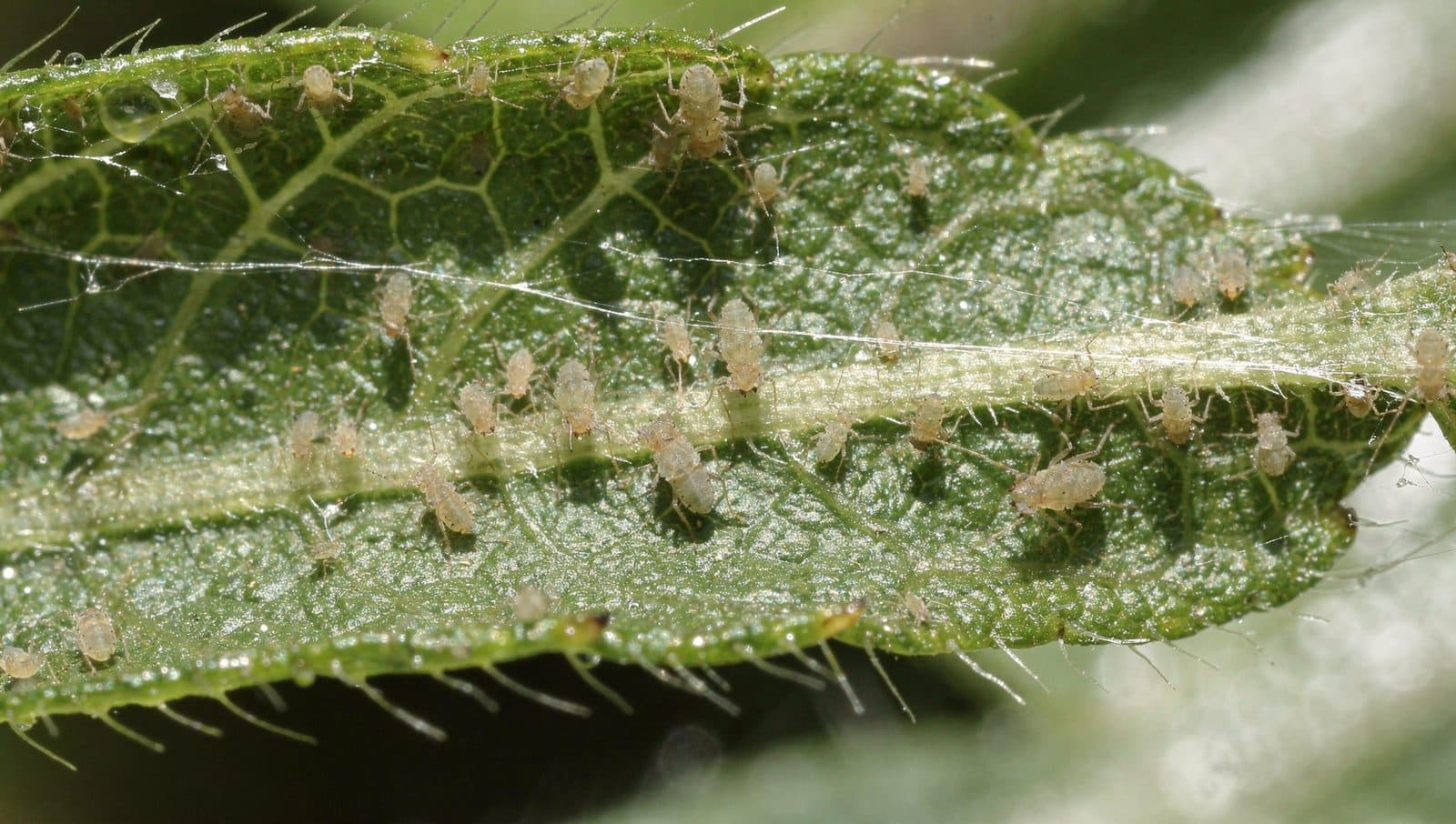
What Insects Live on Tree Leaves?
Tree-leaf insects fall into sap-feeders, chewers, and miners — the damage pattern names the group, and most healthy trees tolerate a surprising amount of it.
At a glance
- The verdict: Multiple suspects
- Who fixes it: You
- Category: Leaf-Pest ID & Environmental Factors
The short answer
The insects on tree leaves are mainly aphids, scale insects, and lace bugs (sap-feeders), caterpillars, sawfly larvae, and Japanese beetles (chewers), plus leaf miners (tunnelers). Read the damage to narrow it down: sticky honeydew and curled leaves mean sap-feeders; ragged holes or skeletonized leaves mean chewers; winding pale tunnels inside the leaf mean miners. Most established, otherwise-healthy trees tolerate a surprising amount of leaf feeding without lasting harm. For high-value or heavily infested trees, an ISA-certified arborist is the right call — not a structural pest company.
Who's the likely culprit?
The sign: insects, honeydew, holes, or tunnels on tree leaves
- AphidsTop suspect
Cluster on tender new shoots; heavy feeding curls the leaves and drips sticky honeydew onto cars, patios, and pavement below, which then feeds black sooty mold.
- Scale insectsTop suspect
Immobile bumps on twigs and leaves. University of Minnesota Extension notes soft-scale honeydew "supports the growth of sooty mold on the leaves of plants, but it is not directly damaging to plants" — the crawler stage is the vulnerable window for control.
- Caterpillars and sawfly larvaePossible
Ragged holes, skeletonized leaves, and sometimes silk tents at branch forks. This group includes cankerworms, tent caterpillars, oakworms, and slug-like sawfly larvae.
- Japanese beetlesPossible
Lacy, skeletonized leaves that appear suddenly in midsummer, often in clusters of visible metallic-green beetles feeding together.
- Lace bugsPossible
Pale stippling on the upper leaf surface paired with dark, tar-like spots of frass on the underside.
- Spider mitesLook-alike
Bronzed, stippled foliage that shows up in hot, dry spells — a mite problem, not an insect, and easy to mistake for drought stress or a chewing pest.
- Leaf minersPossible
Squiggly pale tunnels or blotches inside the leaf tissue itself rather than on the surface — common on birch and boxwood.
Who actually fixes this?
Start here
You
Hosing off a light aphid outbreak on a reachable shrub or small tree, or simply monitoring minor chewing damage, is homeowner-level plant care for most cases.
- Certified arborist — The tree is large, high-value, or heavily infested — canopy-level treatment and diagnosis is an ISA-certified arborist's job, not a homeowner spray job.
- UNH Extension — You want the insect or the damage pattern confirmed before deciding whether treatment is even warranted.
- Garden center — You've confirmed a soft-bodied pest on a reachable shrub or small tree and need a registered soap or oil product.
The details, straight
Three groups, three damage patterns
Nearly every tree-leaf insect sorts into one of three functional groups, and the pattern of damage tells you which before you ever see the bug itself. Sap-feeders — aphids, scale, lace bugs, spider mites — leave sticky honeydew, curled or stippled leaves, and sometimes sooty mold, because they're piercing the leaf to drink rather than biting off tissue. Chewers — caterpillars, sawfly larvae, Japanese beetles — leave ragged holes, skeletonized leaf veins, or entire leaves stripped to lace. Miners tunnel inside the leaf itself, leaving winding pale trails or blotches you can see through the leaf surface but never a hole. Starting with the damage pattern, rather than trying to spot a tiny insect on a tall tree, is the faster and more reliable path to an ID.
How much damage a healthy tree can actually tolerate
Established, otherwise-healthy trees have far more resilience to leaf feeding than most homeowners assume — a tree can lose a meaningful percentage of its leaf tissue to aphids, caterpillars, or leaf miners in a single season and still leaf out normally the following year, because trees store reserves and can compensate for a partial loss of photosynthetic area. The situations that actually warrant escalation are repeated, severe defoliation across multiple seasons, a young or already-stressed tree, or a high-value specimen where even cosmetic damage matters — those are the calls for an ISA-certified arborist, not routine annual insect activity.
When it's not an insect at all
Odd swellings called galls are one of the most commonly misdiagnosed tree symptoms — caused by mites or tiny wasps that trigger the tree's own tissue to grow around them, galls are almost always cosmetic and the responsible insect is often long gone by the time the gall is noticeable. Fungal leaf-spot diseases and ordinary fall color change are two more frequent false positives for "insect damage." Before treating a tree for insects, rule out these non-pest explanations, since no insecticide addresses any of them.
Key takeaways
- Sap-feeders (aphids, scale, lace bugs) cause honeydew, curling, and stippling; chewers (caterpillars, beetles) cause holes and skeletonized leaves; miners cause internal tunnels.
- Soft-scale honeydew feeds sooty mold but doesn't directly damage the tree, per UMN Extension.
- Most healthy, established trees tolerate significant leaf feeding without lasting harm.
- Galls, fungal leaf spot, and normal fall color are commonly mistaken for insect damage and need no insecticide.
- Large or high-value trees are an ISA-certified arborist's job, not a homeowner spray project.
Read the damage, not just the bug
Honeydew, holes, or tunnels each point to a different group of tree-leaf insects — and most healthy trees shrug off more than you'd think.
See the full culprit IDA note for New Hampshire tree owners
Many canopy insects here are seasonal and regional: Japanese beetles feed on tree and shrub foliage across southern New Hampshire from roughly late June into August per UNH Cooperative Extension guidance, while aphids and their honeydew build through the warmer months. UNH Extension's Insect & Arthropod Identification service can confirm whether what you're seeing is a harmless leaf-feeder or a genuine tree-health concern, and an ISA-certified arborist is the right call for a mature or high-value tree. Anchor Pest Services focuses on the structural and yard pests around your home, not the canopy.
NH-licensed applicator #782664 (NHDAMF, RSA 430) · NEPMA member · family-owned since 2017.
Related questions
Sources(4)
- [1]University of Minnesota Extension — Tree and Shrub Insects
Sap-feeder, chewer, and miner damage-pattern categorization for tree leaves
extensionverified 2026-07-14 - [2]University of Minnesota Extension — Scale Insects
Soft-scale honeydew feeds sooty mold without directly damaging the plant
extensionverified 2026-07-14 - [3]University of Kentucky Entomology — Tree Pest Guide (Oak)
Common tree-canopy insect pests and damage identification
academicverified 2026-07-14 - [4]Arboriculture & Urban Forestry (ISA) — Journal Archive
Tree tolerance to leaf-area loss and arborist assessment thresholds
academicverified 2026-07-14
Written & reviewed by
VerifiedDaniel Brady
NH-Licensed Pesticide Applicator · License #782664 (NHDAMF, RSA 430)
Daniel Brady is the New Hampshire–licensed applicator behind Anchor Pest Services, a family-owned pest control company serving the Manchester area since 2017.
Last updated 2026-07-14
Your next question
Honest pest help for New Hampshire homes
Tree-Leaf Insects Are Tree Care — But Your Home Is Our Job
Insects on your tree's leaves are a tree-health question, and we'll always route you to an arborist or Extension when that's the honest answer. Where Anchor Pest Services genuinely helps is the pests around your home — rodents, ants, ticks, and moisture pests drawn to yard debris and foundation clutter. Family-owned since 2017, NH license #782664, serving Manchester, Nashua, Concord and nearby towns.
- Identification first — canopy insects range from harmless to a tree-health concern
- NH-licensed (#782664) for structural and yard pests, not the bugs in your tree canopy
- Serving southern and central New Hampshire homes and yards
NH License #782664 · No obligation · We answer in person
Your next step
- Related guide
Why Are Tree Leaves Dropping Early?
Read the answer - Related guide
What Insects Live Under Leaves?
Read the answer - Related guide
Why Do Leaves Get Sticky Under Trees?
Read the answer - Related guide
How Often Should I Inspect Tree Leaves?
Read the answer - Related guide
Why Are Leaves on One Side of a Tree Dying?
Read the answer - Related guide
Why Are My Maple Tree Leaves Spotted?
Read the answer