
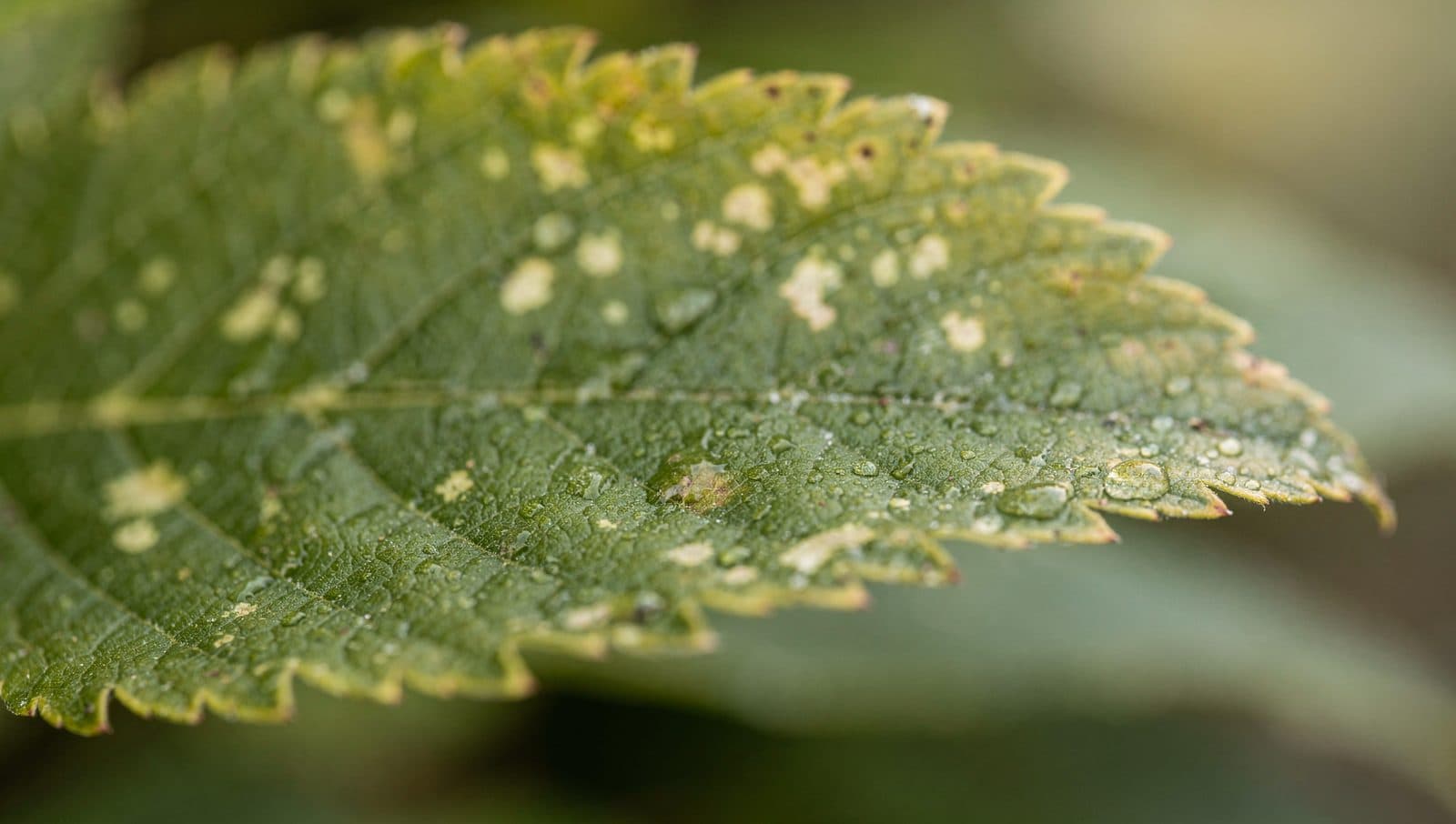
Why Are Leaves on One Side of a Tree Dying?
One-sided dieback in a tree is a classic sign of Verticillium wilt, a soil fungus that invades the vascular system, or one-sided root damage — an arborist and lab call, not a spray job.
At a glance
- The verdict: Usually a disease
- Who fixes it: Certified arborist
- Category: Leaf-Symptom Diagnosis (pest vs disease vs care)
The short answer
Foliage dying on just one side of an otherwise healthy-looking tree points most often to Verticillium wilt, a soil-borne fungus that invades the vascular system and restricts water to whichever side it has colonized, especially in maples. One-sided root damage — from trenching, a girdling root, soil compaction, de-icing salt, or utility work on that side of the tree — is a close second and produces a similar pattern without an infection. Borers or bark beetles girdling a limb are the least likely cause and generally leave visible entry holes. Because Verticillium can't be confirmed by eye and has no cure, this symptom calls for an arborist and a diagnostic lab, not a home remedy.
Pest, disease, or how you're caring for it?
Most leaf problems aren't pests at all. Here's the honest split — the most likely cause, the less likely ones, and how to tell them apart before you treat anything.
- DiseaseMost likelythe usual cause
Foliage on one side of the tree, or a single major limb, wilts and browns while the rest of the canopy looks normal, sometimes with the pattern worsening over one or more growing seasons.
Verticillium wilt — a soil-borne vascular fungus especially common on maplesThe tell:Peel a bit of bark from a wilting branch on the affected side and look for streaking in the sapwood just under the bark, typically green in maples or brown in other species. There is no fungicide cure for Verticillium.
- Care / environmenta less common cause
Dieback confined to the side of the tree where the roots have been disturbed or damaged, without vascular streaking.
Trenching or excavation that severed roots on one sideA girdling root constricting the trunk or major rootsSoil compaction, de-icing salt exposure, or a utility line disturbance concentrated on one sideThe tell:Look for recent digging, construction, sidewalk or driveway work, or visible soil compaction on the same side as the dying foliage.
- Pesta rare cause
A single limb or branch dies while the insect responsible remains hidden inside the wood.
Borers or bark beetles girdling a branch by tunneling under the barkThe tell:Look for small entry holes, sawdust-like frass at the base of the affected limb, or bark that sounds hollow when tapped.
Peel back a bit of bark on a wilting branch to check for vascular streaking, which points to Verticillium wilt. Look for recent excavation, construction, or soil disturbance on the same side as the dying foliage, which points to root damage. Check for small entry holes or frass, which points to a borer. Verticillium and root damage cannot be reliably told apart from streaking alone in every case — a diagnostic lab sample is the only way to confirm Verticillium specifically.
Who actually fixes this?
Start here
Certified arborist
One-sided dieback needs a trained diagnosis before any action — an ISA-certified arborist can assess the tree's overall condition, take samples for lab confirmation of Verticillium, and advise on whether the tree is salvageable or a safety risk.
- UNH Extension — You want lab confirmation of Verticillium wilt specifically — this requires a tissue culture, not a visual ID, and UNH Cooperative Extension can direct a sample to the appropriate diagnostic lab (verify current routing, as UNH's plant disease lab has at times referred samples to University of Maine or Cornell).
The details, straight
Why Verticillium wilt is the leading suspect
Verticillium wilt is caused by a soil-dwelling fungus that enters a tree through its roots and colonizes the vascular tissue that carries water up through the trunk and into the branches — and because the fungus doesn't necessarily spread evenly through the whole vascular system at once, the symptoms can show up on just one side of the tree or in a single major limb while the rest of the canopy looks fine. Michigan State University Extension describes exactly this pattern: 'Sometimes a single branch or the foliage on one side of a tree will die,' with the sapwood beneath the bark showing green streaking in maples or brown streaking in many other susceptible species. Maples are especially prone to Verticillium, which is one reason this symptom shows up so often in New England, where maples are common street and yard trees.
There is no cure — only management and confirmation
Multiple university extension sources agree there is no fungicide that cures Verticillium wilt once it's established in a tree's vascular system; management focuses on keeping the tree as healthy and low-stress as possible (consistent watering during drought, avoiding additional root damage, proper mulching) to help it compartmentalize the infection, and monitoring for further decline. Because Verticillium's vascular streaking can resemble other stresses and can't be definitively confirmed by eye, extension sources recommend having a suspected case sampled and cultured at a diagnostic lab rather than assuming a diagnosis from symptoms alone — and any wood suspected of Verticillium infection should not be chipped into mulch, since the fungus can survive in wood chips and infect other susceptible plants.
When it's root damage instead
A tree's root system is roughly mirrored by its canopy — roots on one side of the tree largely support and supply the branches on that same side — so damage concentrated on one side of the root zone can produce a similar one-sided dieback pattern to Verticillium, but from mechanical injury rather than infection. Trenching for a utility line, driveway or sidewalk construction, soil compaction from heavy equipment, a girdling root that constricts the trunk over years, or repeated de-icing salt runoff can all sever or damage roots on just one side. The tell here is circumstantial rather than internal: look for evidence of recent digging, construction, or soil disturbance on the same side as the dying foliage.
The borer exception
Borers and bark beetles that tunnel beneath the bark can girdle a single branch by cutting off its vascular connection to the rest of the tree, killing just that limb while leaving the rest of the canopy unaffected. This is a genuinely structural, insect-driven cause, but it's the least common explanation for one-sided dieback among the three buckets here, and it typically leaves physical evidence — small round or oval entry holes in the bark, sawdust-like frass accumulating at the base of the branch, or bark that sounds hollow when tapped — that an arborist or Extension entomologist can confirm.
Key takeaways
- One-sided dieback most often means Verticillium wilt, a soil-borne vascular fungus with no cure, especially common on maples.
- Vascular streaking under the bark (green in maple, brown in many other species) is the key tell, but lab confirmation is needed for certainty.
- One-sided root damage from trenching, construction, or a girdling root produces a similar pattern without infection — check for recent soil disturbance.
- Borers girdling a single limb are the least common cause and usually leave visible entry holes or frass.
- This calls for an ISA-certified arborist and a diagnostic lab, not a home remedy or a structural pest treatment — never chip suspected Verticillium wood into mulch.
Not sure it's Verticillium?
Learn the five at-home checks that separate pests, disease, and care problems — and when a symptom needs a lab, not a guess.
See how to tell pest from diseaseA note for New Hampshire tree owners
Maples are among the most common shade and street trees in New Hampshire, and they're also among the species most susceptible to Verticillium wilt, so one-sided dieback on a maple deserves a closer look rather than a wait-and-see approach. UNH Cooperative Extension's plant diagnostic lab can help direct a sample for lab culture (verify current status, as it has at times referred physical disease samples to the University of Maine or Cornell diagnostic clinics), and an ISA-certified arborist can assess whether the tree poses any structural risk as branches decline. Anchor Pest Services is not the right call here unless a borer is specifically confirmed as the structural pest involved — we'll tell you that plainly rather than take on a job that isn't ours.
NH-licensed applicator #782664 (NHDAMF, RSA 430) · NEPMA member · family-owned since 2017.
Related questions
Sources(4)
- [1]MSU Extension — Verticillium Wilt Refresher
One-sided or single-branch dieback pattern and vascular sapwood streaking characteristic of Verticillium wilt
extensionverified 2026-07-14 - [2]Penn State Extension — Verticillium Wilt of Woody Ornamentals
One-sided foliage wilt and lack of a fungicide cure for Verticillium wilt
extensionverified 2026-07-14 - [3]University of Wisconsin Horticulture — Verticillium Wilt of Trees and Shrubs
Vascular streaking, management by reducing stress, and avoiding chipping infected wood into mulch
extensionverified 2026-07-14 - [4]UNH Cooperative Extension — Plant Diagnostic Lab
NH routing for lab-confirmed disease diagnosis, including current referral status to other regional labs
extensionverified 2026-07-14
Written & reviewed by
VerifiedDaniel Brady
NH-Licensed Pesticide Applicator · License #782664 (NHDAMF, RSA 430)
Daniel Brady is the New Hampshire–licensed applicator behind Anchor Pest Services, a family-owned pest control company serving the Manchester area since 2017.
Last updated 2026-07-14
Your next question
Honest pest help for New Hampshire homes
Tree Vascular Disease Is Arborist Work — But Your Home Is Our Job
Diagnosing and managing Verticillium wilt or root damage in a tree is arborist and lab work, and we'll always tell you so. Where Anchor Pest Services genuinely helps is the pests around your home — rodents, ants, ticks, and moisture pests drawn to leaf litter and debris against the foundation. Family-owned since 2017, NH license #782664, serving Manchester, Nashua, Concord and nearby towns.
- We separate a tree-health problem from a pest one before recommending anything
- Licensed New Hampshire applicators, #782664 — free, no-pressure quote
- Structural and yard pest control for Manchester, Nashua, Concord and nearby towns
NH License #782664 · No obligation · We answer in person
Your next step
- Book a NH pro
Pest Control Services
Licensed, family-owned pest control across southern NH.
Book now - Related guide
What Insects Live on Tree Leaves?
Read the answer - Related guide
Why Are Tree Leaves Dropping Early?
Read the answer - Related guide
How Often Should I Inspect Tree Leaves?
Read the answer - Related guide
Why Are My Maple Tree Leaves Spotted?
Read the answer - Related guide
Why Do Leaves Look Sticky or Shiny?
Read the answer