
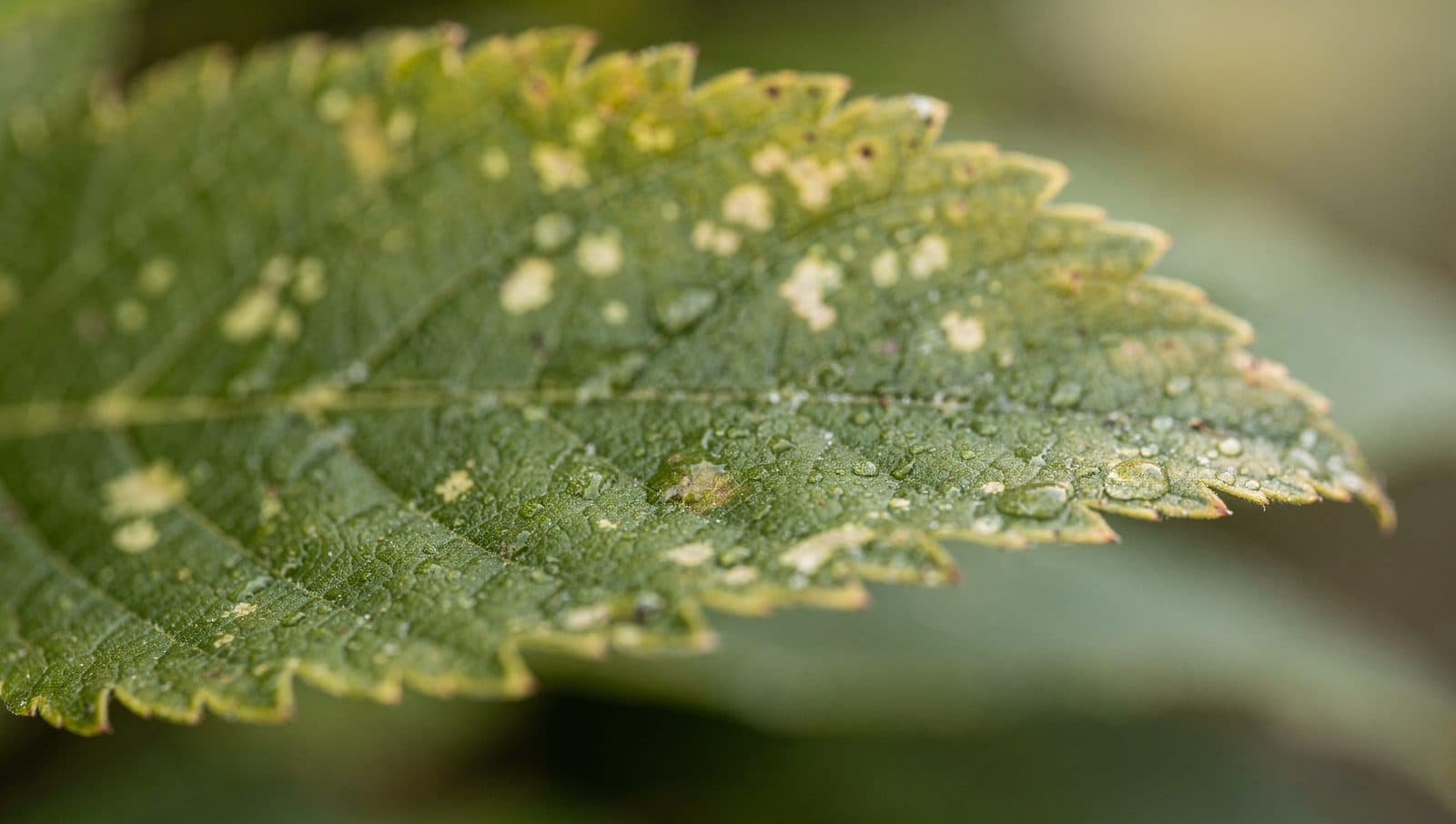
Why Are There Black Dots or Mold on My Leaves?
Black on leaves is either sooty mold sitting on insect honeydew, or a fungal leaf-spot embedded in the tissue — a simple wipe test tells them apart.
At a glance
- The verdict: Could be either — check if it wipes off
- Who fixes it: You
- Category: Leaf-Symptom Diagnosis (pest vs disease vs care)
The short answer
Black spots or a dark film on leaves usually come from one of two different sources, and they call for completely different fixes. If the black film wipes off with a finger or damp cloth and the leaf underneath is sticky, it's sooty mold growing on honeydew from sap-sucking insects like aphids or scale — a pest problem. If the black is embedded in the leaf tissue, has a defined edge, or won't wipe away, it's a fungal leaf spot or tar spot disease. On maples specifically, raised black spots with a yellow halo are almost always tar spot, a cosmetic fungal disease. Try the wipe test first — it's the fastest way to know which one you're dealing with.
Pest, disease, or how you're caring for it?
Most leaf problems aren't pests at all. Here's the honest split — the most likely cause, the less likely ones, and how to tell them apart before you treat anything.
- PestMost likelythe usual cause
Sooty mold — a group of dark fungi growing on top of honeydew excreted by sap-sucking insects (aphids, scale, whiteflies, mealybugs). This is downstream of a pest problem, not an independent disease.
sooty mold on aphid/scale/whitefly honeydewThe tell:The black film wipes off easily, and the leaf surface underneath feels sticky or tacky rather than dry.
- Diseasea less common cause
Fungal leaf-spot diseases like tar spot (raised black spots with a yellow halo, common on maples), anthracnose, and other leaf-spot pathogens that kill and darken tissue directly.
maple tar spotanthracnosefungal leaf-spot diseasesThe tell:The black spots are embedded in the leaf tissue, have defined edges or a yellow halo, and do not wipe off with a finger or cloth.
- Care / environmenta rare cause
Dark necrotic flecking from spray/fertilizer burn, sunscald, or physical damage that has dried and darkened.
fertilizer/pesticide burnsunscaldmechanical bruisingThe tell:The dark marks match a recent spray, fertilizer application, or sun exposure pattern, and show no fungal texture or sticky residue.
Try to wipe a black spot off with a finger or damp cloth. If it wipes away and the leaf underneath is sticky, that's sooty mold sitting on pest honeydew. If it won't wipe off and sits inside the leaf tissue with a defined edge, that's a fungal leaf-spot disease.
This page carries a mixed verdict deliberately: the two leading causes (pest-driven sooty mold and true fungal leaf-spot disease) are both common and easy to confuse from a photo alone, so the wipe test — not a guess — is the honest way to tell them apart.
Who actually fixes this?
Start here
You
Both branches of this symptom resolve to garden care: sooty mold is fixed by controlling the insect producing the honeydew, and fungal leaf-spot disease is fixed with sanitation, airflow, and a garden-center fungicide — neither is structural pest control.
- Garden center — You've confirmed sooty mold (treat the insect with soap/oil) or true leaf-spot disease (fungicide, sanitation).
- Certified arborist — The black dots are on a large tree, especially tar spot on maple leaves, where an ISA-certified arborist can assess canopy-scale treatment options.
- UNH Extension — You can't tell pest-driven mold from disease from the wipe test alone — UNH Cooperative Extension's diagnostic services can confirm it.
The details, straight
The wipe test: your fastest diagnostic
Because both leading causes of black leaf dots look similar in a photo, the single most useful thing you can do is physically test the spot. Rub a black area with a finger or a damp cloth. University of Maryland Extension and UF/IFAS Extension both describe sooty mold as a surface-dwelling fungal film sitting on top of honeydew — not embedded in the leaf — which is exactly why it wipes away, often leaving a slightly sticky residue behind. True leaf-spot diseases like tar spot and anthracnose, by contrast, involve fungal infection of the leaf tissue itself; university diagnostics from Minnesota, Michigan State, and Wisconsin extension programs describe tar spot lesions as raised, dark, and firmly attached, often with a yellow halo, and they will not rub off.
If it wipes off: sooty mold and its pest source
Sooty mold isn't itself a plant pathogen — UMD Extension notes these fungi 'are not plant parasites and do not directly cause plant disease' — but it grows wherever honeydew from aphids, scale, whiteflies, or mealybugs has landed, including on leaves well below the actual insect colony. UF/IFAS Extension is direct about the fix: 'the way to control sooty mold is to control these insects.' Cleaning the mold off without finding and treating the source insect is a temporary cosmetic fix at best; the black film returns as soon as more honeydew accumulates.
If it won't wipe off: fungal leaf-spot disease
Tar spot is one of the most recognizable examples — University of Minnesota, Michigan State, and University of Wisconsin extension resources describe it as a Rhytisma fungus that produces raised black spots, often with a yellow halo, mainly on maple leaves, and note it's largely a cosmetic issue rather than a serious threat to an established tree's health. Anthracnose and other leaf-spot fungi behave similarly — embedded, defined lesions that don't budge with a wipe. Sanitation (raking and disposing of fallen leaves each autumn, since these fungi overwinter in leaf litter) and improving airflow are the standard non-chemical steps; a garden-center fungicide can help on valuable specimens, and a certified arborist can advise on larger trees.
Key takeaways
- Black dots on leaves come from two very different sources: pest-driven sooty mold or a true fungal leaf-spot disease.
- The wipe test is the fastest way to tell them apart — wipes off and sticky underneath means sooty mold on honeydew; embedded and dry means disease.
- On maples, raised black spots with a yellow halo are almost always tar spot, a mostly cosmetic fungal disease.
- Sooty mold won't stay gone until the honeydew-producing insect is controlled; leaf-spot disease needs sanitation and often a fungicide.
- Neither branch is typically a pest-control-company job — route to a garden center, Extension, or an arborist.
Wipe it before you spray anything
A finger or damp cloth tells you in seconds whether you're dealing with pest-driven mold or a fungal leaf-spot disease.
See the full pest-vs-disease triageA note for New Hampshire tree owners
Tar spot on maple leaves is extremely common in New Hampshire's humid summers and, while it looks alarming by late summer, university extension programs across the Northeast describe it as largely cosmetic on established trees — raking and disposing of fallen leaves each fall helps reduce next year's spore load. If you can't tell pest-driven sooty mold from true leaf-spot disease, UNH Cooperative Extension's plant diagnostic services and the free Ask UNH Extension Infoline (1-877-EXT-GROW) can help (note: UNH's plant-disease lab has at times referred physical samples to University of Maine or Cornell — worth checking current status). Anchor Pest Services focuses on structural and yard pests, not leaf disease, but we're glad to point you toward the right resource.
NH-licensed applicator #782664 (NHDAMF, RSA 430) · NEPMA member · family-owned since 2017.
Related questions
Sources(5)
- [1]University of Maryland Extension — Honeydew and Sooty Mold
Sooty mold as a surface fungus on honeydew, not a plant parasite; light-blocking effect
extensionverified 2026-07-14 - [2]UF/IFAS Extension Okaloosa County — Sooty Mold
Controlling the insect source controls sooty mold
extensionverified 2026-07-14 - [3]University of Minnesota Extension — Maple leaf spots/tar spot diagnostic
Tar spot vs anthracnose identification on maple leaves
extensionverified 2026-07-14 - [4]Michigan State University Extension — Black dots on maple: Tar spot
Tar spot is largely cosmetic; sanitation via fall leaf removal
extensionverified 2026-07-14 - [5]University of Wisconsin Horticulture — Tar Spot of Trees and Shrubs
Rhytisma fungus biology and cosmetic impact
extensionverified 2026-07-14
Written & reviewed by
VerifiedDaniel Brady
NH-Licensed Pesticide Applicator · License #782664 (NHDAMF, RSA 430)
Daniel Brady is the New Hampshire–licensed applicator behind Anchor Pest Services, a family-owned pest control company serving the Manchester area since 2017.
Last updated 2026-07-14
Your next question
Honest pest help for New Hampshire homes
Black Leaf Spots Are Garden Care — Your Home Is Our Job
Black dots on your leaves are almost always a plant-care issue — sooty mold on pest honeydew, or a fungal leaf-spot disease — and we'll always say so rather than overselling a treatment you don't need. Where Anchor Pest Services genuinely helps is the structural and yard pests around your home. Family-owned since 2017, NH license #782664, serving Manchester, Nashua, Concord and nearby towns.
- We tell honeydew sooty mold from true disease before recommending anything
- Licensed New Hampshire applicators, #782664 — free, no-pressure quote
- Structural and yard pest control for Manchester, Nashua, Concord and nearby towns
NH License #782664 · No obligation · We answer in person
Your next step
- Related guide
Can Mold Grow on Fallen Leaves?
Read the answer - Related guide
Why Do Leaves Turn Black After Watering?
Read the answer - Related guide
What Causes Brown or Black Leaf Spots?
Read the answer - Related guide
Why Are My Maple Tree Leaves Spotted?
Read the answer - Related guide
What Causes Sticky Residue on Leaves?
Read the answer