
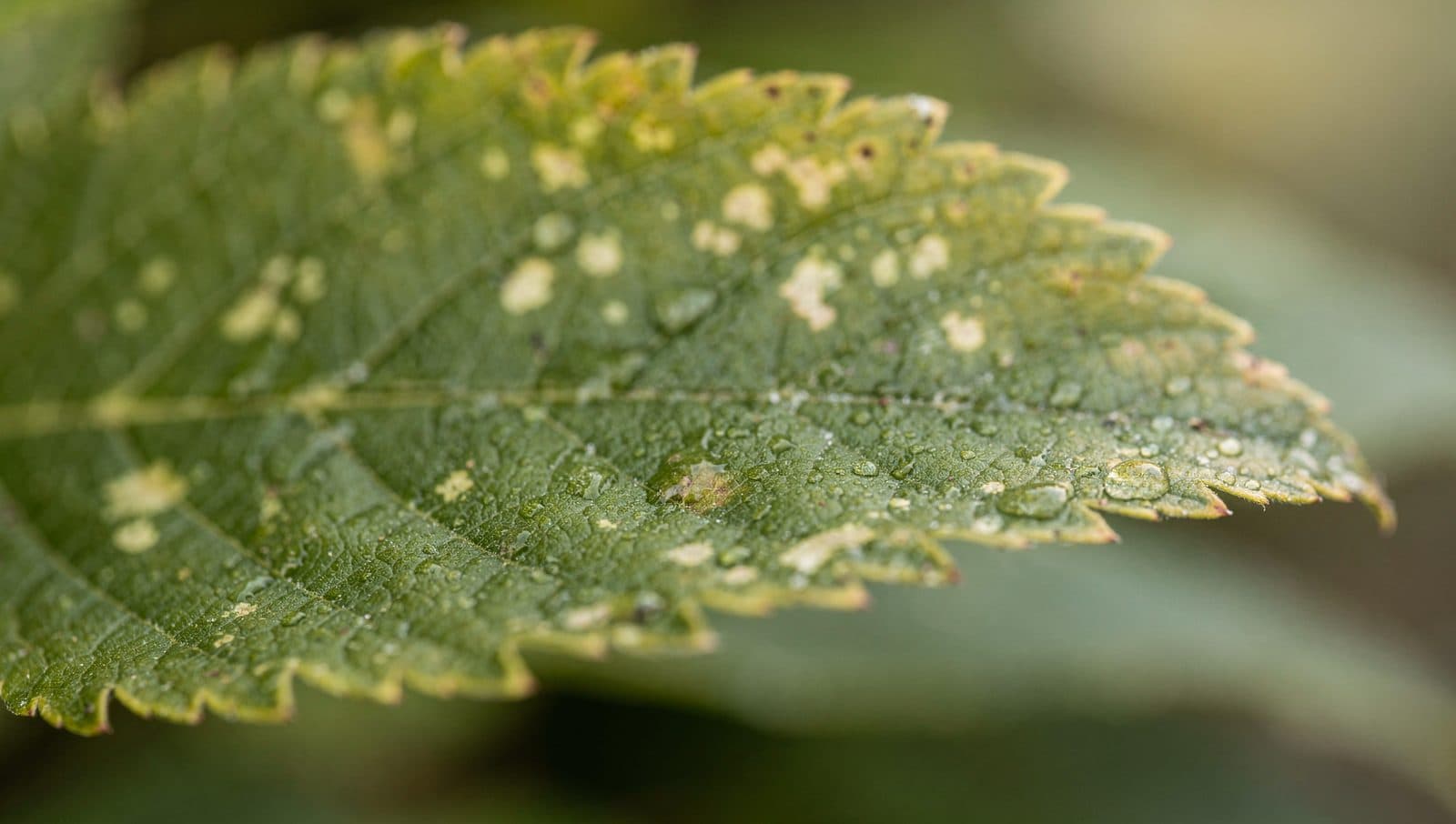
Why Do Leaves Look Sticky or Shiny?
Shiny, sticky leaves are the honeydew signature of sap-sucking insects feeding somewhere on or above the plant.
At a glance
- The verdict: Usually a pest
- Who fixes it: You
- Category: Leaf-Symptom Diagnosis (pest vs disease vs care)
The short answer
A glossy, tacky film on leaves is most often honeydew — the sugary excess that aphids, scale, whiteflies, mealybugs, and similar sap-suckers excrete after feeding. Outdoors, it often rains down from aphid or scale colonies in a tree canopy above, coating lower leaves, cars, and pavement in a sticky sheen even when the insects themselves are out of sight overhead. Indoors or on shrubs, the source is usually on the same plant — flip a leaf and check stem joints and new growth. Ants attracted to the sugar, and a black sooty mold fungus that grows on top of it later, are both secondary clues pointing to the same pest cause.
Pest, disease, or how you're caring for it?
Most leaf problems aren't pests at all. Here's the honest split — the most likely cause, the less likely ones, and how to tell them apart before you treat anything.
- PestMost likelythe usual cause
The same honeydew producers as sticky houseplant leaves — aphids, soft scale, whiteflies, mealybugs, leafhoppers, adelgids — plus, outdoors, aphid or scale colonies high in a tree canopy dripping honeydew onto everything below.
aphidssoft scalewhitefliesadelgids/leafhoppers on treesThe tell:A glossy film, ants actively 'farming' insects on the plant, and visible insects on leaf undersides or stem joints; outdoors, look straight up for a tree canopy overhead.
- Care / environmenta less common cause
Some leaves are naturally glossy or waxy by species; leaf-shine products applied to houseplants leave an artificial sheen; sap can also drip from a mechanical wound on the same plant or one above it.
natural leaf waxinesscommercial leaf-shine product residuedrip from an overhead plant/treeThe tell:No insects are found anywhere on the plant, the sheen is uniform and doesn't feel tacky, or it matches a product you recently applied.
- Diseasea rare cause
Negligible — plant disease doesn't produce a sticky sheen on its own; any dark film present is sooty mold growing on honeydew, which is secondary to the pest, not an independent pathogen of the leaf.
sooty mold growing on honeydew (secondary, not causal)The tell:There's no disease mechanism that makes leaves sticky by itself — treat a sticky, glossy leaf as a pest question first.
Look up first: if there's a tree or larger plant directly above, the stickiness is likely honeydew raining down from insects you can't easily see. If nothing is overhead, flip the leaf itself and check stem joints and new growth for the sap-sucking insect responsible.
Who actually fixes this?
Start here
You
Shiny, sticky leaves on shrubs and houseplants are treated with garden-center products — insecticidal soap or horticultural oil on the plant itself — while a large tree canopy dripping honeydew is usually a job for an arborist, not a homeowner spray or pest-control treatment.
- Garden center — The honeydew source is a shrub or houseplant you can reach and treat directly.
- Certified arborist — The honeydew is dripping from a large tree canopy — spraying a mature tree isn't practical for a homeowner, and an ISA-certified arborist can assess and treat it.
The details, straight
Honeydew: the leaf-shine you didn't ask for
The sticky, glossy look on leaves comes from honeydew, the sugar-rich waste sap-sucking insects excrete after feeding on plant phloem. University of Maryland Extension and UC ANR Ventura County both describe honeydew as a direct by-product of insects like aphids, scale, whiteflies, mealybugs, leafhoppers, and adelgids. It coats not just the insect's own leaf but everything beneath it — which is why a car parked under an aphid-infested tree, or a patio beneath an adelgid-laden hemlock, can end up with the same tacky sheen as the leaves themselves.
Why it's often a tree overhead, not the plant in front of you
Outdoors, a shiny, sticky lower leaf or shrub can be completely healthy and simply sitting under a heavily infested tree canopy. Large shade and street trees are common hosts for aphid and scale populations that go unnoticed because the honeydew and any sooty mold that follows show up on the plants and surfaces below, not conspicuously on the tree itself. This is a useful diagnostic step: before assuming the plant in front of you has its own pest problem, look up and rule out drip from above.
What to do about it
If the source is a reachable shrub or houseplant, an insecticidal soap or horticultural oil from a garden center, applied thoroughly to leaf undersides and out of direct sun, is the standard fix — these are contact-only treatments, so coverage matters more than the product choice. If the source is a mature tree canopy, spraying it yourself usually isn't practical or safe, and an ISA-certified arborist can evaluate the infestation and any treatment options. Either way, cleaning the sticky residue off the surface underneath doesn't solve anything on its own until the insect source is controlled.
Key takeaways
- Shiny, sticky leaves are almost always honeydew from aphids, scale, whiteflies, or similar sap-suckers — a pest, not a disease.
- Outdoors, the source is often a tree canopy overhead, not the plant the sticky leaves are actually on.
- Ants gathering on the sticky residue are a useful secondary clue that a honeydew-producing pest is active.
- Treat a reachable shrub or houseplant with insecticidal soap/horticultural oil; route a large tree to an arborist.
- Cleaning the residue alone doesn't fix it — the insect source has to be controlled or the sheen returns.
Sticky leaves but no bugs in sight?
Look up first — a tree canopy overhead is often the real source of the honeydew coating the leaves below it.
See the full pest-vs-disease triageA note for New Hampshire yards
Aphids on street trees and hemlock woolly adelgid on hemlocks are both known honeydew sources in New Hampshire landscapes, and a sticky sheen on cars or patios under a large tree is a common seasonal complaint. An ISA-certified arborist can assess a mature tree; UNH Cooperative Extension's Insect & Arthropod ID service can help identify a shrub or houseplant pest. Anchor Pest Services focuses on the structural and yard pests around your home, not tree canopy insects, but we're glad to point you to the right resource.
NH-licensed applicator #782664 (NHDAMF, RSA 430) · NEPMA member · family-owned since 2017.
Related questions
Sources(4)
- [1]University of Maryland Extension — Honeydew and Sooty Mold
Honeydew as a by-product of sap-sucking insects and its effect on leaves/surfaces below
extensionverified 2026-07-14 - [2]UC ANR Ventura County — Honeydew and Sooty Mold
Honeydew dripping from tree canopy sources onto surfaces below
extensionverified 2026-07-14 - [3]UGA CAES Newswire — Bugs' meals on leaves cause black fungus
Sooty mold as a secondary symptom of honeydew-producing insects
extensionverified 2026-07-14 - [4]Clemson HGIC — Insecticidal Soaps for Garden Pest Control
Contact-only treatment guidance for honeydew-producing insects
extensionverified 2026-07-14
Written & reviewed by
VerifiedDaniel Brady
NH-Licensed Pesticide Applicator · License #782664 (NHDAMF, RSA 430)
Daniel Brady is the New Hampshire–licensed applicator behind Anchor Pest Services, a family-owned pest control company serving the Manchester area since 2017.
Last updated 2026-07-14
Your next question
Honest pest help for New Hampshire homes
Sticky Leaves Are Plant Care — Your Home Is Our Job
Honeydew on your plants or trees is a garden and tree-care issue, and we'll always say so rather than overselling a treatment you don't need from us. Where Anchor Pest Services genuinely helps is the structural and yard pests around your home — rodents, ants, ticks, and moisture pests. Family-owned since 2017, NH license #782664, serving Manchester, Nashua, Concord and nearby towns.
- We trace shine to sap-sucking honeydew and point you to the right fix
- Licensed and insured in New Hampshire (#782664) — free, honest quote
- Manchester-area and central New Hampshire structural and yard pest control
NH License #782664 · No obligation · We answer in person
Your next step
- Related guide
Why Are My Indoor Plant Leaves Sticky?
Read the answer - Related guide
What Causes Sticky Residue on Leaves?
Read the answer - Related guide
Why Do Leaves Get Sticky Under Trees?
Read the answer - Related guide
What Insects Live on Tree Leaves?
Read the answer - Related guide
Do Ants Harm Leaves or Just Eat Sap?
Read the answer