
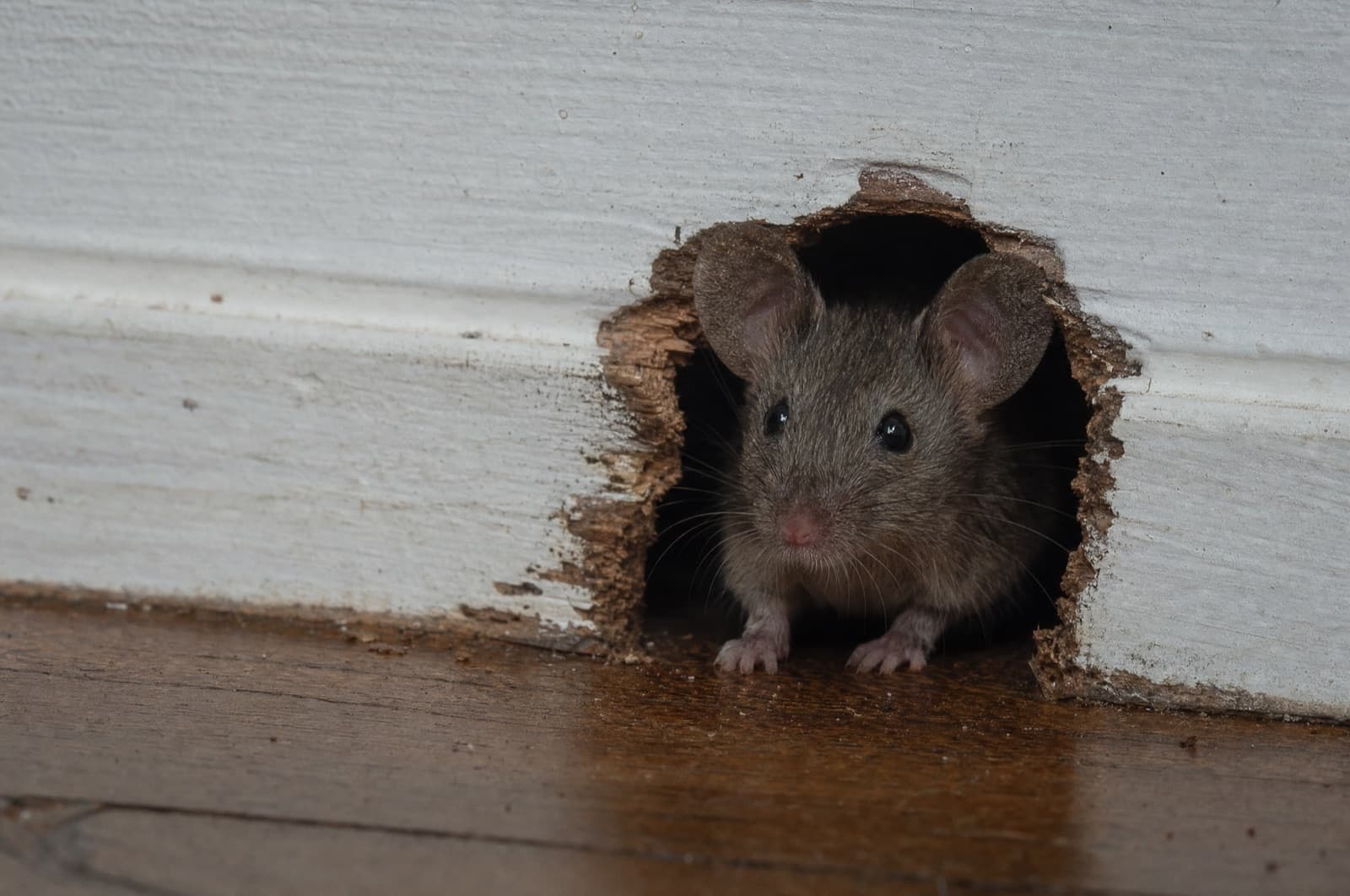
Do Mice Ever Leave on Their Own?
At a Glance
- Short answer: Rarely — indoor mice have little reason to leave and breed instead.
- Key fact: A female mouse can be pregnant again within 24 hours of giving birth.
- NH relevance: Most Northeast indoor mouse activity starts in fall, as outdoor food disappears — the opposite of dispersal.
- Action needed: Trap, remove food/harborage, and seal entry points rather than waiting for mice to leave.
The short of it
Once mice find warmth, food, and a nesting site indoors, they have almost no incentive to leave — and every incentive to breed. House mice are commensal animals, evolutionarily adapted to living alongside people, with a tight home range of roughly 20 feet when resources are good. They breed year-round indoors, producing 5–10 litters a year on a gestation of just 19–21 days, with females able to conceive again within 24 hours of giving birth. Waiting for a self-resolution almost always loses the math: the population grows faster than it disperses.
Do Mice Ever Leave on Their Own — By the Numbers
19–21 days
House mouse gestation period
5–10
Litters a year for an indoor breeding mouse
~20 ft
Typical house mouse home range when resources are good
24 hrs
How soon a female can conceive again after giving birth
The full picture
Mice are built to stay, not wander
House mice are commensal — a term that specifically means adapted to living alongside humans — and a heated structure stocked with crumbs, pet food, or stored goods is close to ideal habitat. UC IPM and public-health guidance both note mice thrive on very little food and shelter and readily nest in sheltered indoor voids, so there's no natural trigger pushing them back outdoors once they're settled.
The population grows while you wait
This is the part that changes the math: house mice breed year-round indoors, producing roughly 5–10 litters annually with a gestation period of just 19–21 days, and a female can conceive again within 24 hours of giving birth. A tight home range of about 20 feet means a well-fed mouse doesn't need to go anywhere — it just needs to keep breeding where it already is.
Fall makes it worse, not better
Most home invasions across the Northeast happen in fall, when outdoor seeds and vegetation disappear and mice move indoors for the season — which is the opposite of a self-resolving problem. Hoping for a spring exodus overlooks that an indoor population has been breeding the entire time it was 'waiting out' the cold.
Bottom line — Don't count on self-resolution. Trap the mice present, remove food and harborage, and seal entry points — the population grows on its own timeline, and it isn't heading for the door.
Waiting hasn't worked, has it?
Indoor mice breed faster than they disperse. Anchor's licensed NH technicians trap, remove attractants, and seal entry points so the population stops growing.
Why this matters in New Hampshire
As Manchester's first hard frost approaches — roughly October 19 at 50% probability, October 29 at 80% (NOAA 1991–2020) — outdoor food and cover for mice collapse fast, and indoor structures become the reliable option. That seasonal pressure is exactly why 'wait and see' fails hardest in NH: the mice arriving in October have every reason to stay through a winter that would kill them outdoors, and they'll spend that winter breeding.
Key local data
Deer mice (Peromyscus) are the hantavirus-relevant species in NH; NH DHHS reports no confirmed case acquired in-state to date.
- NH-licensed applicator · #782664
- Same-day service
- Family-owned since 2017
Service Area Map
Southern New Hampshire
Frequently asked
Sources (5)
- [1]
- [2]
- [3]
- [4]
- [5]
Written & reviewed by
VerifiedDaniel Brady
NH-Licensed Pesticide Applicator · License #782664 (NHDAMF, RSA 430)
Daniel Brady is the New Hampshire–licensed applicator behind Anchor Pest Services, a family-owned pest control company serving the Manchester area since 2017.
Professional Rodent Control
Mice Don't Get Bored and Leave
A heated NH home is ideal mouse habitat — and they breed in it while you wait. Anchor Pest Services removes the population and seals the entry points that let new mice in. Family-owned since 2017, NH license #782664.
- Same-day service across southern NH
- NH-licensed applicators (#782664)
- Free inspection — no flat-price guesswork
NH License #782664 · No obligation · We answer in person
Your next step
- Book a NH pro
Rodent Control
Book now - Next step
Do rodents nest in walls during autumn?
Read the answer - Related guide
Can Mice Infestations Return After Treatment?
Read the answer - Related guide
How Long Does It Take to Get Rid of a Mouse Problem?
Read the answer - Related guide
What Time of Year Are Mice Most Likely to Enter Houses?
Read the answer - Related guide
Can Mice Survive Winter in a House?
Read the answer